Home
Login Register
Trendlines    Last:0.06    -0.001

Time to buy !

 Post Reply 481-500 of 1197
 
Taylor
    30-Sep-2025 10:12  
Contact    Quote!
Time to push to moon If the BB is black Hold right now
 
 
PQTPQK
    30-Sep-2025 09:59  
Contact    Quote!
laggard...
 
 
labuubuuu
    12-Sep-2025 15:00  
Contact    Quote!
Time to buy again
0.029-0.3o

0.034 chance


Battle123
    27-Aug-2025 18:57  
Contact    Quote!
Not much volume leh !!!

Managment sleeping ?

Previous got analyst writeup tis counter got potential , but seem bo tiok leh


Tob231
    27-Aug-2025 11:30  
Contact    Quote!
boh leh ... not sure if it is a trap. 
noooo goooo for me 


PQTPQK
    22-Aug-2025 16:50  
Contact    Quote!
cheong next week ...?

SmallSmall      ( Date: 22-Aug-2025 11:22) Posted:

Got volume today......

SmallSmall      ( Date: 04-Aug-2025 08:37) Posted:

Limited downside for a possible nig haul.....:


SmallSmall
    22-Aug-2025 11:22  
Contact    Quote!
Got volume today......

SmallSmall      ( Date: 04-Aug-2025 08:37) Posted:

Limited downside for a possible nig haul.....:)

SmallSmall      ( Date: 03-Aug-2025 08:44) Posted:

Will this Singapore listco prove to be a good biotech bet as its stock hits bottom?

  Leong Chan Teik
 
  02 August 2025


Those colorful M& M' s and Skittles that kids (and adults too) gobble up might actually contain some health risks from synthetic dyes.
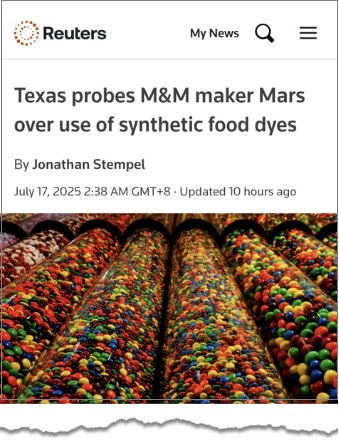
Mars dyes7.25That' s the angle the Texas Attorney General is taking as he launched a probe into Mars Incorporated on July 16, 2025.

He points to their 2016 pledge to swap out artificial colors in U.S. products, which they' ve dragged their feet on&mdash while making the switch in Europe under stricter regulations.

The investigation flags health worries, and pushes for natural alternatives, just like Nestle has done, reports  Reuters.


Another US company, General Mills (owner of brands such as Cheerios and Hä agen-Dazs), faced similar scrutiny but  announced  in June 2025 plans to remove synthetic dyes from its cereals.


This lines up with bigger changes in U.S. food rules on synthetic colors, which come from petroleum.
&ldquo Today, the FDA is asking food companies to substitute petrochemical dyes with natural ingredients for American children as they already do in Europe and Canada,&rdquo said FDA Commissioner Marty Makary, MD, MPH. &ldquo We have a new epidemic of childhood diabetes, obesity, depression, and ADHD. Given the growing concerns of doctors and parents about the potential role of petroleum-based food dyes, we should not be taking risks and do everything possible to safeguard the health of our children.&rdquo   --  Source


Meanwhile, a  cool 7-year-old startup in Israel,  Phytolon, is developing natural food coloring with biotech for a global market that is  estimated  to be worth US$2 billion currently and growing by 50% in 5 years.
Phytolon uses fermentation&mdash basically tweaking baker' s yeast to produce betalains, those natural pigments from beets or prickly pears.
No farms needed.

Their lineup covers yellow, orange, red, pink, and purple vibes, holding up great against pH changes, heat, and time.
These are perfect for stuff like dairy, drinks, candies, and baked goods.
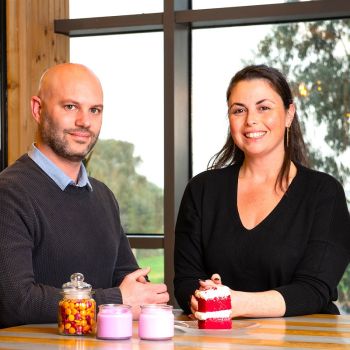
 
Phytolon cofoundersPhytolon co-founders: Dr Halim Jubran (CEO), Dr  Tal Zeltzer (Chief Technology Officer).

Fund-raising: 

&bull US$4.1 million  in Sept 2020 (seed funding)

&bull US$14.5 million  Series A in July 2022

&bull Additional funding  in Oct 2023


&bull   Recent investment  from Rich Products Ventures in Nov 2024


Big players have taken notice. Boston-based biotech company  Ginkgo Bioworks  in April 2025 teamed up with Phytolon to triple output.
Phytolon has received cash injection from  Rich Products Ventures  in November 2024.

Phytolon is a portfolio company of The Trendlines Group, an Israel-Singapore company listed on the Singapore Exchange that' s all about boosting human life by funding and nurturing medtech and agrifood startups to real-life impact.
Trendlines owns a chunky piece&mdash 26.37% directly and 3.24% through the Agrifood Fund&mdash and is hands-on helping Phytolon nail U.S. and Euro approvals.
Phytolon is a pre-revenue company while there already are a few producers such as Oterra.
A comparison of the two is as follows: 


Aspect


Phytolon


Oterra


Company Background


Startup founded in 2018 in Israel focused on biotech innovation.


Established company (as part of Chr. Hansen founded in 1874) world' s largest natural colors supplier,  acquired by  EQT Private Equity in 2021 for  ~US$940M.


Production Technology


Precision fermentation using genetically engineered yeast to produce betalains (pigments identical to those in beets and prickly pears) farm-free, lab-based process.


Traditional extraction and sourcing from plants, fruits, and vegetables (e.g., apples for brown, Colombian forests for blue) relies on agricultural supply chains.


Sustainability Focus


High efficiency: Reduces water use by 95%, land by 88%, and emissions by 90% compared to traditional farming minimizes agricultural variability and waste.


Emphasizes responsible sourcing (e.g., from sustainable forests) and plant-based options for clean-label and vegetarian products focuses on circular economy but tied to agriculture.


Market Focus & Scale


Targets replacement of synthetic dyes in dairy, drinks, candies, and baked goods pre-commercial stage, focusing on partnerships for scale-up.


Broad focus on food & beverage, dietary supplements serves major brands with consistent, high-volume supply dominant market share in natural colors.


Challenges


Still in growth phase higher initial R& D costs regulatory approvals pending for broader markets.


More expensive than synthetics due to complex extraction vulnerable to agricultural supply fluctuations.


Phytolon could be ripe for a buyout or exit that could pay off big for Trendlines shareholders.
That' s especially sweet after a dry spell of major wins since 2021 when  portfolio company OrthoSpin was acquired for US$79.5 million in cash.
Trendlines received US$15.8 million for its 26.9% stake.

Shareholders griped about the no-show of exits at the April 2025 AGM. (See:  TRENDLINES: Shareholders at AGM pressed board on exit strategy and cash controls)

 
Trendlines' rights issue, placement

Trendlines helped pull in a record US$42 million for several of its portfolio companies in 2024, seemingly unaffected by the ongoing war between Israel and Hamas.

Now,  Trendlines is seeking capital for itself with a 1-for-8  rights issue  (subscription at  2.85 cents/share) and a  private share subscription (at  3 cents/share) with several investors.

It hopes to raise up to  S$3.89 million  from the rights issue, and up to  S$6.3 million  from the private subscription (see graphic below).
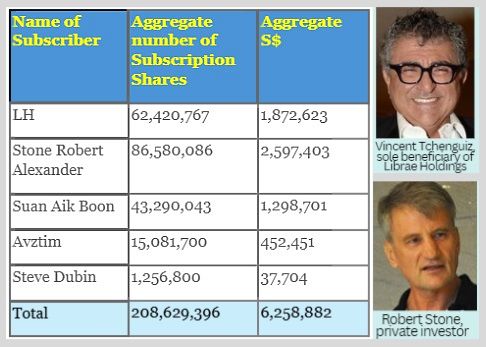
placement7.25&bull Robert Stone will invest $2.6 m via the placement and a further $185,000 to exercise his pro-rata rights shares, raising his stake from 4.75% to as high as  10.13%.
&bull Likewise,  Boon Suan Aik will raise his stake from 4.32% to  6.96%.
(Their final percentages will differ if they subscribe for excess rights shares and depending on the participation rate of other shareholders in the rights issue).
&bull  
Librae Holdings will maintain its stake at a whisker below  30%, the threshold for a compulsory takeover offer. 


Tredlines' stock is scraping all-time lows&mdash around  3 cents  on Aug 1, 2025&mdash making it an attractive target for investors with a load of patience and betting on huge upsides from Trendlines' sale of portfolio companies.
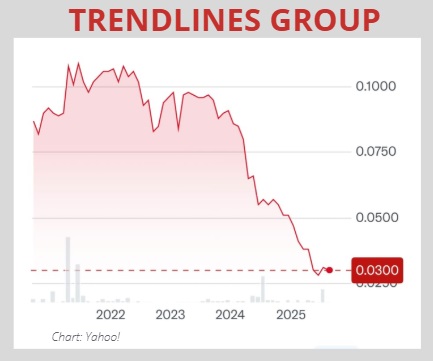
chart7.25


For example,  assuming  5-10X return on the US$20+ million of invested capital into Phytolon, a sale could fetch US$100-200 million, returning  SGD36-76 million  to Trendlines (market cap: SGD33 million). 
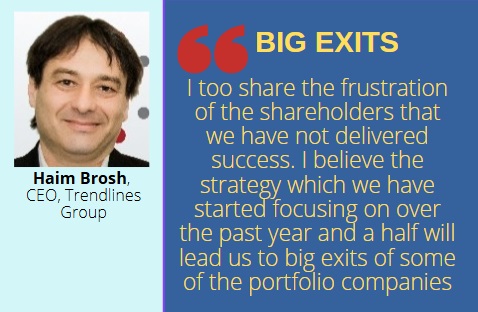
HaimBrosh quote5.25Source:  FY2024 AGM minutes

Phytolon is but one of a number of Trendlines' mature portfolio companies &mdash others include Escala Medical, which develops minimally invasive devices for treating pelvic organ prolapse (POP) in women.

In June 2025, the company  secured US$4.5 million  in funding, including co-financing from the European Innovation Council Fund, to accelerate the business expansion of its device which received  FDA approval in 2022.


labuubuuu
    21-Aug-2025 16:35  
Contact    Quote!
30
Look like sleeping traders parking
28-30
 
 
labuubuuu
    19-Aug-2025 15:55  
Contact    Quote!
Volume
 
 
labuubuuu
    13-Aug-2025 15:56  
Contact    Quote!
Robert head is buying?
29


labuubuuu
    11-Aug-2025 10:07  
Contact    Quote!
Robert stones buy more?
Now 30cts
Stil better than 28 base
 
 
labuubuuu
    08-Aug-2025 16:58  
Contact    Quote!
30
Selling
Good to guy
 
 
labuubuuu
    06-Aug-2025 14:16  
Contact    Quote!
Robert stone Radar trader
 
 
PQTPQK
    06-Aug-2025 13:26  
Contact    Quote!
should break up soon ?,,,
 
 
SmallSmall
    04-Aug-2025 08:37  
Contact    Quote!
Limited downside for a possible nig haul.....:)

SmallSmall      ( Date: 03-Aug-2025 08:44) Posted:

Will this Singapore listco prove to be a good biotech bet as its stock hits bottom?

  Leong Chan Teik
 
  02 August 2025


Those colorful M& M' s and Skittles that kids (and adults too) gobble up might actually contain some health risks from synthetic dyes.

Mars dyes7.25That' s the angle the Texas Attorney General is taking as he launched a probe into Mars Incorporated on July 16, 2025.

He points to their 2016 pledge to swap out artificial colors in U.S. products, which they' ve dragged their feet on&mdash while making the switch in Europe under stricter regulations.

The investigation flags health worries, and pushes for natural alternatives, just like Nestle has done, reports  Reuters.


Another US company, General Mills (owner of brands such as Cheerios and Hä agen-Dazs), faced similar scrutiny but  announced  in June 2025 plans to remove synthetic dyes from its cereals.


This lines up with bigger changes in U.S. food rules on synthetic colors, which come from petroleum.
&ldquo Today, the FDA is asking food companies to substitute petrochemical dyes with natural ingredients for American children as they already do in Europe and Canada,&rdquo said FDA Commissioner Marty Makary, MD, MPH. &ldquo We have a new epidemic of childhood diabetes, obesity, depression, and ADHD. Given the growing concerns of doctors and parents about the potential role of petroleum-based food dyes, we should not be taking risks and do everything possible to safeguard the health of our children.&rdquo   --  Source


Meanwhile, a  cool 7-year-old startup in Israel,  Phytolon, is developing natural food coloring with biotech for a global market that is  estimated  to be worth US$2 billion currently and growing by 50% in 5 years.
Phytolon uses fermentation&mdash basically tweaking baker' s yeast to produce betalains, those natural pigments from beets or prickly pears.
No farms needed.

Their lineup covers yellow, orange, red, pink, and purple vibes, holding up great against pH changes, heat, and time.
These are perfect for stuff like dairy, drinks, candies, and baked goods.

 
Phytolon cofoundersPhytolon co-founders: Dr Halim Jubran (CEO), Dr  Tal Zeltzer (Chief Technology Officer).

Fund-raising: 

&bull US$4.1 million  in Sept 2020 (seed funding)

&bull US$14.5 million  Series A in July 2022

&bull Additional funding  in Oct 2023


&bull   Recent investment  from Rich Products Ventures in Nov 2024


Big players have taken notice. Boston-based biotech company  Ginkgo Bioworks  in April 2025 teamed up with Phytolon to triple output.
Phytolon has received cash injection from  Rich Products Ventures  in November 2024.

Phytolon is a portfolio company of The Trendlines Group, an Israel-Singapore company listed on the Singapore Exchange that' s all about boosting human life by funding and nurturing medtech and agrifood startups to real-life impact.
Trendlines owns a chunky piece&mdash 26.37% directly and 3.24% through the Agrifood Fund&mdash and is hands-on helping Phytolon nail U.S. and Euro approvals.
Phytolon is a pre-revenue company while there already are a few producers such as Oterra.
A comparison of the two is as follows: 


Aspect


Phytolon


Oterra


Company Background


Startup founded in 2018 in Israel focused on biotech innovation.


Established company (as part of Chr. Hansen founded in 1874) world' s largest natural colors supplier,  acquired by  EQT Private Equity in 2021 for  ~US$940M.


Production Technology


Precision fermentation using genetically engineered yeast to produce betalains (pigments identical to those in beets and prickly pears) farm-free, lab-based process.


Traditional extraction and sourcing from plants, fruits, and vegetables (e.g., apples for brown, Colombian forests for blue) relies on agricultural supply chains.


Sustainability Focus


High efficiency: Reduces water use by 95%, land by 88%, and emissions by 90% compared to traditional farming minimizes agricultural variability and waste.


Emphasizes responsible sourcing (e.g., from sustainable forests) and plant-based options for clean-label and vegetarian products focuses on circular economy but tied to agriculture.


Market Focus & Scale


Targets replacement of synthetic dyes in dairy, drinks, candies, and baked goods pre-commercial stage, focusing on partnerships for scale-up.


Broad focus on food & beverage, dietary supplements serves major brands with consistent, high-volume supply dominant market share in natural colors.


Challenges


Still in growth phase higher initial R& D costs regulatory approvals pending for broader markets.


More expensive than synthetics due to complex extraction vulnerable to agricultural supply fluctuations.


Phytolon could be ripe for a buyout or exit that could pay off big for Trendlines shareholders.
That' s especially sweet after a dry spell of major wins since 2021 when  portfolio company OrthoSpin was acquired for US$79.5 million in cash.
Trendlines received US$15.8 million for its 26.9% stake.

Shareholders griped about the no-show of exits at the April 2025 AGM. (See:  TRENDLINES: Shareholders at AGM pressed board on exit strategy and cash controls)

 
Trendlines' rights issue, placement

Trendlines helped pull in a record US$42 million for several of its portfolio companies in 2024, seemingly unaffected by the ongoing war between Israel and Hamas.

Now,  Trendlines is seeking capital for itself with a 1-for-8  rights issue  (subscription at  2.85 cents/share) and a  private share subscription (at  3 cents/share) with several investors.

It hopes to raise up to  S$3.89 million  from the rights issue, and up to  S$6.3 million  from the private subscription (see graphic below).

placement7.25&bull Robert Stone will invest $2.6 m via the placement and a further $185,000 to exercise his pro-rata rights shares, raising his stake from 4.75% to as high as  10.13%.
&bull Likewise,  Boon Suan Aik will raise his stake from 4.32% to  6.96%.
(Their final percentages will differ if they subscribe for excess rights shares and depending on the participation rate of other shareholders in the rights issue).
&bull  
Librae Holdings will maintain its stake at a whisker below  30%, the threshold for a compulsory takeover offer. 


Tredlines' stock is scraping all-time lows&mdash around  3 cents  on Aug 1, 2025&mdash making it an attractive target for investors with a load of patience and betting on huge upsides from Trendlines' sale of portfolio companies.

chart7.25


For example,  assuming  5-10X return on the US$20+ million of invested capital into Phytolon, a sale could fetch US$100-200 million, returning  SGD36-76 million  to Trendlines (market cap: SGD33 million). 

HaimBrosh quote5.25Source:  FY2024 AGM minutes

Phytolon is but one of a number of Trendlines' mature portfolio companies &mdash others include Escala Medical, which develops minimally invasive devices for treating pelvic organ prolapse (POP) in women.

In June 2025, the company  secured US$4.5 million  in funding, including co-financing from the European Innovation Council Fund, to accelerate the business expansion of its device which received  FDA approval in 2022.


SmallSmall
    03-Aug-2025 08:44  
Contact    Quote!

Will this Singapore listco prove to be a good biotech bet as its stock hits bottom?

  Leong Chan Teik
 
  02 August 2025


Those colorful M& M' s and Skittles that kids (and adults too) gobble up might actually contain some health risks from synthetic dyes.

Mars dyes7.25That' s the angle the Texas Attorney General is taking as he launched a probe into Mars Incorporated on July 16, 2025.

He points to their 2016 pledge to swap out artificial colors in U.S. products, which they' ve dragged their feet on&mdash while making the switch in Europe under stricter regulations.

The investigation flags health worries, and pushes for natural alternatives, just like Nestle has done, reports  Reuters.


Another US company, General Mills (owner of brands such as Cheerios and Hä agen-Dazs), faced similar scrutiny but  announced  in June 2025 plans to remove synthetic dyes from its cereals.


This lines up with bigger changes in U.S. food rules on synthetic colors, which come from petroleum.
&ldquo Today, the FDA is asking food companies to substitute petrochemical dyes with natural ingredients for American children as they already do in Europe and Canada,&rdquo said FDA Commissioner Marty Makary, MD, MPH. &ldquo We have a new epidemic of childhood diabetes, obesity, depression, and ADHD. Given the growing concerns of doctors and parents about the potential role of petroleum-based food dyes, we should not be taking risks and do everything possible to safeguard the health of our children.&rdquo   --  Source


Meanwhile, a  cool 7-year-old startup in Israel,  Phytolon, is developing natural food coloring with biotech for a global market that is  estimated  to be worth US$2 billion currently and growing by 50% in 5 years.
Phytolon uses fermentation&mdash basically tweaking baker' s yeast to produce betalains, those natural pigments from beets or prickly pears.
No farms needed.

Their lineup covers yellow, orange, red, pink, and purple vibes, holding up great against pH changes, heat, and time.
These are perfect for stuff like dairy, drinks, candies, and baked goods.

 
Phytolon cofoundersPhytolon co-founders: Dr Halim Jubran (CEO), Dr  Tal Zeltzer (Chief Technology Officer).

Fund-raising: 

&bull US$4.1 million  in Sept 2020 (seed funding)

&bull US$14.5 million  Series A in July 2022

&bull Additional funding  in Oct 2023


&bull   Recent investment  from Rich Products Ventures in Nov 2024


Big players have taken notice. Boston-based biotech company  Ginkgo Bioworks  in April 2025 teamed up with Phytolon to triple output.
Phytolon has received cash injection from  Rich Products Ventures  in November 2024.

Phytolon is a portfolio company of The Trendlines Group, an Israel-Singapore company listed on the Singapore Exchange that' s all about boosting human life by funding and nurturing medtech and agrifood startups to real-life impact.
Trendlines owns a chunky piece&mdash 26.37% directly and 3.24% through the Agrifood Fund&mdash and is hands-on helping Phytolon nail U.S. and Euro approvals.
Phytolon is a pre-revenue company while there already are a few producers such as Oterra.
A comparison of the two is as follows: 


Aspect


Phytolon


Oterra


Company Background


Startup founded in 2018 in Israel focused on biotech innovation.


Established company (as part of Chr. Hansen founded in 1874) world' s largest natural colors supplier,  acquired by  EQT Private Equity in 2021 for  ~US$940M.


Production Technology


Precision fermentation using genetically engineered yeast to produce betalains (pigments identical to those in beets and prickly pears) farm-free, lab-based process.


Traditional extraction and sourcing from plants, fruits, and vegetables (e.g., apples for brown, Colombian forests for blue) relies on agricultural supply chains.


Sustainability Focus


High efficiency: Reduces water use by 95%, land by 88%, and emissions by 90% compared to traditional farming minimizes agricultural variability and waste.


Emphasizes responsible sourcing (e.g., from sustainable forests) and plant-based options for clean-label and vegetarian products focuses on circular economy but tied to agriculture.


Market Focus & Scale


Targets replacement of synthetic dyes in dairy, drinks, candies, and baked goods pre-commercial stage, focusing on partnerships for scale-up.


Broad focus on food & beverage, dietary supplements serves major brands with consistent, high-volume supply dominant market share in natural colors.


Challenges


Still in growth phase higher initial R& D costs regulatory approvals pending for broader markets.


More expensive than synthetics due to complex extraction vulnerable to agricultural supply fluctuations.


Phytolon could be ripe for a buyout or exit that could pay off big for Trendlines shareholders.
That' s especially sweet after a dry spell of major wins since 2021 when  portfolio company OrthoSpin was acquired for US$79.5 million in cash.
Trendlines received US$15.8 million for its 26.9% stake.

Shareholders griped about the no-show of exits at the April 2025 AGM. (See:  TRENDLINES: Shareholders at AGM pressed board on exit strategy and cash controls)

 
Trendlines' rights issue, placement

Trendlines helped pull in a record US$42 million for several of its portfolio companies in 2024, seemingly unaffected by the ongoing war between Israel and Hamas.

Now,  Trendlines is seeking capital for itself with a 1-for-8  rights issue  (subscription at  2.85 cents/share) and a  private share subscription (at  3 cents/share) with several investors.

It hopes to raise up to  S$3.89 million  from the rights issue, and up to  S$6.3 million  from the private subscription (see graphic below).

placement7.25&bull Robert Stone will invest $2.6 m via the placement and a further $185,000 to exercise his pro-rata rights shares, raising his stake from 4.75% to as high as  10.13%.
&bull Likewise,  Boon Suan Aik will raise his stake from 4.32% to  6.96%.
(Their final percentages will differ if they subscribe for excess rights shares and depending on the participation rate of other shareholders in the rights issue).
&bull  
Librae Holdings will maintain its stake at a whisker below  30%, the threshold for a compulsory takeover offer. 


Tredlines' stock is scraping all-time lows&mdash around  3 cents  on Aug 1, 2025&mdash making it an attractive target for investors with a load of patience and betting on huge upsides from Trendlines' sale of portfolio companies.

chart7.25


For example,  assuming  5-10X return on the US$20+ million of invested capital into Phytolon, a sale could fetch US$100-200 million, returning  SGD36-76 million  to Trendlines (market cap: SGD33 million). 

HaimBrosh quote5.25Source:  FY2024 AGM minutes

Phytolon is but one of a number of Trendlines' mature portfolio companies &mdash others include Escala Medical, which develops minimally invasive devices for treating pelvic organ prolapse (POP) in women.

In June 2025, the company  secured US$4.5 million  in funding, including co-financing from the European Innovation Council Fund, to accelerate the business expansion of its device which received  FDA approval in 2022.


SmallSmall
    28-Jul-2025 10:02  
Contact    Quote!
Rights non-renounceable so no rights trading. Hence Price will not be depressed by rights trading,
Some folks appears to be accumulating

SmallSmall      ( Date: 28-Jul-2025 09:06) Posted:

Ex Rights today... Time for rebound :)

SmallSmall      ( Date: 22-Jul-2025 14:48) Posted:

This one accumulation phase.
Rights issue 8 for 1 at $0.03 last cum date this Friday.
Will move some time after ex-dates just like Mermaid and Cosco etc.


SmallSmall
    28-Jul-2025 09:06  
Contact    Quote!
Ex Rights today... Time for rebound :)

SmallSmall      ( Date: 22-Jul-2025 14:48) Posted:

This one accumulation phase.
Rights issue 8 for 1 at $0.03 last cum date this Friday.
Will move some time after ex-dates just like Mermaid and Cosco etc.


SmallSmall
    22-Jul-2025 14:48  
Contact    Quote!
This one accumulation phase.
Rights issue 8 for 1 at $0.03 last cum date this Friday.
Will move some time after ex-dates just like Mermaid and Cosco etc.
 
 
bernardc
    20-Mar-2025 11:49  
Contact    Quote!
Like that...for liaow...time to run road...for window...corrections he had jumped shop with the money??

Joelton      ( Date: 20-Mar-2025 11:37) Posted:

Trendlines terminates subsidiary CEO Anton Wibowo for stealing US$2.1 million
The misappropriations had occurred at Trendlines Agrifood Innovation Centre, Agrifood Fund and a portfolio company, says the group
[SINGAPORE] The employee alleged to have stolen US$2.1 million from a subsidiary of Trendlines Group was the unit&rsquo s chief executive officer and director, Anton Wibowo, the startup incubator based in Singapore and Israel said on Wednesday (Mar 19) evening.
 
Trendlines : 42T 0% said it has terminated Wibowo&rsquo s employment and is considering legal recourse in relation to the misappropriations.
 
This will include any steps deemed feasible for asset recovery, the mainboard-listed company said, adding that it will update shareholders separately if successful.
 
The group said that the misappropriations took place at the Trendlines Agrifood Innovation Centre (AFIC) &ndash where Wibowo was CEO and director &ndash Trendlines Agrifood Fund, and a portfolio company.
 
Wibowo was also the director of Agrifood Fund, which is managed by AFIC.
 
Trendlines said Wibowo deposited the majority of the misappropriated amounts into his personal bank account and various digital wallets that belonged to him.
 
Based on the company&rsquo s annual report issued on Mar 13, nearly US$1.3 million was misappropriated in 2024. The rest of the amount was taken the year before.
 
These findings were the result of an independent investigation by an external audit firm.
 
Trendlines&rsquo audit committee also engaged its internal auditor to carry out a review of the payment procedures and internal controls of the group.
 
The internal auditor made several recommendations related to the process of approving payments, controls on the use of credit cards, and the headquarters&rsquo supervision of subsidiaries.
 
For example, there will be a separation of duties such that roles pertaining to authorisation will not be involved in the bookkeeping process across the group, including subsidiaries.
 
Additionally, the group will provide refresher training on its whistle-blowing procedures. This is despite the company stating in its annual report that no whistle-blower reports were received in connection with the misappropriations.
 
As Trendlines searches for a suitable replacement CEO for AFIC, group founder and chair emeritus Stephen Rhodes will assume the responsibilities of the role in the interim, the company said.
 
It is also in the process of hiring a permanent chief financial officer, who will oversee the implementation of the internal auditor&rsquo s recommendations, among other things.

 
Important: Please read our Terms and Conditions and Privacy Policy .