
 Post Reply
201-220 of 785
Post Reply
201-220 of 785
Hope somebody post this
FLCT divests leasehold property in Melbourne, Australia for A$42.5m
FLCT acquires prime UK freehold warehouse facility for £ 28.3m
FRASERS Logistics & Commercial Trust (FLCT) Frasers L& C Tr: BUOU +0.68% , through its wholly-owned subsidiary, has acquired a prime freehold warehouse property to be developed at Worcester Six, a new business park in the UK, for an all-in maximum consideration of £ 28.3 million (S$51.5 million).
In a bourse filing on Tuesday (Nov 30), the real estate investment trust (Reit) manager said that FLCT will fund the development of the new facility. FLCT will be funding the acquisition through internal resources or existing debt facilities, or both.
The property, acquired from an unrelated third party, Stoford (Worcester), is not expected to have any material effect on FLCT' s net tangible assets, the Reit manager noted.
It estimates the total cost of acquisition to be around £ 29.1 million, which includes the acquisition fee as well as professional and other fees and expenses in connection with the acquisition.
This transaction is a forward-funding arrangement, which enables FLCT to invest in the new Worcester property at a fixed cost, with cash flows managed over the duration of development.
The development of the property is expected to be completed in the first quarter of 2023. Upon completion, the property will be leased to Alliance Flooring Distribution on a new 15-year lease, subject to 5 yearly upward only rent reviews.
The tenant is a subsidiary of Victoria, an international manufacturer and distributor of innovative flooring products which is listed on the London Stock Exchange with operations spanning across the UK, Europe and Australia. The property will also be the tenant' s headquarter flagship warehouse in the UK.
The property, when developed, will be a modern and high quality facility with a total lettable area of 180,121 square feet on a 3.48 hectare site, the Reit manager noted.
" The property is prominently positioned near the entrance to the business park with extensive frontage to the access road. The building will be constructed to high specifications with eaves height of 12.5 metres, 27 loading doors, extensive car parking spaces and a target Energy Performance Certificate rating of A," the Reit manager added.
Chief executive officer of the Reit manager Robert Wallace said that this is the second third-party acquisition by FLCT and scales up the trust' s footprint in the " attractive UK logistics real estate space, where demand and take-up levels are expected to remain strong" .
" The acquisition through a forward funding agreement for a prime, freehold high-specification facility in the UK is the continuation of our strategy to grow FLCT' s core logistics and industrial portfolio in existing markets," he noted.
Wallace added that the proposed acquisition is expected to further enhance FLCT' s portfolio metrics while providing unitholders with a stable and long-term income stream.
The manager expects the acquisition to increase FLCT&rsquo s exposure to the UK market to 10.9 per cent of its total portfolio value, from 10.2 per cent previously. The weighting of FLCT&rsquo s portfolio by value towards logistics and industrial assets will also increase to 61.4 per cent, from 61.1 per cent.
| I suppose nobody in the mood to read anything but I post anyway, very boring staring at the ceiling... tomorrow must go coffee shop to look for coffee lady... DBS says redevelopment opportunities to drive future growth for industrial Reits |
Frasers Logistics & Commercial Trust invests in UK warehouse development
Frasers Logistics & Commercial Trust said late Tuesday it would acquire a property to be developed at Worcester Six, a new business park in the West Midlands, U.K. for a maximum of 28.3 million British pounds, or around S$51.5 million.Under the deal, FLCT' s wholly owned subsidiary Worcester Property will buy the property from unrelated third party Stoford (Worcester), with FLCT to fund the development of the new facility, the trust said in a filing to SGX.
" The acquisition through a forward funding agreement for a prime, freehold high-specification facility in the U.K. is the continuation of our strategy to grow FLCT' s core logistics and industrial portfolio in existing markets," Robert Wallace, CEO of FLCT' s manager, said in the filing.
" The acquisition is our second third-party acquisition, reaffirming FLCT' s deal-sourcing capabilities whilst scaling up our footprint in the attractive U.K. logistics real estate space, where demand and take-up levels are expected to remain strong," Wallace said.
The deal will be funded with internal resources and/or existing debt facilities, the filing said.
Flooring-products tenant
" With a committed lease term of 15 years to an international distributor of flooring products, the proposed acquisition is expected to further enhance FLCT' s portfolio metrics while providing unitholders with a stable and long-term income stream," he added.
The property, which is expected to be completed in the first quarter of 2023, will be leased to Alliance Flooring Distribution, a subsidiary of Victoria PLC, a London-listed flooring manufacturer, on a new 15-year lese, subject to five yearly upward-only rent reviews, the filing said.
The site is positioned near the business park' s entrance, with frontage to the access road, the filing said.
The maximum consideration took into consideration an independent valuation from CBRE of 28.3 million pounds as of 15 November, the filing said.
The property' s location at the Worcester Six business park, in the county of Worcestershire, strategically services the West Midlands, North West, South West and Welsh regions of the U.K., FLCT said, adding around 80 percent of the U.K.' s population can be reached within four hours' drive of the location.
The development would be FLCT' s second warehouse property in the U.K., increasing FLCT' s exposure to the U.K.' s market to 10.9 percent of portfolio value, up from 10.2 percent before the acquisition, the filing said.
From UOBKH
&bull Re-position from Reopening Plays to New Economy Plays. We expect a knee jerk reaction to sell S-REITs. The selling pressure is likely to be cushioned by S-REITs&rsquo defensive cash flows. Investors could de-risk by trimming positions in hospitality REITs, such as ART (BUY/Target: S$1.20), CDREIT (HOLD/Target: S$1.24) and FEHT (BUY/Target: S$0.71). Switch to New Economy Plays, such as AREIT (BUY/Target: S$3.83), FLT (BUY/Target: S$1.79) and MINT (BUY/Target: S$3.72). FCT (BUY/Target: S$2.98) provides resiliency from necessity spending at suburban retail malls.
&bull Frasers Logistics Trust (FLT SP/BUY/Target: S$1.79)
&bull Sizeable sponsor pipeline supports future growth. FLT has right of first refusal to acquire logistics properties with NLA of 2.0m sqm in the Asia Pacific region and Europe from sponsor Frasers Property (FPL). The acquisition pipeline is valued at more than S$5b as of Jan 21. FPL is also actively developing more logistics properties and the sponsor pipeline expands at a rate of about S$200m per year.
&bull Value creation through development. Newly-acquired Blythe Valley Park located near Birmingham has 3 hectares of vacant land, which could be developed into four units of logistics warehouses. Similarly, Farnborough Business Park located in Thames Valley has a development site (Plot C, Pinehurst III & IV). Management is reviewing feasibility to redevelop the site into a last-mile e-commerce fulfilment centre instead given its proximity to Farnborough Airport and a highdensity residential catchment.
I will be posting this in all REITs stock in which I have some interests. But please hor, due diligence please, do not take this as the final and only positive statement and cheong to take up positions.....if you are lazy to read through the entire article, just focus on the highlighted parts....
Why is the Singapore REIT market going so strong after two years of COVID-19?
SINGAPORE: Singapore real estate investment trusts or S-REITs have emerged as a resilient segment of the local stock exchange in the past two years.
Traditionally a key pillar of the portfolios of individual investors in Singapore, the iEdge S-REIT Index, regarded as the S-REIT benchmark, reported a total return of 5.2 per cent since the start of 2020 to Nov 17.
This was despite S-REITs raising new equity from unitholders, creating additional units and leading to potential dilution risk. In the past 23 months, S-REITs raised a total of S$8 billion through placements and rights issues led by mega-issuances from Ascendas Real Estate Investment Trust and Frasers Commercial Trust.
Most S-REITs largely maintained their dividends, compensating for the fall in unit prices in this period.
Global financial markets including S-REITs initially crashed when COVID-19 became a pandemic, with investors panicking and selling liquid financial assets. For investors daring and savvy enough to put money to work during the trough in end-March 2020, total returns from capital gains have been a whopping 57 per cent.
Despite headlines on troubles in the retail space and how work-from-home has made offices redundant, occupancies measured by leases have remained high for S-REITs holding shopping malls and offices in Singapore, with little problems in rental collection, even if fewer are using these spaces.
In the hardest hit hotel sector, the fall in physical property asset value was contained to less than 10 per cent at a portfolio level among the S-REITs tracked by OCBC, a good outcome despite the pandemic curbing travel.
Hospitality REITs will likely need time to recover and could do better in a 24-month timeframe as borders reopen further.
S-REITs today generate a significant volume of trading activity for the stock exchange - about one-fourth of the daily turnover before COVID-19. Primary equity markets in Singapore also skew towards S-REITs.
S-REITs, at S$110 billion, represents 12 per cent of Singapore& rsquo s whole equity market by market cap & ndash a figure that is 6 per cent for Australia and only 2 per cent for Japan, the other two top REIT markets in the Asia-Pacific with large domestic economies.
WHY S-REITS STILL ATTRACT SO MANY INVESTORS
The top-performing Singapore stock in the past 23 months goes to iFAST Corporation, an investment products distribution platform, which generated total returns of 771 per cent during this time, superseding the Bloomberg Bitcoin Galaxy Index at 750 per cent.
This is lower than the 1,131 per cent on the Bloomberg Galaxy Crypto Index tracking cryptocurrencies.
Still, S-REITs and the Singapore commercial property market continue to attract significant investor attention.
Investors in Singapore are very familiar with the nuts and bolts of running a property, and understand how policies like stamp duties, urban planning, zoning, tenancy and ownership rules influence whether and when investors should buy an investment property and what to look out for in assessing a property& rsquo s attractiveness.
Many like the idea of owning a passive, stable and recurring income stream. S-REITs generate fairly stable revenue, with the iEdge S-REIT Index reporting revenue per unit of S$132.5 in 2019.
Though it dropped 6.3 per cent in 2020, analysts expect a rebound to S$135.6 this year.
S-REITs are a good source of income. Qualifying S-REITs are encouraged to pay gains to unitholders instead of hoarding profits as they not taxed on dividends distributed to unitholders.
The key challenge is share dilution when S-REITs need to raise to acquire new properties.
Past transactions that have stirred market discussions include K-REIT Asia& rsquo s (now known as Keppel REIT) 87.5 per cent interest in Ocean Financial Centre in 2011, Ascott Residence Trust& rsquo s acquisition of Ascott Orchard Singapore, Citadines City Centre Frankfurt and Citadines Michel Hamburg in 2017 and Lippo Malls Indonesia Retail Trust& rsquo s acquisition of Puri Mall in 2021.
S-REITs are also regulated as a collective investment scheme under the Securities and Futures Act, where there is a 50 per cent cap on the leverage limit for S-REITs to keep credit risks in check. As listed entities, S-REITs also follow SGX rules on the disclosure of information and the right for minority investors to vote on major matters.
S-REITS MORE ACCESSIBLE THAN EVER
Until S-REITs were launched in July 2002, the commercial property market was inaccessible to most individual retail investors, with ticket sizes of each standalone commercial property in the millions and billions of dollars.
Today, all it takes is S$230 at last Wednesday& rsquo s prices for an individual investor to buy into CapitaLand Integrated Commercial Trust (& ldquo CICT& rdquo ), Singapore& rsquo s largest REIT, and enjoy a portion of CICT& rsquo s rental income from shopping malls and offices.
Few investment opportunities provide such stability for 4 to 7 per cent dividend yield per year. It& rsquo s little wonder such investment classes with a dividend income and the potential for capital gains appeal to investors with a neutral risk profile at Singapore& rsquo s median age of 42.
Singapore has maintained an encouraging ecosystem for the development of S-REITs. Regulatory uncertainty is minimised as regulators routinely seek industry feedback from REIT managers, investors and lawyers before introducing new rules.
The market has grown to include fund managers who invest in S-REITs as their specialty, REIT exchange traded funds and REIT derivatives.
Bank lenders and bond investors in Singapore are highly familiar with S-REITs, together providing a pool of liquidity that allows the S-REIT market to grow bigger. Brokerages are also prepared to lend individual investors buying larger amounts of REIT units.
WILL GAINS IN S-REITS CONTINUE?
The bigger question is whether we will continue to see capital gains in the coming 12 to 24 months as interest rates rise.
In a world where stock market prices are affected by sentiments, Reddit fads and breaking news, S-REITs continue to see strong investor demand because their valuation is backed by commercial properties where asset value has seen a continued upward trend.
Indeed, S-REIT indices are not a good representation of the underlying economy. They are weighted towards larger S-REITs, rather than each S-REIT& rsquo s contribution to the Singapore economy.
The iEdge S-REIT& rsquo s top five components make up 43.3 per cent of the index which have an outsized influence on total returns.
Three are large-cap industrial REITs with industrial properties in Singapore and countries across Asia-Pacific, Europe and the United States & ndash in a world where logistics, data centres, business parks and manufacturing facilities have been resilient through the pandemic.
The remaining two are large-cap commercial REITs owning quality assets with tenants largely staying put despite the economic downturn, with occupancies remaining above 90 per cent.
Beyond the broad index, S-REITs that hold hotels and shopping malls located in the city centre have been dragged by the pandemic. With the city centre hollowed out as we work from home and international travelers non-existent, these S-REITs have underperformed Industrial REITs.
Furthermore, the S-REIT industry has been kept buoyant by an inflow of capital. The broad money supply in Singapore has surged by 10.9 per cent year-on-year as of September. With interest rates on cash near-zero, all that money needs to go somewhere.
The S-REITs market is unlikely to cool anytime soon. There is momentum. Thirteen out of the 80 IPOs with primary share offering in Singapore since 2016 were S-REITs raising S$5.6 billion collectively at an average offer size of S$430 million.
Outside of S-REITs, a further S$2.7 billion was raised for two listings, Kakao Corp, the Internet company global depository receipt listing and NetLink NBN Trust, a business trust which holds infrastructure assets.
The remaining 65 had an average offer size of S$28 million & ndash small cap listings with limited liquidity.
Tellingly, the two upcoming IPOs in Singapore - Daiwa House Logistics Trust and Digital Core REIT - are both S-REITs.
The equity analyst community is still optimistic and forecasting a rise in S-REIT dividends in the next 12 to 24 months.
Driven by the growth and resiliency of industrial assets, particularly logistics warehouse and data centres, the Big Three industrial REITs of Ascendas Real Estate Investment Trust, Mapletree Logistics Trust and Mapletree Industrial Trust also recorded average total returns of 15.6 per cent in the past 23 months.
DON& rsquo T DISMISS SGX
Looking ahead, Singapore investors should not be so quick to dismiss the SGX, given the current slew of corporate restructuring exercises with the potential for capital gains, which may not be immediately apparent to new individual investors in the market.
Buying S-REITs is likely to remain a cornerstone investment strategy for many individual investors. The more pertinent decision points remain how much S-REITs should feature as a percentage of one& rsquo s investment portfolio and which specific ones to invest in.
Still, until a next financial crisis with significant liquidity stress, we are unlikely to repeat the kind of capital gains seen from March 2020 to date in S-REITs.
A lot of the negatives has since been priced in, with the broad iEdge S-REIT Index trading at 1.1 times the price-to-book value, indicating that the market cap of the S-REITs as a broad basket is now higher than the value of the underlying properties.
Share holders will only recive 2.57 sgd.
Yes. Agree with you. I have been holding FLCT since its 2016 IPO at 89 cts.
FLCT is a rare rare crown jewel. Just like MINT, it keeps increasing its DPU consistently. Something to be treasured, especially for its rare freehold property assets.
Lobster ( Date: 11-Nov-2021 18:27) Posted:
|
Wow, looks like very few in this gaint REIT..... heard some thing is going to happen within the group, but of course I won' t know la...
FLCT posts 6.3% rise in H2 DPU to S$0.0388
FRASERS Logistics and Commercial Trust' s (FLCT) Frasers L& C Tr: BUOU +2.01% distribution per unit (DPU) rose by 6.3 per cent to 3.88 Singapore cents for its second half ended Sep 30, from 3.65 cents a year ago.
Gross revenue was up 11.4 per cent to S$237.6 million for the half-year period, from S$213.3 million a year ago. This was mainly attributable to acquisitions undertaken in FY2020 and FY2021, although it was partially offset by divestment activities during the same period, the manager said in a bourse filing on Thursday (Nov 11).
Net property income (NPI) grew 12.3 per cent on the year to S$181.3 million for the half year, from S$161.4 million.
The DPU will be paid out on Dec 16, 2021, after the record date on Nov 19. Meanwhile, for the full year ended Sep 30, DPU was higher at 7.68 cents, versus 7.12 cents a year ago, and distributable income jumped 34.3 per cent to S$270.1 million.
Industrial S-REITs remain ' choice sector' top picks being A-REIT, FLCT and MLT
Industrial Singapore REITs (S-REITs) are now the plays for the " new economy" , write DBS Group Research analysts Dale Lai and Derek Tan in a sector report on Sept 23." Investors have often baulked at the industrial S-REITs' tight yields of [around] 5.7% (4.5% for large caps) but we believe that this premium is justified," say the analysts.
" With the sector' s earnings resilience proven during the Covid-19 recession and with economies re-opening, we believe that sector remains on a firm footing to deliver decent growth of more than 3% compound annual growth rate (CAGR) over FY2021-FY2023," they add.
In the report, Lai and Tan suggest that investors invest alongside structural growth trends within the new economy assets of logistics, data centres and business parks.
The mix, say Lai and Tan, will deliver both growth and capital upside.
Industrial REITs have been actively growing their portfolios in recent years, with over $6.7 billion announced and completed year-to-date (y-t-d), which now contribute close to 90% of assets.
During the onset of the Covid-19 pandemic in March 2020, yield spreads between large-cap and mid-cap industrial REITs peaked at 4.0%.
Since then, the sub-sector have mostly outperformed other sectors, with it being " the most defensive and least impacted by the pandemic" .
The way Lai and Tan see it, industrial REITs will deliver strong growth momentum from FY2022 onwards.
However, returns are looking " increasingly compressed" with competition from funds.
" In the past 10 years, we have seen dividend yields of industrial S-REITs compressing steadily. Between the beginning of 2011 and now, the most significant yield compression was experienced at the end of FY2017. In the first six years of the last decade, industrial S-REITs have been trading at an average yield of [around] 7.2%," note the analysts.
To this end, REITs' sponsors' pipeline and the ability to kick-start greenfield or brownfield developments will be an advantage to any REIT going forward.
" In our estimation, large-cap REITs have a potential pipeline of more than $7.8 billion they could tap on in the near future. Mid-cap REITs have a significantly smaller potential pipeline of $2.6 billion in realisable pipeline they could tap on. In our opinion, this is likely the key reason for the premium valuations of the large-cap industrial REITs," say the analysts.
Among the S-REITs, Lai and Tan have indicated their preference for Ascendas REIT (A-REIT), Frasers Logistics & Commercial Trust (FLCT) and Mapletree Logistics Trust (MLT).
" In the large-cap REITs space, we prefer FLCT and MLT for their growth potential and access to high-quality new economy assets that are increasingly becoming harder to come by," they write.
" We also like A-REIT for its diversified exposure to new economy asset plays, coupled with its attractive yields," they add.
To them, these REITs have a " continued access to pipelines that can potentially grow their assets under management (AUM) by 13% to 40%" .
" [Their] redevelopments to rejuvenate some of their ageing assets will offer added upside to net asset values (NAVs)," they write.
Selected mid-cap industrial REITs such as Ascendas India Trust, ARA LOGOS Logistics Trust (ALLT) and ESR-REIT could also benefit from their sponsors' pipeline with a lower cost of capital.
Ascendas India Trust has recently invested into a data centre development - deemed a " new economy asset class" - in Mumbai.
" With a surge in demand for data centre space globally, Ascendas India Trust' s entry into the data centre asset class at this opportune time will enable it to grow its portfolio quickly," write the analysts.
ALLT is another trust that could see " exponential growth" in its portfolio following its share price rally at the start of 2021.
" LOGOS has also been quick in demonstrating its commitment to ALLT since taking over as the REIT' s new Sponsor. Having addressed concerns of a lack of acquisition pipeline ALLT faced previously, we believe that it could be another mid-cap REIT to benefit from robust portfolio growth going forward," say Lai and Tan.
Finally, ESR-REIT' s improved share price, in addition to its sponsor' s remaining stake in the Australian property fund, could " pave the way for more accretive pipeline acquisitions in the future" .
" Moreover, with its sponsor being one of the largest logistics and industrial developers and fund managers in the region, this could provide ESR-REIT with a multitude of pipeline acquisitions in the future," say the analysts.
Among the mid-caps, Lai and Tan say they prefer ALLT and ESR-REIT " for their access to new economy assets from sponsor pipelines" .
Furthermore, both REITs have been included into the FTSE EPRA NAREIT Developed Asia Index on Sept 20, which could be a catalyst to support their " much-improved share prices" .
" With the improvement in their respective weighted average cost of capital (WACC), we believe that conditions are conducive for both REITs to embark on further accretive acquisitions to rival those of their large-cap peers. Moreover, any acquisitions will have an incrementally significant impact to their earnings given their smaller AUM," say Lai and Tan.
Btw, I wrote in to SGX and they corrected the error
Took them almost three weeks to correct it, so very efficient
Took them almost three weeks to correct it, so very efficient
Goldfinger ( Date: 04-Sep-2021 20:02) Posted:
|
Thanks - good to have corroboration.
Lobster ( Date: 04-Sep-2021 17:51) Posted:
|
PhilipTan asked: " SGX website shows dividends at 1.442 cents per share
But I only received 1.31 cents per share
Typo error by SGX? Anyone experiencing the same issue?"
Goldfinger asked: " If you look at the corporate action, it shows 2.618 cents per share. Really wierd. Sleeping as usual."
Not weird, and no error... So, I' ll try to explain, slowly, as best as I can.
1. First, let me state that FLCT pays a half yearly dividends, but has the habit or policy of paying an advance especially in its 2Q payment.
2. Now, this apparent confusion started with FLCT announcing a private placement of 240 million on 24 May to be listed on 3 June 21
3. And, they decided on an ADVANCE payment for the period 1 April to 2 June, but, to pacify those uniholders who are NOT entitled to the
NEW 240 million private placement shares, ONLY pre-placement uniholders will receive it
4. And to make it clearly so, the Ex-date for this ADVANCE dpu was put as 1June, since the NEW placement shares will be listed on 3 June.
5. In May 2021, they announced that the quantum of dpu under this ADVANCE distribution would be ESTIMATED to be $0.01308 cents.
The key word here is " ESTIMATE"
6. After the successful private placement of the 240 million shares (@ the high end of $1.399), the company announced on the 5 August that
the ACTUAL advanced payment from the period 1 April to 2 June would be $0.0131 (0.00721 + 0.00589).
7. At the same time, it also revealed that balance payment. from 3 June to 30 Sep will be paid after the 3Q results.
Thereafter, it will revert to its half yearly dpu payment.
SO IN CONCLUSION, $0.0131 IS THE CORRECT PAYMENT.
An advice I want to share is that it is good to check your dividends against the official declaration on SGX website, because there may be
instances, they may miss out paying you, as I discovered once in 2007, during the time they issued CHEQUE payment to shareholders.
DO NOT assume, SGX will AUTOMATICALLY pay you what is due to you. Mistake happens.
But I only received 1.31 cents per share
Typo error by SGX? Anyone experiencing the same issue?"
Goldfinger asked: " If you look at the corporate action, it shows 2.618 cents per share. Really wierd. Sleeping as usual."
Not weird, and no error... So, I' ll try to explain, slowly, as best as I can.
1. First, let me state that FLCT pays a half yearly dividends, but has the habit or policy of paying an advance especially in its 2Q payment.
2. Now, this apparent confusion started with FLCT announcing a private placement of 240 million on 24 May to be listed on 3 June 21
3. And, they decided on an ADVANCE payment for the period 1 April to 2 June, but, to pacify those uniholders who are NOT entitled to the
NEW 240 million private placement shares, ONLY pre-placement uniholders will receive it
4. And to make it clearly so, the Ex-date for this ADVANCE dpu was put as 1June, since the NEW placement shares will be listed on 3 June.
5. In May 2021, they announced that the quantum of dpu under this ADVANCE distribution would be ESTIMATED to be $0.01308 cents.
The key word here is " ESTIMATE"
6. After the successful private placement of the 240 million shares (@ the high end of $1.399), the company announced on the 5 August that
the ACTUAL advanced payment from the period 1 April to 2 June would be $0.0131 (0.00721 + 0.00589).
7. At the same time, it also revealed that balance payment. from 3 June to 30 Sep will be paid after the 3Q results.
Thereafter, it will revert to its half yearly dpu payment.
SO IN CONCLUSION, $0.0131 IS THE CORRECT PAYMENT.
An advice I want to share is that it is good to check your dividends against the official declaration on SGX website, because there may be
instances, they may miss out paying you, as I discovered once in 2007, during the time they issued CHEQUE payment to shareholders.
DO NOT assume, SGX will AUTOMATICALLY pay you what is due to you. Mistake happens.
The current share price levels for the Singapore REIT (S-REIT) sector presents an & ldquo opportunity& rdquo for investors to re-enter, say DBS Group Research analysts Derek Tan, Rachel Tan, Dale Lai and Geraldine Wong on Aug 30.
On the back of the US Federal Reserve chairman Jeremy Powell& rsquo s broad messaging that the US central bank will & ldquo stay the course& rdquo as opposed to being early in its expected taper programme in the 2HFY2021.
On this, the team sees a & ldquo more patient& rdquo FED to be conducive for S-REITs to re-rate, with a rate hike some time away.
& ldquo Taking the cue from the last rate hike normalisation in 2HFY2013-2018, a 1.5 years difference between & ldquo taper signal& rdquo to the first rate hike will imply the first hike will likely be in 2023,& rdquo they write.
As such, the analysts say they & ldquo see sufficient buffer and S-REITs to find its ground post pandemic before addressing interest rate risks and thus recommend investors to take the recent share price weakness to add& rdquo .
To the team, FY2021 and FY2022 yields for S-REITs are attractive at 5.5% and 6.0% respectively. The figures imply that yield spreads against the SG 10-year bond are close to -1 standard deviation (s.d.) at 4.0% to 4.5%.
Furthermore, the potential inclusion of some S-REITs in the FTSE EPRA Nareit Developed Asia Index has brought about more visibility for the sector. This is due to the wider representation of Singapore in major property indices, note the analysts.
As it is, selected mid-cap S-REITs have already attracted incremental inflows due to their possible inclusion into the index.
From now, the analysts say they expect the overall sector to & ldquo build its base from now on& rdquo .
& ldquo We remain optimistic that the S-REITs can continue to ride on the gradual re-opening of the Singapore economy and maintain our view that the robust earnings growth projections in 2HFY2021-2022 to drive a re-rating for the S-REITs,& rdquo they write.
& ldquo We prefer selected retail and office S-REITs (Mapletree Commercial Trust, Suntec REIT, Frasers Centrepoint Trust, Lendlease Global Commercial REIT) and industrial S-REITs for its robust growth trajectories (Mapletree Logistics Trust, Mapletree Industrial Trust, Frasers Logistics & Commercial Trust, ARA LOGOS Logistics Trust and ESR-REIT). Amongst hotels, we prefer global diversified names like CDL Hospitality Trusts.
If you look at the corporate action, it shows 2.618 cents per share. Really wierd. Sleeping as usual.
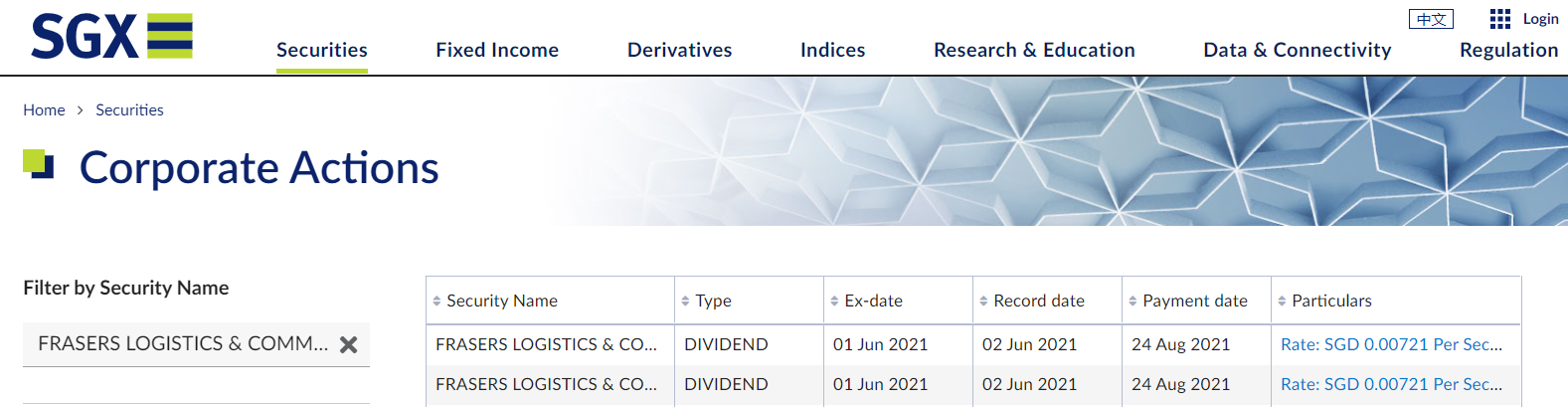
PhillipTan ( Date: 24-Aug-2021 18:25) Posted:
|
SGX website shows dividends at 1.442 cents per share
But I only received 1.31 cents per share
Typo error by SGX? Anyone experiencing the same issue?
But I only received 1.31 cents per share
Typo error by SGX? Anyone experiencing the same issue?
Analysts keep ' add' on Frasers Logistics & Commercial Trust on ' fairly steady quarter'
Analysts from CGS-CIMB Research and OCBC Investment Research have maintained " add" on Frasers Logistics & Commercial Trust (FLCT) after the REIT posted its updates for the 3QFY2021 on Aug 4.CGS-CIMB analysts Lock Mun Yee and Eing Kar Mei have upped their target price to $1.62 from $1.57 amid the REIT' s " stable operating and financial metrics" during the quarter.
FLCT posted an overall portfolio occupancy of 96.3%, 0.5 percentage points lower q-o-q due to a slight slip in its commercial portfolio.
Analysts from CGS-CIMB Research and OCBC Investment Research have maintained " add" on Frasers Logistics & Commercial Trust (FLCT) after the REIT posted its updates for the 3QFY2021 on Aug 4.
CGS-CIMB analysts Lock Mun Yee and Eing Kar Mei have upped their target price to $1.62 from $1.57 amid the REIT' s " stable operating and financial metrics" during the quarter.
FLCT posted an overall portfolio occupancy of 96.3%, 0.5 percentage points lower q-o-q due to a slight slip in its commercial portfolio.
The research team at OCBC has, on the other hand, lowered its fair value estimate on FLCT to $1.60 from $1.62 due to a slight environmental, social and governance (ESG) discount.
In its ESG update, the team, in an Aug 6 report, says the REIT has improved in its human capital development programmes. It also falls into the highest scoring range for the &lsquo Corporate Governance' category compared to that of its peers around the world.
" The ratio of green-certified properties in its portfolio remains above the global average," adds the team. " We note that FLCT' s industrial portfolio was named Global Sector Leader (Listed Industrial) for the third consecutive year in the 2020 GRESB Assessment, which is one of the global ESG benchmarks for real estate."
That said, it has raised its DPU forecasts for the FY2021 and Fy2022 by 0.9% and 1.7% respectively on account of FLCT' s recent acquisitions.
To the team, one of the REIT' s merits is its defensive profile due to its high occupancy rate, long WALE and manageable lease expiries for the rest of the FY2021 and FY2022.
Units in FLCT closed 2 cents lower or 1.3% down at $1.51 on Aug 11, or 1.37 times P/B with a dividend yield of 5.27% for the FY2021, according to CGS-CIMB' s estimates.
FLCT' s takes S$1.1m hit to distributable income, says it is positioned to face challenging environment
THE impact of the Covid-19 pandemic on the distributable income of Frasers Logistics and Commercial Trust (FLCT) is about S$1.1 million for the nine months ended June 30, mainly due to rental waivers and allowance for doubtful receivables attributable to the Covid-19 pandemic, the manager said in a business update on Wednesday.The manager of the real estate investment trust (Reit) said that it will continue to monitor the situation closely, support tenants and exercise prudence.
That said, it noted that FLCT is well-positioned to face the current challenging global environment. This is given its resilient portfolio, strong balance sheet and financial flexibility. While the retail segment of the commercial portfolio is challenged by the Covid-19 pandemic, it accounts for just 1.6 per cent of FLCT' s overall income.
It is also expected to benefit from structural trends driven by the growth of e-commerce activities and adoption of hub-and-spoke models, which will drive demand for logistics and suburban office spaces respectively, said the manager.
As at June 30, FLCT' s portfolio is valued at S$6.84 billion, comprising 103 properties across Singapore, the United Kingdom, Australia, Germany and the Netherlands. Occupancy rate came in at 96.3 per cent while the weighted average lease expiry (Wale) stood at 4.9 years.
For the third quarter ended June 30, some 74,865 square metres of leasing was completed, representing 2.8 per cent of total lettable area. Portfolio rental reversion rose by 0.8 per cent.
On the acquisition front, FLCT had acquired a S$564.2 million portfolio of six European properties and raised gross proceeds of about S$335.8 million through a private placement.
Some S$540 million had been refinanced in the year to date and it had in July priced S$150 million of its maiden 2.18 per cent sustainability notes due 2028.
Units of FLCT ended Wednesday S$1.52, down S$0.01 or 0.7 per cent.