
 Post Reply
1-20 of 5653
Post Reply
1-20 of 5653
Operator / Market EBITDA Margin (%)Net Profit Margin (%)Core Profit Driver /
StatusStarHub (Singapore) 🇸 🇬 ~17.8% &ndash 18.9%~3.7% &ndash 4.0%Squeezed by MVNO price wars and DARE+ investment costs.
CelcomDigi / Maxis (Malaysia) 🇲 🇾 ~41% &ndash 42%~12.0% &ndash 14.5%Market consolidation and stabilized shared 5G architecture.
Telkom Indonesia / Telkomsel 🇮 🇩 ~50.0% &ndash 52.0%~11.0% &ndash 13.0%Strong digital data demand across a massive, scale-driven market.
China Mobile (China) 🇨 🇳 ~14.0% &ndash 15.0%~13.0%Scale efficiencies offset by low-margin state computing pivots.
Taiwan Mobile / FarEasTone 🇹 🇼 ~30.0% &ndash 36.0%~8.5% &ndash 10.0%Profiting rapidly from post-merger synergy efficiencies.
IMDA time to wake up, a non-profitable operators will cause singapore broadband and mobile network collapse.
Is it what you looking for? ended up, when all die, wait for foreign companies to take over and jack up the price and lose control completely?
Come on, IMDA, what you are doing, your poor efficiency on approval of Simba and M1 deal, and jeorpadise the whole market is causing singapore lacking behind the future technology evolution,
without a fast speed network, all LTA free gantry ERP, parking and etc, all won' t be materialise.
StatusStarHub (Singapore) 🇸 🇬 ~17.8% &ndash 18.9%~3.7% &ndash 4.0%Squeezed by MVNO price wars and DARE+ investment costs.
CelcomDigi / Maxis (Malaysia) 🇲 🇾 ~41% &ndash 42%~12.0% &ndash 14.5%Market consolidation and stabilized shared 5G architecture.
Telkom Indonesia / Telkomsel 🇮 🇩 ~50.0% &ndash 52.0%~11.0% &ndash 13.0%Strong digital data demand across a massive, scale-driven market.
China Mobile (China) 🇨 🇳 ~14.0% &ndash 15.0%~13.0%Scale efficiencies offset by low-margin state computing pivots.
Taiwan Mobile / FarEasTone 🇹 🇼 ~30.0% &ndash 36.0%~8.5% &ndash 10.0%Profiting rapidly from post-merger synergy efficiencies.
IMDA time to wake up, a non-profitable operators will cause singapore broadband and mobile network collapse.
Is it what you looking for? ended up, when all die, wait for foreign companies to take over and jack up the price and lose control completely?
Come on, IMDA, what you are doing, your poor efficiency on approval of Simba and M1 deal, and jeorpadise the whole market is causing singapore lacking behind the future technology evolution,
without a fast speed network, all LTA free gantry ERP, parking and etc, all won' t be materialise.
freestyle123 ( Date: 03-Jun-2026 14:08) Posted:
|
Except Singtel supported by temasek unlimited cash flow and business diversity, all mobile network providers are bleeding including singtel mobile network in Singapore.
We are lucky that Autopilot technology was slow down globally except in China. or else, we are lacking behind for high technology.
Does 3 telco has fund to build up 6G and 7G net work? Answer is no.
Better expedite the consolidation and build up the telco company cash flow to fund next generation mobile network.
We are lucky that Autopilot technology was slow down globally except in China. or else, we are lacking behind for high technology.
Does 3 telco has fund to build up 6G and 7G net work? Answer is no.
Better expedite the consolidation and build up the telco company cash flow to fund next generation mobile network.
freestyle123 ( Date: 03-Jun-2026 14:02) Posted:
|
Singapore fixed global broadband speed is world no1. However mobile speed in world no 15.
It is very embarassing for a small and high income country.
Why? Question to IMDA, you introduced 4th telco and allow MVNO operator, except making it cheaper, you are damaging the global competition.
you shall be ashamed on it.
It is very embarassing for a small and high income country.
Why? Question to IMDA, you introduced 4th telco and allow MVNO operator, except making it cheaper, you are damaging the global competition.
you shall be ashamed on it.
Speediman ( Date: 25-May-2026 15:05) Posted:
|
Starhub (and Singtel) actually in a strong position here. One competitor about to be cut off at the knees by the regulator, another about to be in a fire sale with no competitive tension and confidence draining away.
IMDA can consider implementing quality controls that all brands must achieve. They have probably lost oversight on these areas.
1) Based on network bandwidth, determine the number of users each Telco can take in. There must be a fair limit, eg if Simba buys a bandwidth meant for 200K users, they cannot have 300/400K users trying to use it. IMDA must conduct periodic checks.
2) Force " telcos" if necessary to limit or even reduce their subscriber base if there have taken in far more than their network can sustain. Excess users to pay a fine eg $50 per subscriber on a quaterly basis.
3) Set a price floor if necessary to prevent race to the bottom
1) Based on network bandwidth, determine the number of users each Telco can take in. There must be a fair limit, eg if Simba buys a bandwidth meant for 200K users, they cannot have 300/400K users trying to use it. IMDA must conduct periodic checks.
2) Force " telcos" if necessary to limit or even reduce their subscriber base if there have taken in far more than their network can sustain. Excess users to pay a fine eg $50 per subscriber on a quaterly basis.
3) Set a price floor if necessary to prevent race to the bottom
Alignment ( Date: 20-May-2026 11:52) Posted:
|
Good points. You have addressed potential financial penalties and operating restrictions imposed by the regulator and also reduced competitiveness from an operating standpoint. But do you think other operators might have a claim for damages against Simba due to their losses or lost profits suffered from unfair competition?
Speediman ( Date: 20-May-2026 10:13) Posted:
|
Fines to Simba is almost a certainty, question is how much
Simba might be restricted to take up more customers to ensure a certain network efficiency and make sure no further violations. Simba might even need to cough up more monies to buy extra spectrum to cater for their excess customer base.
Alignment ( Date: 20-May-2026 09:48) Posted:
|
The Simba investigation sounds serious. If the investigation does uncover what the IMDA is looking for, what is the remedy? Fines to the regulator and damages to the other operators, or worse?
starhub should delist itself
what benefits are there for starhub to buy m1? lousy business that keppel don't want
Starhub can buy M1 on the cheap now...
M1 is now left hanging in the air. Keppel dont want, Simba cannot buy, Singtel doesnt need M1.
Alternatively keppel buy Starhub mobile and repackage as new a Telco and do a new IPO.
Analysts tip StarHub as &lsquo obvious&rsquo front runner for M1 after Simba merger stalls
The setback is expected to weigh on Keppel, which had planned to monetise M1 through the deal
[SINGAPORE] The pause on the proposed merger between telcos M1 and Simba announced on Monday (May 18) has revived speculation that rival StarHub could re-enter the picture as a buyer.
Analysts are assessing alternative pathways for consolidation in Singapore&rsquo s telecommunications market, after the Infocomm Media Development Authority said that it had halted its assessment of the proposed M1-Simba consolidation until further notice.
The authority said that Simba could have been using radio frequency bands that it had not been assigned to provide mobile services, with possible enforcement action to follow.
The setback is expected to weigh on Keppel, which had planned to monetise M1 through the deal.
Citi analyst Brandon Lee expects about S$1.3 billion worth of announced monetisation to be removed from the asset manager&rsquo s 2025 financial year.
Shares of Keppel : BN4 -2.08% fell as much as 5 per cent on Monday to their lowest level since December 2025, though the counter later pared some losses, closing 2.1 per cent lower at S$10.38.
CGS International (CGSI) downgraded Keppel&rsquo s shares to a &ldquo hold&rdquo from its previous &ldquo add&rdquo call, lowering its target price to S$11.50 from S$13.52.
Analyst Lim Siew Khee forecast a drop in dividends, to S$0.45 per share from S$0.48 per share.
&ldquo We expect share price to be range-bound as Keppel refocuses on optimising M1 as monetisation momentum could stall slightly,&rdquo she said on Monday, noting that M1 is a non-core asset.
Shares of Simba&rsquo s Australia-listed parent Tuas Ltd took a hit on Monday after the news. The counter closed 63 per cent down at A$2.27.
UOB Kay Hian (UOBKH) analyst Adrian Loh said that the &ldquo outsized negative reaction&rdquo suggests that the market has concluded there &ldquo may be major operational, compliance and legal failures&rdquo in Tuas Ltd.
StarHub back in the picture
&ldquo There is obviously only StarHub left to bid for M1,&rdquo said Paul Chew, head of research at Phillip Securities Research.
&ldquo It is an opportunity for StarHub to achieve its goal to be a clear No 2 operator by revenue market share,&rdquo he added.
UOBKH&rsquo s Loh said that while the proposed merger between M1 and Simba could still materialise in a year or two, StarHub could &ldquo rekindle its interest in M1&rdquo .
Speculation about a merger between the two telcos has been going on for years, with StarHub having lost out to Simba in the now-suspended deal.
Responding to queries from The Business Times, StarHub said that it &ldquo would not want to speculate beyond the information publicly available at this stage&rdquo .
Outlook on Keppel&rsquo s &ldquo Plan B&rdquo
Keppel announced on Monday that it would execute its &ldquo Plan B&rdquo for M1.
The 90-day restructuring will involve improving M1&rsquo s efficiency to boost its run rate earnings before interest, taxes, depreciation and amortisation) by rightsizing the company and reducing costs.
Analysts welcomed the plan.
Noting that the telco industry&rsquo s &ldquo profit pool has plunged&rdquo , Phillip&rsquo s Chew noted that &ldquo Plan B&rdquo is aimed at enhancing M1&rsquo s intrinsic value before its sale.
UOBKH&rsquo s Loh expects the plan to yield improvements, as M1&rsquo s team will be able to implement strategies to strengthen the business once it is free of the sale and purchase agreement from May 21.
The analyst believes that M1&rsquo s future sales prospects will not be impacted by the breakdown of the deal, given that it fell through due to Simba&rsquo s potential breaches &ldquo and not because M1 is unsellable or has any major issues&rdquo .
&ldquo This aspect is worth investigating and highlighting because it is unfair to surmise that M1 is a troubled business when it was the actions of the acquiring party that toppled the deal.&rdquo
https://bt.sg/fueZ
Analysts tip StarHub as 'obvious' front runner for M1 after Simba merger stalls
The setback is expected to weigh on Keppel, which had planned to monetise M1 through the deal
Analysts tip StarHub as 'obvious' front runner for M1 after Simba merger stalls
The setback is expected to weigh on Keppel, which had planned to monetise M1 through the deal
if ceo & board stil gong gong abt tiz openning. still contrationary not expansionary something is very wrong..
moneynoenough ( Date: 07-May-2026 21:22) Posted:
|
IDA needs to do something to revive Telco fortunes... Starhub and M1 are both struggling.
They failed once in their bid for M1, here's a second chance, don't screw it up.
Speediman ( Date: 18-May-2026 08:48) Posted:
|
Simba takeover of M1 is off the table.
Simba might get a big fine for breach of airwave
Is this good news for Starhub?
Will Teledata launch a counter bid?
Simba might get a big fine for breach of airwave
Is this good news for Starhub?
Will Teledata launch a counter bid?
StarHub CEO on staying the dividend course through headwinds By Julian Wong
When Nikhil Eapen became group CEO of StarHub in early 2021, he inherited a company in need of reinvention.
StarHub had been built on a single insight: bundle everything. And for years, that was enough. Mobile, broadband, pay television, fixed line. StarHub was among the first telcos in the world to offer an all-in-one package.
Eventually, consumer behaviour shifted with the times, shaped by changing needs and expectations across each segment. StarHub, known as the challenger and innovator, now needed to reignite its spark.
&ldquo StarHub has changed over the last five years,&rdquo Eapen says. &ldquo We are now a full-fledged telco and enterprise services company.&rdquo
Two businesses, one company
According to Eapen, StarHub is roughly evenly split between its consumer and enterprise operations today.
On the consumer side, it considers itself number two in mobile by revenue market share, number one in residential broadband (a position built through organic growth and solidified with the acquisition of the MyRepublic Broadband brand), and dominant in pay television by differentiating itself as the &ldquo Home of Sports&rdquo .
But mobile is no longer the whole story, as its enterprise business now narrows the gap with the consumer business in scale.
The enterprise business has two components. The larger of StarHub&rsquo s regional enterprise divisions generates roughly $600 million to $700 million in annual revenue and is built around a managed digital infrastructure platform.
Rather than the traditional systems-integrator models of reselling and implementing third-party hardware and software, StarHub offers enterprise customers (campuses, large corporations, government-linked entities) a modular platform built on its own cloud-native network. Contract range varies in the millions.
The second component is Ensign Infosecurity (Ensign), a cybersecurity joint venture focused on government and large-enterprise clients. Ensign generates around $400 million in annual revenue and currently operates close to breakeven.
&ldquo When investors value StarHub, they don&rsquo t really factor in the value of Ensign,&rdquo Eapen says.
Since this interview, however, that has changed. On April 15, StarHub announced it had agreed to terminate its assigned rights arrangement with Temasek for total cash proceeds of $121 million, and expects to recognise a fair value gain of over $200 million from the transaction.
StarHub retains a 38.92% equity interest in Ensign, which remains an important cybersecurity partner to the group.
Winning revenue share without cutting price
At the same time, the more immediate challenge in the consumer business is the state of Singapore&rsquo s mobile market, where pricing has been driven to levels that Eapen calls &ldquo shocking.&rdquo
Plans for less than $10 a month, with generous data allowances, have become a common sight at promotional booths in Singapore shopping malls.
Eapen understands: &ldquo If it&rsquo s there, you&rsquo re gonna take it.&rdquo
But he views it as a symptom of a sector that has been &ldquo structurally distorted&rdquo and that is now correcting.
StarHub&rsquo s response has been to compete on value rather than to match the price cuts. Its flagship 5G Unlimited+ plan bundles unlimited voice and data, roaming inclusions, and device and cybersecurity protection into a single package.
It aims to offer more value for a slightly higher spend, rather than fewer features at a lower price.
&ldquo What we are not doing is taking revenue market share by taking pricing down,&rdquo Eapen says.
&ldquo Instead, we are delivering more value. Not the lowest price, but a good price. And at that great price, real value.&rdquo
In the fourth quarter of 2024, StarHub grew its subscriber base while holding average revenue per user (ARPU) flat at $22.
Growing subscribers without sacrificing ARPU &mdash without cutting price &mdash is the signal he says investors should be watching most closely.
The dividend question
StarHub has long been a familiar name among income investors on the Singapore Exchange, and it has maintained its commitment to a dividend of 6 cents per share despite challenges.
In the most recent financial year, for instance, free cash flow turned negative and net debt rose, even while its payout ratio exceeded 100%.
Eapen is keen to address each of these.
Firstly, he points out that the deterioration in free cash flow was driven primarily by a single large, non-recurring payment of approximately $190 million for 700MHz spectrum. The spectrum had been auctioned in 2016&ndash 2017, but only became available after international broadcasters in the region vacated the band in 2025.
Set against a starkly different market environment, the mobile sector at the time of the auction was in far better health than it was when telcos in Singapore received the spectrum bands in 2025.
After normalising for that payment, StarHub&rsquo s cash balance stands at approximately $857.1 million as of Dec 31, 2025.
&ldquo Our cash flow dipped, but it will start going back up,&rdquo Eapen says. &ldquo It&rsquo s something we can definitely do with high confidence.&rdquo
Steady plus
Eapen is also specific about the signals investors should look for in StarHub.
In mobile: ARPU. He points out that investors should look at whether this number holds steady across the sector, and then starts to climb.
In enterprise: Order book. StarHub has been signing contracts faster than it recognises revenue, meaning the pipeline is growing faster than the numbers currently show. Large contract announcements that StarHub is allowed to disclose would then be a secondary signal to watch.
On the balance sheet: the Ensign assigned rights transaction, which has since closed.
The $121 million in cash proceeds and the expected fair value gain of over $200 million have done precisely what Eapen anticipated, strengthening the cash position and crystallising value that had not previously been reflected.
Overall, Eapen&rsquo s phrase for the investment case is &ldquo Steady Plus&rdquo .
Steady: a dividend that is supportable now, at a yield he describes as attractive at current share prices, and backed by a substantial cash balance and a capital expenditure cycle that has largely run its course.
Plus: the operating leverage that becomes available as the mobile sector stabilises and enterprise momentum continues to build.
&ldquo Think of us as: you&rsquo ll get your dividend in the short term, we can commit to that,&rdquo he says.
&ldquo And then that should hopefully give you the patience to wait for the mid-to-long term, where you&rsquo ll see the positive benefits of operating leverage and a reflation upwards in our financial performance.&rdquo
For investors, the steady part is available now. The plus, Eapen argues, is a matter of patience. After all, as he points out, the sector is steadily moving in the right direction.
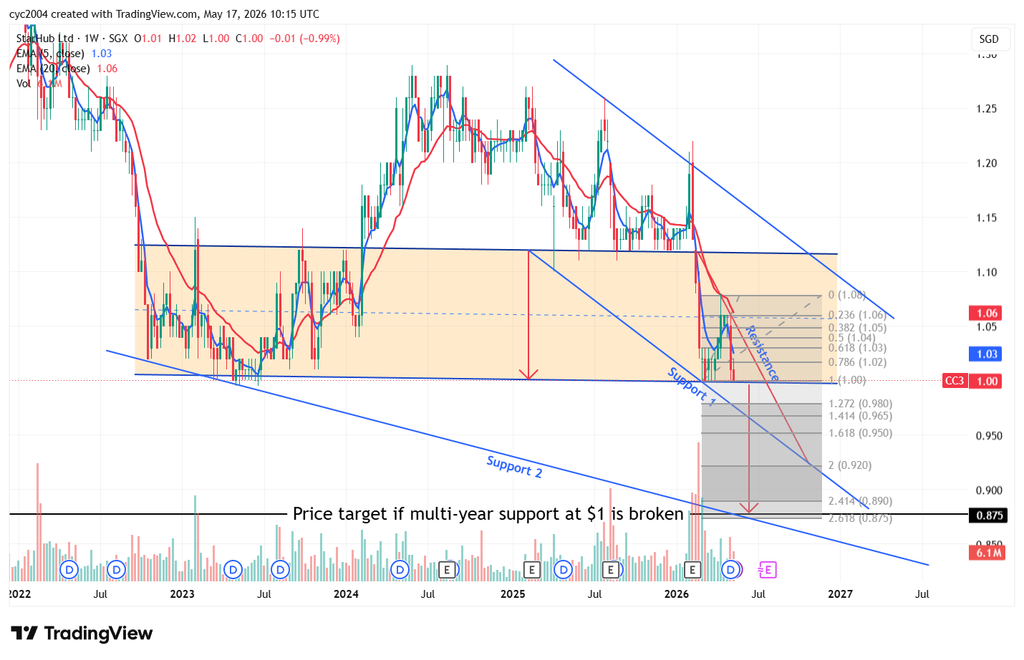
sinking like singpost