 Post Reply
1-20 of 1600
Post Reply
1-20 of 1600
SGX Stocks 2026: 3 Debt-Free Dividend Stocks with Growing Yields
Three SGX-listed stocks carry zero debt, hold plenty of cash, and raised their dividends for FY2025. We break down what' s behind each payout increase &mdash and what dividend investors should watch for.
What gives a company&rsquo s board the confidence to raise dividends?
There are many possible answers.
But one of the most overlooked is a simple one: having
zero debt on the balance sheet.
Think about it. When a company owes nothing to creditors, every dollar of cash it generates belongs to shareholders. There are no interest payments eating into profits. No loan repayments draining the coffers.
Management can focus on growing the business &ndash and rewarding those who own it.
Here are three SGX-listed stocks that carry zero debt, sit on sizable cash piles, and raised their dividends for FY2025.
Sheng Siong Group (SGX: OV8)
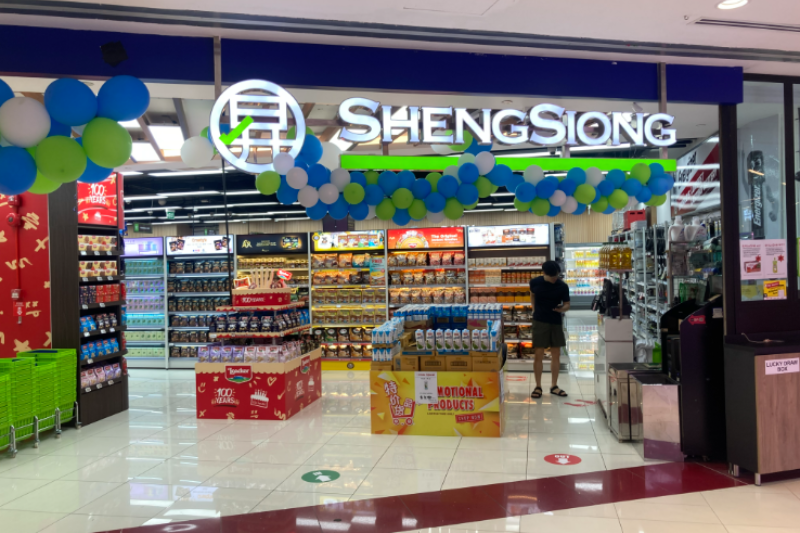
Sheng Siong is one of Singapore&rsquo s largest supermarket operators, with 93 stores across Singapore and China as at 31 March 2026.
The retailer had a good FY2025.
Revenue rose 9.9% year on year (YoY) to S$1.57 billion, fuelled by 12 new store openings &ndash its biggest expansion since 2018.
Gross margin improved from 30.5% to 31.3% as the group sold more house-brand products.
Net profit grew 8.7% YoY to S$149.5 million.
Free cash flow, the lifeblood of dividends, came in at S$215.8 million, up 7.5% YoY.
And the balance sheet? Cash of S$435.5 million. Debt of zero.
With all that going for it, the board raised the total FY2025 dividend to S$0.070, up 9.4% from S$0.064 a year ago.
At a share price of S$3.03 as at 28 May 2026, the trailing dividend yield works out to around 2.3%.
This is the textbook case.
Earnings grew, cash flow grew, and dividends followed suit.
Venture Corporation (SGX: V03)
Venture is a technology solutions provider serving customers across life sciences, networking, semiconductor equipment, and lifestyle consumer domains.
FY2025 was a tougher year.
Revenue fell 7.4% YoY to S$2.53 billion, dragged by softer demand in the Lifestyle Consumer segment and unfavourable currency movements.
Net profit dipped 7.4% to S$227.0 million, though net margin held at 9.0%.
So why did the board raise the total dividend from S$0.75 to S$0.80?
The answer lies in the balance sheet.
Venture held S$1.28 billion in net cash with zero debt as at end-FY2025. Free cash flow, while lower at S$223.5 million, still covered the higher payout.
One caveat, though.
The FY2025 dividend of S$0.80 included a special dividend of S$0.05.
Strip that out, and the ordinary dividend stayed flat at S$0.75.
The &ldquo growth&rdquo came from the company dipping into its cash reserves, not from higher earnings.
Still, there are reasons for optimism.
Demand for AI-related infrastructure is picking up across Venture&rsquo s networking, test and measurement, and semiconductor equipment businesses.
Management expects these early signs of recovery to strengthen through 2026.
At a share price of S$17.83 as at 28 May 2026, the trailing yield comes to around 4.5%.
SBS Transit (SGX: S61)
As Singapore&rsquo s largest bus operator, SBS Transit runs around 200 bus services and a fleet of some 3,400 buses, as well as rail services through the North East Line, Downtown Line, and two LRT systems.
The headline number for FY2025 is eye-catching: total dividends jumped 73.0% YoY to S$0.4960 per share.
But look closer.
Of that S$0.4960, a whopping S$0.3199 came from a special dividend.
Ordinary dividends &ndash an interim of S$0.0895 and a final of S$0.0866 &ndash totalled just S$0.1761.
At a share price of S$3.50 as at 28 May 2026, the ordinary dividend yield is around 5.0%.
How could SBS Transit afford such a large special payout?
Once again, the balance sheet tells the story.
Cash of S$384.3 million. No debt. And free cash flow that surged to S$104.3 million, up from just S$21.5 million a year ago.
The operations side is less clear-cut.
Revenue slipped 2.7% to S$1.5 billion, and net profit fell 13.0% to S$61.2 million.
The loss of the Jurong West bus package hurt, and another setback looms with the Tampines package set to go from July 2026.
Rail operations, at least, continue to benefit from higher ridership and fare adjustments.
Get Smart: What zero debt really means for dividends
All three companies share one thing in common &ndash zero debt and plenty of cash.
That combination gave each board the room to
raise dividends in FY2025, even when the operating environment was far from perfect.
But as fellow investors, we should always look beneath the headline dividend figure.
Special dividends may not come around again at the same level.
The most dependable dividend growth comes from companies that raise their ordinary payouts year after year, backed by growing free cash flow.
A debt-free balance sheet is a great starting point.
But it is the quality and consistency of the underlying cash flow that keeps dividends going.
Disclosure: The Smart Investor owns shares of Sheng Siong.
The following are top SGX-listed companies renowned for generating robust free cash flows (FCF) and maintaining strong balance sheets:
1. Singapore Exchange Ltd (SGX: S68)
- The Business: The sole approved financial exchange operator in Singapore.
- FCF & Financials: FCF nearly doubled from S$392.4 million in FY2023 to S$773.6 million by FY2025, buoyed by its resilient fee structures and lack of capital-intensive overhead.
2. Sheng Siong Group Ltd (SGX: OV8)
- The Business: One of Singapore' s largest supermarket chains with over 90 outlets.
- FCF & Financials: Continues to punch above its weight by generating S$215.8 million in FCF. The company maintains a " war chest" of cash with zero bank debt, enabling consistent dividend payouts.
3. UOL Group Limited (SGX: U14)
- The Business: A leading real estate developer and hospitality investor.
- FCF & Financials: Has seen its FCF surge to around S$1.2 billion, representing a robust 86% conversion rate from its operating income, allowing the company to aggressively pay down debt and multiply dividends.
4. HRnetGroup Limited (SGX: CHZ)
- The Business: A premier recruitment and staffing specialist operating across Asia.
- FCF & Financials: Maintains a completely debt-free balance sheet with over S$260 million in cash reserves. It consistently converts net income into FCF, supporting a trailing dividend yield of over 5.8%.
5. Venture Corporation Limited (SGX: V03)
- The Business: A global provider of technology solutions and electronics manufacturing services.
- FCF & Financials: Backed by an exceptionally liquid balance sheet featuring over S$1.28 billion in net cash, providing a resilient cushion for its annual dividend distributions
too simplistic a view as they take into consideration that all stores will make money....
in reality, some are making losses..
Joelton ( Date: 09-May-2026 09:38) Posted:
Higher target prices for Sheng Siong on earnings growth from new stores
Several analysts have raised their target prices for Sheng Siong Group, citing expectations that demand will remain resilient and new store openings will drive earnings.
Along with his &ldquo buy&rdquo call, Alfie Yeo of RHB Bank Singapore has raised his target price for the supermarket chain to $3.45 from $3.02, reflecting a higher valuation multiple.
In FY2026, Yeo expects Sheng Siong to report higher earnings, driven partly by the 12 new stores it opened in FY2025.
In 1QFY206, Sheng Siong reported earnings of $43 million, up 12% y-o-y, and revenue was up 12% to $452 million, in line with Yeo&rsquo s estimates. Thanks to a better sales mix, gross margins improved by 0.7 percentage points to 31%.
Yeo&rsquo s new target price is based on a 28 times multiple of blended FY2026 and FY2027 earnings, reflecting deeper and wider market penetration, up from an earlier 25 times multiple on FY2026 earnings. &ldquo Growth outlook is positive, as Sheng Siong Group continues to penetrate the market with more stores,&rdquo he says.
This year, the company has already secured three new outlets and is awaiting tender results for another five. Yeo expects Sheng Siong to bid for two more tenders in the next 6&ndash 12 months.
&ldquo For the longer term, its new distribution centre will support more than 120 stores eventually. Finally, we believe that the Singapore market&rsquo s positive fund flows will provide tailwind and lift valuations higher over the medium term,&rdquo he reasons.
Yeo says his higher multiple of 28 times, which is slightly above the Singapore grocery retail sector&rsquo s long-term average forward P/E valuation of 26 times, is justified because of the pace at which Sheng Siong is growing.
Yeo notes that despite the Middle East conflict, Sheng Siong, with its diversified supply base, has not seen any hiccups. Neither will higher energy costs hurt its margins &ldquo strongly&rdquo as the company hedges. &ldquo In addition, suppliers have yet to increase prices,&rdquo says Yeo.
For him, key downside risks to his earnings estimates include slower-than-expected store openings, lower sales demand and per-sq-ft traction, and the inability to maintain the current gross profit margin.
&ldquo We expect Sheng Siongs&rsquo s performance to remain resilient, as it targets the mass market value segment, which will enjoy the effects of downtrading in a soft consumption environment,&rdquo says Yeo.
Chu Peng of OCBC Group Research has kept her call at &ldquo hold&rdquo but has raised her fair value for Sheng Siong from $2.78 to $3.26, on the premise that this is a defensive business amid rising inflation and slower economic growth.
&ldquo Demand for groceries could be supported by a shift in consumption patterns towards a focus on value-for-money purchases due to inflationary pressures and a higher cost of living.
&ldquo Moreover, grocery sales could be supported by inflation-relief measures announced in Singapore&rsquo s Budget 2026, such as the CDC vouchers,&rdquo she adds.
Chu, citing management, says Sheng Siong expects to maintain rational pricing unless its competitors become aggressive.
Its suppliers have also flagged potential price hikes, but some are holding back given the weak consumer sentiment.
While consumer spending is cautious and prioritising daily essentials, sales should see &ldquo support&rdquo as the next tranche of $500 in CDC vouchers, originally scheduled for January 2027, has been brought forward to June.
Chu says Sheng Siong is now trading at a 12-month forward P/E of 27.3 times, around 3 s.d. above its historical average of 20.2 times.
She has revised her earnings forecasts and raised the fair value estimate to $3.26, reflecting a lower cost of equity assumption and a higher terminal growth rate.
Chee Zheng Feng of DBS Group Research is a bit more cautious. He has raised his target price, too, from $2.60 to $2.80. His call remains &ldquo hold&rdquo .
Chee sees a slightly improved earnings outlook and longer‑ term growth optionality. His new target price of $2.80 is pegged to a higher 26 times forward P/E, up from 24 times, which is 2.5 s.d. above the five-year average.
&ldquo We believe the higher valuation premium is justified by a more conducive store network expansion environment, a rational competitive landscape, and increased investor appetite for defensive names amid heightened geopolitical uncertainty stemming from the ongoing Iran war,&rdquo says Chee.
|
|
Stop Watching the Tickers: 5 Stocks to &ldquo Buy and Forget&rdquo for a Decade
Constantly checking stock prices rarely builds wealth. The real gains often come from holding great businesses over time. These five stocks are the kind investors can consider owning for the next decade.
 By Charlyn T.May 19, 2026Updated:May 19, 20267 Mins Read
Building
long-term wealth isn&rsquo t about watching stock tickers, chasing headlines, or reacting to every price movement daily.
Instead, it is about owning quality businesses that you can &ldquo buy and forget.&rdquo
What &ldquo Buy and Forget&rdquo Really Means
To be sure, taking this stance does not mean you should ignore your investments after you buy them.
It simply means
selecting businesses that you can trust for the long run.
You hold them through market cycles and allow compounding to do its work instead of reacting to short-term noise.
Compounding is something that should be left to work for years and not weeks, let alone days.
What Makes a Stock Suitable for Long-Term Holding
Stocks with a strong economic moat that can protect their earnings are candidates for long-term investing.
Another plus point is when the company focuses on long-term value creation and not short-term gains.
Additionally, these high-quality picks will also have a history of consistent earnings growth.
DBS Group &mdash The Global Platform Leader
DBS Group (SGX: D05) became Southeast Asia&rsquo s largest bank in 1998.
Today, it has operations spanning 19 markets with a keen focus on Greater China, Southeast Asia and South Asia, a network that is hard to match.
For the full year of 2025 (FY2025), DBS achieved a record total income of S$22.9 billion.
The local bank didn&rsquo t lose any steam heading into the first quarter of 2026 (1Q2026) with total income reaching a new high of almost S$6 billion.
That&rsquo s despite net interest income (NII) slipping 5% YoY due to a lower net interest margin.
DBS is still no doubt the leader among our local banks.
Its current market cap of S$171 billion, as of 14 May 2026, is ahead of
Oversea-Chinese Banking Corporation (SGX: O39), or OCBC, and
United Overseas Banking (SGX: U11), or UOB, which reported market capitalisations of S$103 billion and S$62 billion respectively.
But wait, there&rsquo s more to consider.
DBS is not just the largest &mdash it has scored a return on equity (ROE) of 17% for 1Q2026 on an annualised basis, easily beating OCBC (13%) and UOB (11.5%).
ST Engineering &mdash The Dividend Growth Blue Chip
Global technology and defence powerhouse,
ST Engineering (SGX: S63) or STE, is backed by government contracts and long-term aviation maintenance.
The company won S$18.7 billion worth of new contracts in 2025, and ended the year with a massive order book of S$33.2 billion.
The conglomerate has not slowed down in 2026, securing an additional S$4.8 billion in new contracts across its business segments in the first three months of the year.
Having a multi-year order book allows the company to &ldquo lock in&rdquo years of future work, providing highly visible and stable income for the next few years.
To improve total shareholder return, STE intends to distribute one-third of any YoY profit increase as incremental dividends.
The group has displayed continuous dividend increments over the years.
Total dividends for 2025 amounted to S$0.23 per share, a 35% increase over the 2024 dividend of S$0.17, and a 44% increase compared to the S$0.16 paid in 2023.
Notably, 2025&rsquo s dividend included a S$0.05 special dividend.
Venture Corp &mdash The Structural Growth Leader
Venture Corp (SGX: V01) serves as a strategic partner and manufacturer for global giants in key sectors such as life sciences and advanced networking.
With the worldwide push for better medical technology and rising complexity of semiconductor testing, Venture Corp is well-positioned to benefit from the increasing sector demand.
As of 31 March 2026 (the end of 1Q2026), the company has a net cash position of S$1 billion.
This substantial cash surplus has been sustained even after accounting for consistent dividend payouts and share buybacks, reflecting the company&rsquo s ability to grow.
Sheng Siong &mdash The Defensive Compounder
As a classic all-weather stock,
Sheng Siong (SGX: OV8) remains resilient regardless of the economy as daily groceries and household essentials never go out of style.
In fact, when times get tough, consumers cut down on dining out and eat at home instead.
And where do they go to get cheaper groceries?
That&rsquo s right &mdash Sheng Siong.
The company&rsquo s performance backs this up.
In 2025, revenue rose by nearly 10% YoY to S$1.6 billion, while maintaining a gross profit margin of 31.3%.
The momentum continued into 1Q2026, with revenue jumping 12.4% YoY to S$452.8 million even as the gross profit margin slipped slightly to 31%.
Additionally, the supermarket chain holds over S$461.1 million in cash and cash equivalents with zero debt.
Combined with a consistent gross profit margin of approximately 30%, Sheng Siong is clearly capable of providing long-term investors with predictable cash flows and stable dividends.
Keppel DC REIT &mdash The Scalable Challenger
As of 31 December 2025,
Keppel DC REIT (SGX: AJBU) has 25 data centres across Asia-Pacific and Europe valued at S$6.3 billion.
With a portfolio occupancy of 95.8% and a weighted average lease expiry (WALE) of 6.7 years as of the end of 1Q2026, tenants are locked in for the long haul.
Plus, a built-in rental escalation clause tied to inflation has been implemented to help offset any costs that may eat into unitholder returns.
With technology giants like
Microsoft Corp (NASDAQ: MSFT) and
Alphabet (NASDAQ: GOOGL) pouring billions into artificial intelligence (AI), global data centre capacity is expected to double by 2030.
Keppel DC REIT has intentionally focused on stabilised assets in supply-constrained markets, allowing its assets to benefit from the &ldquo supply squeeze.&rdquo
Established players like Keppel DC REIT can keep occupancy high and leasing conditions favourable.
Why Most Investors Struggle to &ldquo Hold for a Decade&rdquo
More often than not, when the stock prices fall, investors&rsquo loss aversion instinct kicks in and they end up panic selling.
Investors who get swayed will make impulsive decisions that negatively impact their long-term goals.
Usually those who fail to do their due diligence before investing find it hard to remain invested.
Without a solid understanding of the business, they lack the foundation necessary to justify holding their position when things get shaky.
The secret to long-term holding is very simple.
Just shift your focus from daily price changes to underlying business performance.
Stop monitoring your portfolio constantly &ndash you only need to review your holdings periodically, say every six months, to ensure your investment thesis remains intact.
Get Smart: Wealth Is Built in the Waiting
When you plant a seed, watching it closely every day wouldn&rsquo t make the plant grow faster.
The true source of wealth is not constant activity, but rather the product of owning high-quality businesses over extended periods.
The real challenge of investing only begins after you have identified the right stocks.
It lies in having the discipline to &ldquo let go&rdquo and allow their performance to deliver powerful results over time.
bad sandwich..
moneynoenough ( Date: 06-May-2026 04:28) Posted:
another attempt up k2..?
moneynoenough ( Date: 05-May-2026 03:06) Posted:
unusual optimism..?
price closed confidently over a long weekend, n yet surprised with a higher closing on xd..
party just getting started counting down to cdc bonaza.. |
|
|
|
Higher target prices for Sheng Siong on earnings growth from new stores
Several analysts have raised their target prices for Sheng Siong Group, citing expectations that demand will remain resilient and new store openings will drive earnings.
Along with his &ldquo buy&rdquo call, Alfie Yeo of RHB Bank Singapore has raised his target price for the supermarket chain to $3.45 from $3.02, reflecting a higher valuation multiple.
In FY2026, Yeo expects Sheng Siong to report higher earnings, driven partly by the 12 new stores it opened in FY2025.
In 1QFY206, Sheng Siong reported earnings of $43 million, up 12% y-o-y, and revenue was up 12% to $452 million, in line with Yeo&rsquo s estimates. Thanks to a better sales mix, gross margins improved by 0.7 percentage points to 31%.
Yeo&rsquo s new target price is based on a 28 times multiple of blended FY2026 and FY2027 earnings, reflecting deeper and wider market penetration, up from an earlier 25 times multiple on FY2026 earnings. &ldquo Growth outlook is positive, as Sheng Siong Group continues to penetrate the market with more stores,&rdquo he says.
This year, the company has already secured three new outlets and is awaiting tender results for another five. Yeo expects Sheng Siong to bid for two more tenders in the next 6&ndash 12 months.
&ldquo For the longer term, its new distribution centre will support more than 120 stores eventually. Finally, we believe that the Singapore market&rsquo s positive fund flows will provide tailwind and lift valuations higher over the medium term,&rdquo he reasons.
Yeo says his higher multiple of 28 times, which is slightly above the Singapore grocery retail sector&rsquo s long-term average forward P/E valuation of 26 times, is justified because of the pace at which Sheng Siong is growing.
Yeo notes that despite the Middle East conflict, Sheng Siong, with its diversified supply base, has not seen any hiccups. Neither will higher energy costs hurt its margins &ldquo strongly&rdquo as the company hedges. &ldquo In addition, suppliers have yet to increase prices,&rdquo says Yeo.
For him, key downside risks to his earnings estimates include slower-than-expected store openings, lower sales demand and per-sq-ft traction, and the inability to maintain the current gross profit margin.
&ldquo We expect Sheng Siongs&rsquo s performance to remain resilient, as it targets the mass market value segment, which will enjoy the effects of downtrading in a soft consumption environment,&rdquo says Yeo.
Chu Peng of OCBC Group Research has kept her call at &ldquo hold&rdquo but has raised her fair value for Sheng Siong from $2.78 to $3.26, on the premise that this is a defensive business amid rising inflation and slower economic growth.
&ldquo Demand for groceries could be supported by a shift in consumption patterns towards a focus on value-for-money purchases due to inflationary pressures and a higher cost of living.
&ldquo Moreover, grocery sales could be supported by inflation-relief measures announced in Singapore&rsquo s Budget 2026, such as the CDC vouchers,&rdquo she adds.
Chu, citing management, says Sheng Siong expects to maintain rational pricing unless its competitors become aggressive.
Its suppliers have also flagged potential price hikes, but some are holding back given the weak consumer sentiment.
While consumer spending is cautious and prioritising daily essentials, sales should see &ldquo support&rdquo as the next tranche of $500 in CDC vouchers, originally scheduled for January 2027, has been brought forward to June.
Chu says Sheng Siong is now trading at a 12-month forward P/E of 27.3 times, around 3 s.d. above its historical average of 20.2 times.
She has revised her earnings forecasts and raised the fair value estimate to $3.26, reflecting a lower cost of equity assumption and a higher terminal growth rate.
Chee Zheng Feng of DBS Group Research is a bit more cautious. He has raised his target price, too, from $2.60 to $2.80. His call remains &ldquo hold&rdquo .
Chee sees a slightly improved earnings outlook and longer‑ term growth optionality. His new target price of $2.80 is pegged to a higher 26 times forward P/E, up from 24 times, which is 2.5 s.d. above the five-year average.
&ldquo We believe the higher valuation premium is justified by a more conducive store network expansion environment, a rational competitive landscape, and increased investor appetite for defensive names amid heightened geopolitical uncertainty stemming from the ongoing Iran war,&rdquo says Chee.
DBS, RHB raise Sheng Siong target prices on expansion runway, CGSI holds steady
Its diversified supply base mitigates the risk of major disruptions from the Middle East conflict, says RHB
[SINGAPORE] Supermarket operator Sheng Siong&rsquo s robust first-quarter results have prompted analysts at DBS Group Research and RHB to raise their target prices, driven by an improved margin outlook and a fertile environment for store expansion.
Sheng Siong reported a 12.6 per cent year-on-year rise in net profit for the first quarter of 2026 to S$43.4 million, on a 12.4 per cent growth in revenue. The top-line growth was largely fuelled by new store openings and healthy same-store sales growth supported by festive demand.
RHB maintained its &ldquo buy&rdquo rating and raised its target price from S$3.02 to S$3.45, while DBS maintained its &ldquo hold&rdquo and increased its target price from S$2.60 to S$2.80.
Still, CGS International (CGSI) did not raise its target price despite a positive call, leaving it at S$3.40.
Stronger performance to come
RHB in the Monday note outlined expectations for Sheng Siong to have stronger performance in upcoming quarters, fuelled by a full 12-month earnings contribution from the 12 new stores the group opened in FY2025.
Analyst Alfie Yeo noted that Sheng Siong has already secured three new outlets for the 2026 financial year and is awaiting the results for five other tenders. For the longer term, he highlighted that the company&rsquo s new distribution centre will eventually support more than 120 stores.
Additionally, the group&rsquo s diversified supply base mitigates the risk of major disruptions from the Middle East conflict, said Yeo, adding that suppliers have yet to raise prices.
Also positive on Sheng Siong, DBS marginally lifted its 2026 and 2027 earnings forecasts by 0.3 per cent and 3.9 per cent, respectively, to reflect stronger store expansion prospects and improved margin assumptions.
Analyst Chee Zheng Feng said he expects a &ldquo high likelihood&rdquo of store availability emerging from struggling competitors, noting that Hao Mart and Ang Mo could potentially relinquish stores, creating further expansion opportunities for Sheng Siong.
However, he warned that earnings momentum is expected to moderate in the coming quarters. The strong first-quarter 2026 performance was partially lifted by the timing of Chinese New Year and SG60 vouchers.
Growth is projected to slow down sequentially as new store contribution moderates and high base effects emerge in the second half of the year, he said.
Potential cost pressures
Releasing its note a few days earlier on Apr 30, CGSI maintained its &ldquo add&rdquo rating and kept its target price unchanged.
While acknowledging the strong in-line first-quarter results, CGSI analysts Meghana Kande and Lim Siew Khee highlighted potential cost pressures.
Although suppliers have not implemented significant price increases yet, CGSI warned that sustained higher fuel and freight costs could raise sourcing costs for Sheng Siong in 2026.
Nevertheless, CGSI remained positive on the stock, noting that scale efficiencies should help cushion the impact of higher shipping costs. The brokerage said it continues to view Sheng Siong as a key beneficiary of consumers trading downwards for more value-for-money options in an inflationary environment.
RHB' s Yeo raises target price for Sheng Siong to $3.45 on earnings growth from new stores and resilient margins
Alfie Yeo of RHB Bank Singapore has turned more bullish on Sheng Siong Group as he sees continued earnings growth from new stores. Along with his " buy" call, Yeo has raised his target price for the supermarket chain to $3.45 from $3.02 after applying a higher valuation multiple.
This current FY2026, Yeo expects Sheng Siong to report higher earnings, driven partly by its 12 new stores that were opened in FY2025.
For its 1QFY206, Sheng Siong reported earnings of $43 million, up 12% y-o-y, revenue was up 12% to $452 million, in line with Yeo' s estimates. Thanks to a better sales mix, gross margins improved by 0.7 points to 31.
Yeo' s new target price is based on 28x blended FY2026 and FY2027 earnings on deeper and wider market penetration, up from an earlier multiple of 25x FY2026. " Growth outlook is positive, as Sheng Siong Group continues to penetrate the market with more stores," he says.
This year, the company has already secured three new outlets and is awaiting tender results for another five. Yeo expects Sheng Siong to bid for two more tenders in the next 6-12 months.
" For longer term, its new distribution centre will support more than 120 stores eventually. Finally, we believe that the Singapore market&rsquo s positive fund flows will provide tailwind and lift valuations higher over the medium term," he reasons.
Yeo says his higher multiple of 28x, which is slightly above the Singapore grocery retail sector&rsquo s long-term average forward P/E valuation of 26x, is justified because of the pace at which Sheng Siong is growing.
Yeo notes that despite the Middle East conflict, Sheng Siong, with its diversified supply base, has not seen any hiccups. Neither will higher energy costs hurt its margins " strongly" as the company hedges. " In addition, suppliers have yet to increase prices," says Yeo.
For him, key downside risks to his earnings estimates include slower-than-expected store openings, lower sales demand and per sq ft traction, and the inability to maintain gross profit margin at current levels.
" We expect Sheng Siongs&rsquo s performance to remain resilient, as it targets the mass market value segment, which will enjoy effects of downtrading in a soft consumption environment," says Yeo.
another attempt up k2..?
moneynoenough ( Date: 05-May-2026 03:06) Posted:
unusual optimism..?
price closed confidently over a long weekend, n yet surprised with a higher closing on xd..
party just getting started counting down to cdc bonaza..?
moneynoenough ( Date: 10-Apr-2026 02:47) Posted:
up up more..
https://www.businesstimes.com.sg/companies-markets/sheng-siong-dbs-among-winners-singapores-s1-billion-energy-support-package-rh |
|
|
|
unusual optimism..?
price closed confidently over a long weekend, n yet surprised with a higher closing on xd..
party just getting started counting down to cdc bonaza..?
moneynoenough ( Date: 10-Apr-2026 02:47) Posted:
up up more..
https://www.businesstimes.com.sg/companies-markets/sheng-siong-dbs-among-winners-singapores-s1-billion-energy-support-package-rhb
moneynoenough ( Date: 24-Mar-2026 02:53) Posted:
| situational circumstances say its going to be at least a 3 dollar coy... now waiting for main bcker ocbc to give her blessing.. |
|
|
|
S$8m director pay, Iran war risks among issues raised by Sheng Siong investors ahead of AGM
Asked about declaring special dividend, group says maintaining balance sheet strength is &lsquo prudent&rsquo
[SINGAPORE] Grocery store operator Sheng Siong : OV8 -0.33% said it sees further room for margin improvement, although the Iran conflict could exert &ldquo upward pressure on costs and prices&rdquo , in response to shareholder queries ahead of its annual general meeting on Apr 29.
&ldquo While there may still be room for further improvement over time, the group remains focused on balancing competitiveness and value for customers, rather than maximising margins in the short term,&rdquo said Sheng Siong on Thursday (Apr 23).
A shareholder had asked if there remains leeway for growth since Sheng Siong&rsquo s gross margin has been on the rise and hit a record high of 31.3 per cent for 2025.
The company said that its gross profit margin improvement was driven by a better sales mix, stronger contributions from fresh produce, direct sourcing, efficient supply chain management and the efforts to manage higher costs.
In response to a query on the Iran war&rsquo s impact, Sheng Siong noted that the Middle East conflict has increased costs for energy and freight but said it manages such risks through diversified sourcing and direct procurement.
&ldquo At this stage, the group does not foresee any major disruptions that would materially affect the availability of essential products,&rdquo it said.
Navigate Asia in
Special dividend and director pay
In response to a shareholder&rsquo s query on whether the group plans to declare a special dividend, Sheng Siong said it &ldquo believes it is prudent to maintain financial flexibility and a strong balance sheet&rdquo .
The shareholder had pointed out that the group&rsquo s 70 per cent dividend payout ratio has not changed since 2017, while its balance sheet is flush with cash, comprising 40 per cent of total assets.
Sheng Siong added that it retains a strong cash position not only for working capital needs, but also to respond to growth opportunities.
Another shareholder question pointed out that the pay of three executive directors &ndash Lim Hock Eng, Lim Hock Chee and Lim Hock Leng &ndash seemed &ldquo excessive&rdquo , at around S$8 million per person.
Sheng Siong said that while their annual basic salaries range from S$300,000 to S$375,000, the majority of their pay depends on the group&rsquo s financial performance.
&ldquo For FY2025, the group delivered a strong set of results, including record revenue, profit and store expansion,&rdquo Sheng Siong said. &ldquo If the group performs less well, (the directors&rsquo ) remuneration would also be significantly lower,&rdquo it said.
Store network strategy, RTS threat
A shareholder asked if there was a shift in the group&rsquo s strategy of opening stores in heartland areas, given its three new stores in suburban and downtown malls.
Sheng Siong said that it takes into account factors such as reasonable rent, suitable space configuration and &ldquo a strong or potentially strong catchment population&rdquo .
&ldquo Historically, such opportunities have been more readily available in heartland locations, although more opportunities in malls have emerged in recent years.&rdquo
It added that the mall-based stores &ldquo may carry a slightly different product mix depending on the catchment profile and available space&rdquo .
Sheng Siong said it is &ldquo satisfied&rdquo with the performance of the new mall-based stores and will continue exploring &ldquo suitable opportunities in malls where the economics are attractive&rdquo .
To a question on how the upcoming Johor Bahru-Singapore Rapid Transit System (RTS) Link may affect business at Sheng Siong&rsquo s stores in northern Singapore, the group said the potential impact is &ldquo uncertain&rdquo .
The impact of the link, set to launch in 2027, &ldquo will depend on factors such as exchange rates, relative pricing and consumer preferences&rdquo , said Sheng Siong.
&ldquo For the supermarket sector, management believes that convenience, proximity and the need for frequent purchases will remain key drivers of grocery shopping behaviour,&rdquo the group said.
&ldquo While some consumers may choose to shop across the border more often after the RTS opens, the higher opportunity cost of time relative to the absolute savings on groceries may limit the overall impact.&rdquo
The company also said it is exploring alternative partnerships with delivery platforms to provide delivery services after the termination of its joint venture with Deliveroo.
HIt the 5EMA at 3.06 and rebounded. Currently, the candlestick is bearish engulfing.
Let' s see if it can stage a strong rebound this afternoon, but I doubt so. JurongW ( Date: 09-Apr-2026 19:53) Posted:
The share price has appreciated by an impressive ~30% since 10 March simply remarkable!
Perhaps it is time for a breather, as the latest candle shows a noticeably long wick compared to those earlier in the rally.
Still, markets have a way of surprising us&hellip anything is possible.
JurongW ( Date: 09-Apr-2026 19:45) Posted:
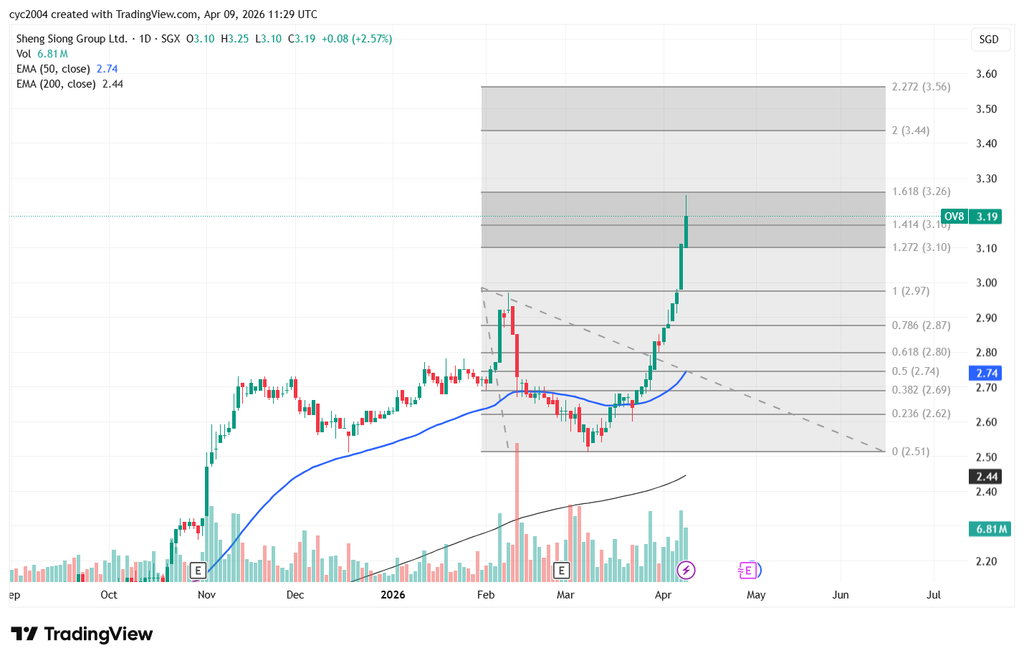
Just to add, it had a strong rally from 2.51 to 3.25.
If there is a retracement from peak at 3.25, expect good support at around 2.97 to 3.00
|
|
|
|
Sheng Siong, DBS among winners of Singapore&rsquo s S$1 billion energy support package: RHB
Most direct equity beneficiaries are in consumer staples and heartland retail, it says
[SINGAPORE] Investors should pivot towards companies with strong pricing power and direct policy linkage as Singapore navigates an energy-driven &ldquo cash-flow cushion&rdquo , RHB said in a strategy report on Wednesday (Apr 8).
On Tuesday, Singapore announced a S$1 billion support package in response to the Middle East energy shock.
&ldquo The policy architecture is not a demand stimulus but instead a targeted cash-flow cushion designed to preserve household purchasing power for essentials,&rdquo RHB stated.
Identifying the beneficiaries and laggards, RHB analyst Shekhar Jaiswal said: &ldquo The clear winners are heartland consumption, suburban retail real estate investment trusts and domestic land transport, while aviation faces headwinds and cost pressure.&rdquo
Heartland retail and staples in the lead
The brokerage identified Sheng Siong : OV8 +2.57%, Frasers Centrepoint Trust (FCT) : J69U -0.88% and CapitaLand Integrated Commercial Trust (CICT) : C38U -1.69% as clear winners of the package.
&ldquo The most direct equity beneficiaries of the government package are concentrated in consumer staples and suburban heartland retail,&rdquo Jaiswal said.
&ldquo Supermarket operators and suburban mall landlords with necessity-led tenant mixes are first-order beneficiaries, while more discretionary or tourism-dependent retail formats will see limited benefit,&rdquo he added.
Bringing forward the release of S$500 in Community Development Council vouchers from September to June and enhancing Cost-of-Living payments are expected to drive immediate footfall to heartland supermarkets and suburban malls.
RHB noted that prior voucher cycles have consistently shown a measurable uplift in mall footfall and rental reversions.
FCT, with its portfolio anchored in Housing & Development Board heartland catchments such as Causeway Point and Northpoint City, is viewed as the &ldquo purest heartland retail proxy&rdquo .
Similarly, Sheng Siong is expected to benefit from &ldquo trade-down demand&rdquo as cost-conscious households shift towards value-oriented grocery formats.
CICT is also favoured as a secondary beneficiary.
CICT&rsquo s suburban and integrated mall assets, including IMM, Junction 8 and Tampines Mall, benefit from the same voucher-driven footfall dynamics as FCT &ndash though its Central Business District office exposure may dilute the purity of the retail voucher play.
The brokerage also identified ComfortDelGro : C52 0% as a transport beneficiary.
&ldquo The government&rsquo s measures of co-funding the cost increases for essential transport services including school bus routes, senior mobility and disability services could provide a margin backstop for ComfortDelGro&rsquo s bus division, and the cash relief for taxi drivers and platform workers could reduce fleet churn,&rdquo Jaiswal said.
Banks and utilities as macro hedges
As the Middle East conflict continues to drive energy prices higher, RHB recommends Sembcorp Industries : U96 +0.45% as a primary macro hedge.
The upcoming Q3 electricity tariff reset is expected to be materially steeper, which will benefit generation asset owners with both regulated and merchant capacity.
&ldquo Sembcorp benefits directly from both the regulated tariff reset in Q3, which will fully reflect the doubled fuel price for the first time, and from unregulated merchant power pricing in a high-energy-cost environment,&rdquo RHB said.
For the banking sector, RHB maintains a &ldquo buy&rdquo rating on DBS : D05 -0.03% and OCBC : O39 -0.36%.
A hawkish tone from the government suggests that 2026 headline inflation will exceed prior forecasts.
This environment should keep elevated Singdollar rates in place, which is expected to remain a net positive for net interest margins across the three Singapore banks.
The government&rsquo s broader fiscal response also injects liquidity into the economy and supports transaction banking activity.
Names to be cautious on
In contrast, RHB remains cautious on Singapore Airlines : C6L -1.33% and Sats : S58 -1.08%.
The aviation sector faces unmitigated fuel cost pressure and route disruptions through Middle Eastern airspace, which add significant distance and fuel burn to Europe-bound flights, RHB said.
&ldquo Officials specifically warned that air transport, sea transport and tourism face higher costs and weaker demand, and the deferral of the sustainable aviation fuel levy &ndash which we believe is marginally helpful &ndash does not alter the fundamental economics of airlines facing jet fuel costs that have roughly doubled,&rdquo Jaiswal noted.
up up more..
https://www.businesstimes.com.sg/companies-markets/sheng-siong-dbs-among-winners-singapores-s1-billion-energy-support-package-rhb
moneynoenough ( Date: 24-Mar-2026 02:53) Posted:
| situational circumstances say its going to be at least a 3 dollar coy... now waiting for main bcker ocbc to give her blessing.. |
|
The share price has appreciated by an impressive ~30% since 10 March simply remarkable!
Perhaps it is time for a breather, as the latest candle shows a noticeably long wick compared to those earlier in the rally.
Still, markets have a way of surprising us&hellip anything is possible.JurongW ( Date: 09-Apr-2026 19:45) Posted:
Just to add, it had a strong rally from 2.51 to 3.25.
If there is a retracement from peak at 3.25, expect good support at around 2.97 to 3.00
JurongW ( Date: 09-Apr-2026 19:42) Posted:
Potential targets indicated, provided that u trust Fibonacci.
As shown, share price hit 1.618 fibo level (3.26) and traders took profit. This will be the resistance that it had to overcome before testing the next resistance at 2.00 fibo level (3.44)
 |
|
|
|
Just to add, it had a strong rally from 2.51 to 3.25.
If there is a retracement from peak at 3.25, expect good support at around 2.97 to 3.00
JurongW ( Date: 09-Apr-2026 19:42) Posted:
Potential targets indicated, provided that u trust Fibonacci.
As shown, share price hit 1.618 fibo level (3.26) and traders took profit. This will be the resistance that it had to overcome before testing the next resistance at 2.00 fibo level (3.44)
ivylock ( Date: 09-Apr-2026 13:19) Posted:
| All the experts here, so what is the target price it should hit? |
|
|
|
Potential targets indicated, provided that u trust Fibonacci.
As shown, share price hit 1.618 fibo level (3.26) and traders took profit. This will be the resistance that it had to overcome before testing the next resistance at 2.00 fibo level (3.44)
ivylock ( Date: 09-Apr-2026 13:19) Posted:
| All the experts here, so what is the target price it should hit? |
|
All the experts here, so what is the target price it should hit?

sgtrader ( Date: 30-Mar-2026 16:06) Posted:
|


