


| Latest Forum Topics / Straits Times Index |
 Post Reply Post Reply
|
|
STI to cross 3000 boosted by long-term investors
|
|||||
|
WanSiTong
Supreme |
27-Jul-2015 19:31

|
||||
|
x 0
x 0 Alert Admin |
Credit Suisse sees limited stock market impact from impending elections Judging from historical trends, the impending general elections will see " limited" impact on the Singapore stock market, state Credit Suisse analysts Gerald Wong and Kwee Hong Ching in a July 27 note. Diving back into past elections, Wong and Ching note that the STI' s absolute performance had some correlation between changes in the ruling PAP' s vote share in the 1988, 1991, 1997, 2001 and 2006 elections. " The relationship broke down in 2011 when a 6.5% loss in PAP' s vote share coincided with a 0.5% gain in STI one month later, " he states. The Electoral Boundaries Review Committee report was released on July 24 and the previous four elections were held within 54 days following the release of the report. Meanwhile, no major policy changes are likely prior to the elections, including, lifting of the slew of property cooling measures. " The Monetary Authority of Singapore noted recently that it is still ' premature' to consider removing any of the cooling measures," state Wong and Ching. As the nature of Singapore' s very exposed economy, the stock market will be driven more by external factors, especially the timing of the US Federal Reserves' rate hike. Within this context, Credit Suisse sees Singapore banks a beneficiary, as they can enjoy an improvement in net interest margins. Palm oil stocks, meanwhile, will benefit from a moderate El-Nino effect. Specific stocks recommended by Credit Suisse include DBS , UOB , First Resource , SIA , AGX, Raffles Medical and CapitaLand Mall Trust. |
||||
| Useful To Me Not Useful To Me | |||||
|
WanSiTong
Supreme |
27-Jul-2015 19:26
|
||||
|
x 0
x 0 Alert Admin |
China market rout enters new frenzied phase, Shanghai down 8.6%, Hang Seng down 3% July 27, 2015 : 4:44 PM China stocks plunged today in one of the worst-ever single day fall as retail investors hit by margin calls continued to liquidate their positions. The main benchmark Shanghai Composite was down a whopping 8.6% or 349.5 points to 3,818.72 points while the other widely followed Chinese barometer Shenzhen Composite Index was down 1,027.6 points or 7.6% to 2,683.45 points. The drop in the two mainland indices was the biggest in over 8 years. The selling began just after lunchtime or 2 pm. At that point Shanghai Index was down just 2% for the day but within 45 minutes or so the losses in Shanghai had ballooned to nearly 9%. Everything from blue chips to state-owned banks and insurance companies was hit hard. Hong Kong' s Hang Seng Index was down 771 points or 3.07% while the China H-shares focused Hang Seng China Enterprise Index was down 448.35 points or 3.84%. Having surged 150% over 10 months to early June, Chinese A-shares have been in a tailspin since. The market began rebounding from early July lows after Beijing announced various invites to help put a floor underneath the market. The surprise 7% GDP growth estimate for April-June quarter two weeks ago had helped stabilised things but other recent data including the flash purchasing managers index or PMI last week have dampened sentiments again. The key to China market rout is margin calls. While quite a lot of forced selling due to margin calls has already taken place, there is lot more to go. So far, Chinese authorities have spent 860 billion yuan ($ 190 billion) in trying to rescue the market. According to Bank of America Merrill Lynch estimates brokerages and banks have lent 3.7 trillion yuan ($ 816 billion) to punters for their margin trading activities. At one times leverage that is 7.4 trillion yuan ($ 1.6 trillion) stocks that are being carried on margin or 15% of the total current market capitalisation of A-shares or nearly 40% of the two A-shares markets total free float. Analysts expect the bumpy ride in China stocks to continue for a while. Beijing will announce the official PMI numbers on Saturday August 1. If the PMI falls below 50, as many economists are forecasting, investors should brace for further sharp one-day plunges in weeks to come. " The slide indicates that the Chinese authorities are reducing capital inflows following their frenzied measures to support the stock market three weeks ago," says Nigel Green, CEO of deVere Group, an investment consultancy in the UK. " It appears that, unsurprisingly, those measures are unsustainable in the longer-term, that the market is currently vulnerable without government support, and investors remain uncertain of the situation. " Green says the latest crash is another chapter in the China slowdown story. " The unfolding situation in China is likely to create volatility in the financial markets until the end of the year," he notes. Investors, he argues, should consider ' China- proofing ' their portfolios to manage risk and benefit from the inevitable buying opportunities. " While China' s slowdown is likely to be the big geopolitical driver of turbulence in coming months, there will be no hard landing as Chinese authorities have all the tools at their disposal to ensure it does not happen, " he says. Chinese economy is maturing, he notes, and there' s a deliberate shift away from commodity-hungry infrastructure spending. Still, he says, Beijing will need to do much more than they are currently doing to stoke domestic consumption to avoid the slowdown taking a firmer economic stranglehold. " |
||||
| Useful To Me Not Useful To Me | |||||
|
|
|||||
|
gavinl
Supreme |
27-Jul-2015 19:19
|
||||
|
x 0
x 0 Alert Admin |
Nice one. I like it.
|
||||
| Useful To Me Not Useful To Me | |||||
|
Octavia
Supreme |
27-Jul-2015 15:47

|
||||
|
x 0
x 0 Alert Admin |
How We Got Here - The 2008 Financial Crisis For DummiesIt could never happen again, right? 
|
||||
| Useful To Me Not Useful To Me | |||||
|
risktaker
Supreme |
27-Jul-2015 15:45
Yells: "Posts are opinions. Do not take it as investment advise " |
||||
|
x 0
x 0 Alert Admin |
maybe can take some short position hehe | ||||
| Useful To Me Not Useful To Me | |||||
|
|
|||||
|
Demostation
Supreme |
27-Jul-2015 15:26
|
||||
|
x 0
x 0 Alert Admin |
Whenever news of election is near, we usually can see bears around. This round worse, because I think the market got no money to support itself..Hahaha.. |
||||
| Useful To Me Not Useful To Me | |||||
|
francisd
Master |
27-Jul-2015 15:25

Yells: "BUY LOW SELL HIGH" |
||||
|
x 0
x 0 Alert Admin |
Shanghai market dropped to day 7.7%........ |
||||
| Useful To Me Not Useful To Me | |||||
|
bishan22
Supreme |
27-Jul-2015 15:23
|
||||
|
x 0
x 0 Alert Admin |
Slaughtered by SSE....
|
||||
| Useful To Me Not Useful To Me | |||||
|
|
|||||
|
Demostation
Supreme |
27-Jul-2015 15:09
|
||||
|
x 0
x 0 Alert Admin |
If you permanently take a bearish view of the Singapore stock market, you will make tons of money, lol..Take another few years of bearishness to go. |
||||
| Useful To Me Not Useful To Me | |||||
|
risktaker
Supreme |
27-Jul-2015 13:25
Yells: "Posts are opinions. Do not take it as investment advise " |
||||
|
x 0
x 0 Alert Admin |
market turn down liao... looks like correction is here.... | ||||
| Useful To Me Not Useful To Me | |||||
|
WanSiTong
Supreme |
27-Jul-2015 13:18
|
||||
|
x 0
x 0 Alert Admin |
Noon Market Singapore in the redJuly 27, 2015 : 12:42 PM Singapore stocks traded in negative territory at midday, in line with broad declines in other Asian markets. Commodities also slipped after China' s statistics bureau reported that industrial profits dropped 0.3% yoy in June, in contrast with a 0.6% gain in May. Bernard Aw, Market Strategist at IG Asia, said: " Asian markets (are) poised for more selling." By 12.08pm, the Straits Times Index dipped 0.83% to 3,324.75. Market breadth was negative. Excluding warrants, decliners outnumber gainers 292 to 76. The Straits Times Index traded between 3,321.80 and 3,348.83, after opening 0.11% lower at 3,348.82. A total of 745 million shares worth $ 440.8 million changed hands, giving an average price of 59 cents for the entire market. WE Holdings, Chinese Global, OEL (Holdings), International Healthway Corporation , and QT Vascular were among the most actively traded counters. Among the decliners, Singapore eDevelopment plunged 29% to 5.9 cents. The property and information technology group is planning to undertake a rights cum warrants issue of up to a total of nearly 4 billion new shares in the company to raise up to $ 112 million in net proceeds. CEFC International tumbled 6% to 32 cents in active trading. The company, engaged in trading of petrochemical, and fuel oil and petroleum products, says there is no current development regarding its fund-raising options or getting a loan from its controlling shareholder and that the company is still at the " preliminary stage of evaluation" . Yoma Strategic Holdings slipped 2% to 46.5 cents. The company, which develops real estate and project manages real estate developments, posted a 77.7% increase in earnings to $ 2.6 million in the first quarter ended June 30, 2015. DBS Group Holdings dipped 1% to $ 21.13 This is in spite of the banking group posting a 15% rise in earnings to $ 1.12 billion for the 2Q15 ended June Nicholas Teo, Market Analyst at CMC Markets, said:. " Today' s earnings report has highlighted once more the strength of the current management team in being able to constantly demonstrate the solid execution of their various business segments in the face of a deteriorating economic environment. " Raffles Medical Group inched 1% lower to $ 4.90. The medical services provider' s net profit rose 2.2% to $ 15.9 million in the second quarter ended June 30, 2015. Stocks that went ex-dividend / distribution today include The Hour Glass Limited, Mapletree Industrial Trust , and Frasers Commercial Trust . |
||||
| Useful To Me Not Useful To Me | |||||
|
bishan22
Supreme |
27-Jul-2015 09:39
|
||||
|
x 0
x 0 Alert Admin |
Stay clear... sea of reds..... Monday blues.... |
||||
| Useful To Me Not Useful To Me | |||||
|
|
|||||
|
Demostation
Supreme |
27-Jul-2015 09:30
|
||||
|
x 0
x 0 Alert Admin |
Will deduct your salary, lol! Hahaha...
|
||||
| Useful To Me Not Useful To Me | |||||
|
WanSiTong
Supreme |
27-Jul-2015 09:29
|
||||
|
x 0
x 0 Alert Admin |
Sorry...I' m late! Market Preview Singapore market to open lower Eyes on DBS, Yoma, Raffles MedicalJuly 27, 2015 : 8:44 AM The STI is expected to consolidate after the Dow Jones Industrial Average last week posted its biggest drop since January. The Dow dropped 517.92 points, or 2.9%, to 17,568.53. The Standard & Poor' s 500 Index slid 2.2% and the Nasdaq Composite Index fell 2.3%, the biggest declines for both gauges since March. At home, the Straits Times Index ended 0.11% lower at 3,352.65. Decliners outnumbered gainers 269 to 183. A total of 1.68 billion shares worth $ 959.3 million changed hands. Here are some stocks and factors to watch: DBS Group Holdings posted a 15% rise in earnings to $ 1.12 billion for the 2Q15 ended June. DBS closed 2 cents higher at $ 21.40 on July 24. Yoma Strategic Holdings posted a 77.7% increase in earnings to $ 2.6 million in the first quarter ended June 30, 2015. Yoma Strategic ended at 47.5 cents. Raffles Medical Group ' s net profit rose 2.2% to $ 15.9 million in the second quarter ended June 30, 2015. Raffles Medical ended at $ 4.95. Singapore eDevelopment, the property and information technology group, is planning to undertake a rights cum warrants issue of up to a total of nearly 4 billion new shares in the company to raise up to $ 112 million in net proceeds. The stock closed at 8.3 cents. China-based property developer First Sponsor Group posted earnings of $ 7.6 million, compared to a loss of $ 3.2 million a year ago due to IPO expenses. First Sponsor closed at $ 1.305. A wholly owned subsidiary of F & B firm Envictus International Holdings has proposed to acquire a property in Selangor for $ 14.9 million. Envictus ended at 12.4 cents. CEFC International says there is no current development regarding its fund-raising options or getting a loan from its controlling shareholder and that the company is still at the " preliminary stage of evaluation" . CEFC closed at 34 cents. |
||||
| Useful To Me Not Useful To Me | |||||
|
Octavia
Supreme |
27-Jul-2015 00:26
|
||||
|
x 0
x 0 Alert Admin |
Abenomics End Game: Thousands Protest In Downtown Tokyo, Demand Abe' s Resignation As PM Disapproval SoarsConsidering that Shinzo Abe' s first reign as prime minister of Japan lasted precisely one year from September 26, 2006 until September 26 of the following year, when he voluntarily resigned due to diarrhea, the fact that he has managed to stay in power for nearly 3 years since ascending to power for the second time in December 2012 and unleashing the currency-crushing and market-surging policy of unprecedented debt and deficit monetization known as " Abenomics" is quite impressive. It also confirms that as long as the stock market keeps going higher politicians have nothing to fear even if it means a total collapse in living standards for the rest of the population. 
Yet even with the Nikkei pushing on 18 years highs, it appears that Abe may have reached his rigged market rating benefit cap, because even as the Nikkei was soaring, Abe' s approval rating was plunging. As we reported a month ago, " Abe Cabinet' s approval rating plunged to 39%, matching a record low, as more than half of voters oppose the new US-sanctioned military/security legislation being debated in the Diet.... As his popularity has waned, Abe has become more and more desperate to keep support and has, for the first time in 70- years, lower the minimum voting age from 21 to 18." Since then things have gone from bad to worse for Abe, whose popularity rating last week plunged to a record low, while the number of Japanese citizens who disapprove of his policies has finally surpassed 50%, and rose to 52.6% in a Sankei poll, while the 47news.com poll shown below shows approval at just under 38% while dispparoval at 52%. 
It spilled over last night when after years of growing resentment to their premier who panders to the rich, to big exporters, to the Japanese military-industrial complex, and of course, to the US government and Goldman Sachs (whose idea Abenomics was from the very beginning) thousands of protestors rallied Friday night in downtown Tokyo in a campaign of " Say no to the Abe government," targeting Japanese Prime Minister Shinzo Abe' s " runaway" policy. The protestors gathered at the Hibiya Park, Diet building and the prime minister' s official residence, shouting " Abe step down," " definitely oppose war" and " protect constitution." 
People hold up signs saying " No to the Abe administration" in a gathering at Hibiya Park in Tokyo on July 24, 2015. They expressed opposition to Prime Minister Shinzo Abe' s policies on a wide range of issues such as national security bills, the Trans-Pacific Partnership free trade initiative and the planned relocation of a U.S. military base within Okinawa Prefecture. 

[Photos: Imagine China] According to CRI, the anger of the Japanese population was sparked ever since the Abe administration started to push forward a series of controversial security-related bills in parliament debates. In the immediate aftermath of the forced passage the controversial bills in the lower house Abe' s approval rate tumbled 10 percentage points immediately while the disapproval rate surged to over 50 percent. So what happens next? Unless Abe relents and pockets his military expansion ambitions, it is very likely that another massive, and career ending, blast of diarrhea is in the prime minister' s immediate future. But first, as we said one month ago, and now as others admit, Abe will do everything in his power to, well, stay in power. Which is quite limited, i.e., print more. As Bloomberg reports, expectations for further BOJ easing may increase amid a falling approval rating of PM Abe&rsquo s Cabinet, says Daisaku Ueno,Tokyo-based chief currency strategist at Mitsubishi UFJ Morgan Stanley Securities, in an interview. Uen adds that market participants are focusing on whether Cabinet&rsquo s approval rating can maintain key 30% level amid possible passage by upper house of security bills this summer and ahead of upper house elections in July 2016. His assessment: there is rising risk that BOJ will be pressured to ease policy further in autumn when govt is likely to struggle to find funding sources for its budgets. Which reveals one more important aspect of QE: in addition to being the only catalyst pushing stocks to record highs even as the global economy slides into recession if not outright depression, it has become the new normal politicians' favorite and only means of holding on to power: if ratings plunge, print if they continue plunging, print some more. By the time Abe is finally booted out of power, peacefully or otherwise, the Yen may well be at 200 which in turn will be the catalyst that finally destroys the already careening Japanese economy. But destroyed cataclysm and demographic disaster aside, at least the Nikkei will have hit all time record highs. |
||||
| Useful To Me Not Useful To Me | |||||
|
WanSiTong
Supreme |
25-Jul-2015 06:32
|
||||
|
x 0
x 0 Alert Admin |
Dow -0.92% 17,568.53 / -163.39
Nasdaq -1.12% 5,088.63 / -57.78 S& P -1.07% 2,079.65 / -22.50 Wall Street slides to end rough week on macro, earnings concerns
The S& P 500 and Nasdaq posted their largest weekly drops since March on Friday as slowing global growth dragged commodity-related stocks lower while an earnings-fueled drop in Biogen took down the biotech sector. Biogen (BIIB.O) more than halved its revenue growth forecast for 2015 and its stock lost 22 percent to close just above $300. Stocks in the energy and materials sectors weighed heavily on the market after weaker-than-expected economic data from China and the euro zone raised concerns about global growth. Oil prices hit their lowest since March. " You got underwhelming revenue growth on balance and then you layer on top of that concern over a global economic slowdown, that becomes self-fulfilling," Art Hogan, chief market strategist at Wunderlich Securities in New York, said of the stock market weakness. Amazon (AMZN.O) was the bright spot on Friday, rising more than 20 percent at one point and closing up 10 percent at $530.50. The online retailer posted an unexpected quarterly profit and its market cap ballooned to $247 billion, making it the tenth-largest U.S. company by market value. However, Amazon' s spike highlighted the thinning of leadership in the S& P 500. Gains on the index so far this year can be attributed to Amazon and just three more companies. At the close of trading on Friday, the Dow Jones industrial average .DJI fell 163.39 points, or 0.92 percent, to 17,568.53, the S& P 500 .SPX lost 22.5 points, or 1.07 percent, to 2,079.65 and the Nasdaq Composite .IXIC dropped 57.78 points, or 1.12 percent, to 5,088.63. For the week, the S& P fell 2.2 percent and the Nasdaq slid 2.3 percent in their largest weekly drops since the last week of March. The 2.9 percent fall on the Dow was the largest for any week since January. Selling in stocks accelerated after a report from the Wall Street Journal said Democratic presidential candidate Hillary Clinton will propose nearly doubling the U.S. capital gains tax rate on short-term investments. Second-quarter S& P 500 earnings have been mixed, with 74 percent of companies beating analysts' profit expectations but just 52 percent surpassing revenue expectations, according to Thomson Reuters data. Adding to the concerns regarding lukewarm earnings, the S& P 500 is relatively expensive, trading at 16.9 times forward 12 months' earnings, above the 10-year median of 14.7 times, according to StarMine data. Dow component Visa (V.N) ended up 4.3 percent at $74.80 after the credit and debit card company' s results handily beat expectations. Declining issues outnumbered advancing ones on the NYSE by 2,246 to 831, for a 2.70-to-1 ratio on the downside on the Nasdaq, 2,144 issues fell and 660 advanced for a 3.25-to-1 ratio favoring decliners. The benchmark S& P 500 index posted 13 new 52-week highs and 54 new lows the Nasdaq Composite recorded 50 new highs and 200 new lows. Some 7.3 billion shares changed hands on U.S. exchanges, above the daily average of 6.6 billion so far this month. |
||||
| Useful To Me Not Useful To Me | |||||
|
Octavia
Supreme |
24-Jul-2015 12:48
|
||||
|
x 0
x 0 Alert Admin |
Quite unlikely.Think the most they defer the interest rate hike to next year while waiting for Europe, Japan and maybe China QE next to spur the world economy.
|
||||
| Useful To Me Not Useful To Me | |||||
|
WanSiTong
Supreme |
24-Jul-2015 12:46
|
||||
|
x 0
x 0 Alert Admin |
Noon Market Singapore stocks lower at half timeJuly 24, 2015 : 12:37 PM Singapore stocks inched lower at midday, in line with broad declines in other Asian markets. Bernard Aw, Market Strategist at IG Asia, said: " The Straits Times Index should encounter some support at the 3,350 level, though we will not rule out intraday slippages below that level, given soft leads from overnight markets." By 12.23pm, the Straits Times Index dipped 0.09% to 3,353.37. Market breadth was negative. Excluding warrants, decliners outnumber gainers 212 to 139. The Straits Times Index traded between 3,346.86 and 3,366.52, after opening 0.13% higher at 3,360.86. A total of 811.2 million shares worth $ 449.6 million changed hands, giving an average price of 55 cents for the entire market. Foreland Fabrictech Holdings, Debao Property Development, CEFC International, GKE Corporation, and Xpress Holdings were among the most actively traded counters. Among the gainers, OSIM International advanced 5% to $ 1.535. The retailer of luxury massage chairs, saw 2Q earnings fall 24% to $ 22 million, or 3 cents per share, in 2Q15 from $ 30 million in 2Q14. Sales in 2Q ended June fell 13 % to $ 159 million while 2Q profit before tax fell 25% to $ 29 million. Sheng Siong Group rose 2% to 88.5 cents. It posted a 23.1% increase in net profit to $ 13.6 million in the second quarter ended June 30, 2015, from $ 11.1 million in the previous corresponding quarter. CapitaLand Commercial Trust added 1% to $ 1.485. The REIT, which invests in high quality income-producing commercial properties, reported a DPU of 2.19 cents for the financial quarter ended June 30, 2015 (2Q15). For 1H15, CCT attained a DPU of 4.31 cents, a 2.1% increase yoy due to higher rents achieved across its portfolio. Among the decliners, GSS Energy plunged 28% to 10.2 cents after a trading halt was lifted. The company, engaged in oil production and precision engineering, is expecting to post a loss for the 2Q15 ended June and for the rest of the FY15 ended Dec 2015. Stocks that went ex-dividend / distribution today include SATS, Mapletree Logistics Trust, First Real Estate Investment Trust (REIT), Keppel REIT, and Cache Logistics Trust. |
||||
| Useful To Me Not Useful To Me | |||||
|
Qanghoo
Supreme |
24-Jul-2015 12:38
|
||||
|
x 0
x 0 Alert Admin |
If this is so, then, Aunti Jane' s gonna have to float QE4 instead of upping interest, right?
|
||||
| Useful To Me Not Useful To Me | |||||
|
Octavia
Supreme |
24-Jul-2015 12:33
|
||||
|
x 0
x 0 Alert Admin |
US Recession Imminent - World Trade Slumps By Most Since Financial CrisisAs goes the world, so goes America (according to 30 years of historical data), and so when world trade volumes drop over 2% (the biggest drop since 2009) in the last six months to the weakest since June 2014.
 This isn&rsquo t stagnation or sluggish growth. This is the steepest and longest decline in world trade since the Financial Crisis. Unless a miracle happened in June, and miracles are becoming exceedingly scarce in this sector, world trade will have experienced its first back-to-back quarterly contraction since 2009. Both of the measures above track import and export volumes. As volumes have been skidding, new shipping capacity has been bursting on the scene in what has become a brutal fight for market share [read&hellip Container Carriers Wage Price War to Form Global Shipping Oligopoly]. Hence pricing per unit, in US dollars, has plunged 14% since May 2014, and nearly 20% since the peak in March 2011. For the months of March, April, and May, the unit price index has hit levels not seen since mid-2009. 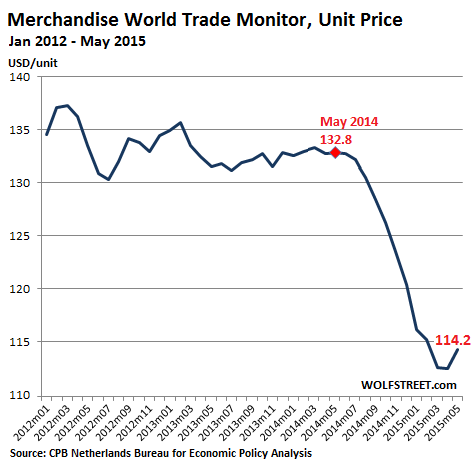
World trade isn&rsquo t down for just one month, or just one region. It wasn&rsquo t bad weather or an election somewhere or whatever. The swoon has now lasted five months. In addition, the CPB decorated its report with sharp downward revisions of the prior months. And it isn&rsquo t limited to just one region. The report explains:
Given these trends, the crummy performance of our heavily internationalized revenue-challenged corporate heroes is starting to make sense: it&rsquo s tough out there. |
||||
| Useful To Me Not Useful To Me | |||||