| Latest Forum Topics / Others |
 Post Reply Post Reply
|
|
DBS
|
|||||
|
risktaker
Supreme |
20-Mar-2017 14:38

Yells: "Posts are opinions. Do not take it as investment advise " |
||||
|
x 0
x 0 Alert Admin |
Deutsche Bank: " The Probability Of A Negative Shock Is High" by Tyler Durden
Mar 19, 2017 8:47 PM
For the second week in a row, Deutsche Bank' s strategist Parag Thatte has a somewhat conflicted message for the bank' s clients: on one hand, he writes that positive economic surprises continue " but are getting less so" , and although the divergence between hard data surprises and sentiment is diminishing the bank is somewhat confident that a " pullback in the very near term is unlikely" (here DB disagrees with Goldman Sachs). However, Thatte is increasingly hedging, and notes that because a " rally without a 3-5% sell-off that is typical every 2-3 months is now running over 4 months and is in the top 10% of such rallies by duration" , he cautions that " the probability of seeing a negative shock is high" especially since Q1 buyback blackout period has begun. Here are the key observations from the Deutsche Bank strategist:


* * * DB' s summary take on near-term equity moves:
* * * Away from equities, the picture in rates, commodities and currencies based on trader flows is as follows:

|
||||
| Useful To Me Not Useful To Me | |||||
|
Benjamin_29
Member |
10-Mar-2017 10:27
|
||||
|
x 0
x 0 Alert Admin |
For disruption to occur, first, the new technology must offer unique or superior value proposition. Second, mass market must be able to accept this new technology. As of current, there is no superior value proposition to using electric cars. It neither charge fast nor cover long range as compared to traditional cars that run on fuel. There is also lack of charging infrastructure for mass to confidently use EVs. Moreover, car companies can yet to standardise on the electrical plug or outlet interfaces for the cars. The comfort and features you mentioned are not superior value proposition as they can also be offered by tradtional cars. The value proposition offered by environmentalists is that electric cars are more " green" . However, that' s also not quite true as it still depends on the where the electricity comes from and how it is being generated. Therefore, EVs shall never fully take off. The concept of EVs is not new. For many decades there is yet to be significant breakthrough in the electric battery charging and range. Hybrids may offer better value proposition
|
||||
| Useful To Me Not Useful To Me | |||||
|
|
|||||
|
destinykraze
Elite |
10-Mar-2017 07:44
Yells: "Reality is only a matter of perception" |
||||
|
x 0
x 0 Alert Admin |
Health care and the financials were the top performing sectors, each gaining over 1 percent in the week before a rate hike. Energy traded consistently higher, positive 70 percent of the time.
|
||||
| Useful To Me Not Useful To Me | |||||
|
risktaker
Supreme |
10-Mar-2017 07:17
Yells: "Posts are opinions. Do not take it as investment advise " |
||||
|
x 0
x 0 Alert Admin |
have u drove a telsa or electric vehicle before ? Go take a comfort taxi.... They have Hybrid and ask them if it is nice....U dont have doesnt mean its not good.. lol...I think this year jan or feb there is a new hybrid of EV being used my comfort taxi... it has alot of features The cost of EV will come down in the future ...Remember everything that is new is expensive ....and once mass market model is out.... people will switch to EV becos 1) Cost Saving on Fuels 2) Low Maintenance 3) Superb smooth driving experience 4) Low Carbon Footprint for Hybrid and 0 Carbon Footprint for Pure EV if your Electricity is charge by Solar 5) U will love the advance technology the EV will offer
|
||||
| Useful To Me Not Useful To Me | |||||
|
destinykraze
Elite |
10-Mar-2017 00:14
Yells: "Reality is only a matter of perception" |
||||
|
x 0
x 0 Alert Admin |
market too bullish. Correction way too healthy. Everyone buying on dips. hard to see big drops. |
||||
| Useful To Me Not Useful To Me | |||||
|
|
|||||
|
Benjamin_29
Member |
09-Mar-2017 23:49
|
||||
|
x 0
x 0 Alert Admin |
In my opinion, Oil will never be fully disrupted, neither shall electric cars fully take off | ||||
| Useful To Me Not Useful To Me | |||||
|
risktaker
Supreme |
09-Mar-2017 20:41
Yells: "Posts are opinions. Do not take it as investment advise " |
||||
|
x 0
x 0 Alert Admin |
Just Stay away from oil and Gas market will slowly transformed into alternative and Battery... Yup GP Batteries looks good
|
||||
| Useful To Me Not Useful To Me | |||||
|
risktaker
Supreme |
09-Mar-2017 20:18
Yells: "Posts are opinions. Do not take it as investment advise " |
||||
|
x 0
x 0 Alert Admin |
We&rsquo re probably underestimating how quickly electric vehicles will disrupt the oil marketUnpredictably rapid growth happens pretty predictably.Updated by David Roberts@drvox[email protected] Feb 2, 2017, 9:20am EST
/cdn0.vox-cdn.com/uploads/chorus_image/image/53048115/ev_charging_station.0.jpg) (Shutterstock) (Shutterstock)
Just about every analyst agrees that the electric vehicle market is poised for rapid growth. But how rapid? It&rsquo s not an idle question. The rate of EV growth will have huge implications for oil markets, auto markets, and electric utilities. Yet it is maddeningly difficult to predict the future forecasts for the EV market are all over the place. I don&rsquo t think the wide range of projections means that we&rsquo re blind here, though &mdash I think we can make educated guesses. Specifically, I think history justifies optimism, the belief that the high-end projections (like those in a new study I discuss below) are closer to the truth. Let&rsquo s walk through it. EVs could do serious damage to oil &mdash or not muchTransportation accounts for a huge portion of US carbon emissions. As recently as 2014, it was behind the electricity sector &mdash 26 percent of US emissions to electricity&rsquo s 30 percent. But as Vox has reported, and the US Energy Information Administration (EIA) just confirmed, as of 2016, they have crossed paths. &ldquo Electric power sector CO2 emissions,&rdquo EIA writes, &ldquo are now regularly below transportation sector CO2 emissions for the first time since the late 1970s.&rdquo /cdn0.vox-cdn.com/uploads/chorus_asset/file/7908553/main.png) EIA EIA
This is happening because power sector &ldquo carbon intensity&rdquo &mdash carbon emissions per unit of energy produced &mdash is falling, as coal is replaced with natural gas, renewables, and efficiency. The only realistic prospect for reducing transportation sector emissions rapidly and substantially is electrification. How much market share EVs take from oil (gasoline is by far the most common use for oil in the US) will matter a great deal. However, as Rice University&rsquo s Dan Cohan explains in The Hill, EV forecasts are all over the map. The EIA&rsquo s " Annual Energy Outlook 2017" is much more bullish about EVs than in previous years &mdash its forecast for the EV market is &ldquo nearly double its forecast from last year, and nearly 10 times its forecast from 2014.&rdquo It no longer thinks hybrids or plug-in hybrids will play a major role. It believes EVs are ready. However, even with that boost, EIA has EVs at 8 percent of US market share in 2025 (it&rsquo s 1 percent today), plateauing there as US mileage standards stop falling. The other big, influential forecast, BP&rsquo s 2017 Energy Outlook, has EVs at just 6 percent of global market share by 2035. &ldquo Overall,&rdquo BP writes, &ldquo the increase in demand for car travel from the growing middle class in emerging economies overpowers the effects of improving fuel efficiency and electrification, such that liquid fuel demand for cars rises by 4 [million barrels a day through 2040] &mdash around a quarter of the total growth over the Outlook.&rdquo That is &hellip something short of revolutionary. As Cohan notes, however, others are more optimistic:
Projections for EV growth feed into projections for oil demand. EIA, IEA, and BP expect demand for oil to continue rising into the 2040s and even beyond. On the other hand, Michael Liebreich, the head of Bloomberg New Energy Finance, expects oil demand to peak in 2025. The CFO of Royal Dutch Shell agrees &mdash he said the company expects it to peak within five to 15 years. The World Energy Council predicts peak demand in 2030. Into this milieu comes a big new study that claims all those previous projections are hopelessly pessimistic. New study says oil and coal are F&rsquo dToday saw the release of a new study from the Grantham Institute for Imperial College London and the Carbon Tracker Initiative. It argues that solar photovoltaics (PV) and EVs together will kick fossil fuel&rsquo s ass, quickly. &ldquo Falling costs of electric vehicle and solar technology,&rdquo they conclude, &ldquo could halt growth in global demand for oil and coal from 2020.&rdquo That would be a pretty big deal. The &ldquo business as usual&rdquo (BAU) scenarios that typically dominate these discussions are outdated, the researchers argue. New baseline scenarios should take into account updated information on PV, EV, and battery costs. (The EIA doesn&rsquo t expect inflation-adjusted prices of EVs to fall to $30,000 until 2030, even as multiple automakers say they&rsquo ll hit that within a few years.) And baseline scenarios should take into account the commitments made in the Paris climate agreement, they say. (All the data and assumptions are available along with the study, and there is an interactive dashboard that allows you to fiddle around with scenario results, if you want to dig in.) Using that new baseline produces some pretty eye-popping numbers. To wit: &ldquo EVs could make up a third of the road transport market by 2035, more than half the market by 2040, and more than two thirds of market share by 2050.&rdquo And also: &ldquo Oil demand could be flat from 2020 to 2030 then fall steadily to 2050.&rdquo Again, that would be a very big deal! Most big forecasters, and big energy companies, expect coal to rise at least through 2030 and oil to rise basically forever. These new scenarios do not reflect hippie idealism, they just take seriously a) the cost curves demonstrated by PV, EVs, and batteries so far, and b) what countries said they would do in Paris. They assume that all this talk about climate change is not a bunch of BS &mdash that it&rsquo s a real problem and we&rsquo re really going to try to solve it. (Admittedly, Trump has complicated that picture, but he can&rsquo t stop the rest of the world.) If these forecasts play out, fossil fuels could lose 10 percent market share to PV and EVs within a decade. A 10 percent loss in market share was enough to send the US coal industry spiraling, enough to cause Europe&rsquo s utilities to hemorrhage money. It could seriously disrupt life for the oil majors. &ldquo Growth in EVs alone could lead to 2 million barrels of oil per day being displaced by 2025,&rdquo the study says, &ldquo the same volume that caused the oil price collapse in 2014-15.&rdquo Yet, according to the study&rsquo s authors, virtually none of big fossil fuel companies are taking the possibility seriously, or planning for it. /cdn0.vox-cdn.com/uploads/chorus_asset/file/7822031/wireless_charge5.jpg) Javier Zarracina/Vox Javier Zarracina/Vox
Taking optimism seriouslySo EV forecasts range from modest to revolutionary. What should we make of this? It seems to me that we don&rsquo t come to these questions with a clean slate. The very kind of models this study critiques are the ones that have consistently underestimated the growth of solar and wind. They use baseline scenarios that assume no further cost and policy changes when, in reality, cost and policy changes are both rapid and inevitable. Multiple drivers (pardon the pun) are lining up behind EVs &mdash rapidly falling battery costs, rising range, synergy with other new energy technologies, widespread international policy support, growing consumer interest, and (my pet dark horse) wireless EV charging. Experience shows that markets at the center of this kind of interest and activity do not continue to grow on a steady, linear path. They take off, lurching into exponential growth. That shift is impossible to predict in advance with any precision, but at this point, we ought to know that it&rsquo s coming. By now, we need not be neutral toward this range of projections. History has taught us that for new, distributed, consumer-focused technologies, unexpected explosive growth is &hellip to be expected. Big oil companies and investors would do well to prepare. |
||||
| Useful To Me Not Useful To Me | |||||
|
|
|||||
|
risktaker
Supreme |
09-Mar-2017 20:02
Yells: "Posts are opinions. Do not take it as investment advise " |
||||
|
x 0
x 0 Alert Admin |
Crude Plunges Below $49, Dragging Markets Lower All Eyes On Draghiby Tyler Durden
Mar 9, 2017 6:32 AM
While traders will be focused on the ECB, and Mario Draghi, early Thursday, it is unlikely that the European central bank will announce anything overly dramatic (see preview in a subsequent post), and instead the attention will be on the ECB' s inflation forecast for hints of when the ECB may accelerate tapering after its December 2016 QE cut, as Draghi scrambles to catch up with commodity inflation, if not so much core CPI, which has remained subdued.
However, a more pressing development as US traders get to their desks today, will be the ongoing collapse in WTI, which after crashing 5.5% yesterday, has plunged as much as 3% this morning, sliding not only below $50 for the first time since December 1, but also dropped under $49, and was trading $48.90 at last check, as a near record number of net long spec positions suddenly rush to unwind their exposure. 
The fact that yesterday the DOE reported that U.S. crude stockpiles rose by another +8.2m bbl to a record 528.4m bbl, will probably not help the selloff. 
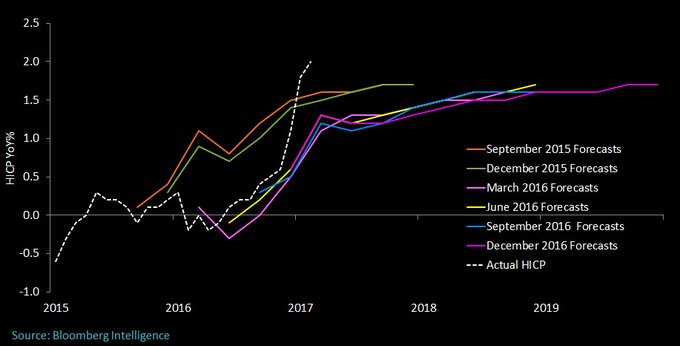
After resisting oil' s gravitational drag earlier, S& P futures snapped, and were trading lower by 0.2% at 2,357. Should the drop persist, this would be the longest losing streak for the index in five weeks. Elsewhere, European and Asian stocks fell, ahead of the European Central Bank&rsquo s meeting while the Bloomberg Dollar Spot Index headed for its best back-to-back weeks since December, rising after yesterday' s blockbuster ADP report and expectations that tomorrow' s NFP will not derail the Fed' s March reta hike, the euro and yen dropped. Speaking of the ADP report, RBC chief economist Tom Porcellisaid the report was so strong it meant the payrolls report on Friday would have to be unbelievably dire to deter the Fed from hiking next week. " There is almost no number that would stop them," said Porcelli. " It would take an extreme event for the Fed to take a pass at this point." Indeed, he noted the ADP surprise meant there was a real chance payrolls could beat expectations, perhaps by a lot. " On the face of it, ADP is consistent with private payrolls of about 340,000," he said. The current median forecast is for a rise of 190,000. With a hike seemingly certain, and more likely over the year, yields on two-year Treasury notes climbed to 1.378 percent, the highest since August 2009. 10Y yields rose for the 9th consecutive day as central banks dominated markets on Thursday. The US 2Y premium over German debt widened to 220 basis points, the largest gap since early 2000. That is a burden for the euro that is likely to only get heavier as the European Central Bank seems wedded to its super-easy policy. Jumping across the Atlantic, investors are looking for signs of an end to European stimulus during today' s ECB announcement . While economists surveyed by Bloomberg predict the ECB will reiterate that its monthly bond-buying program will run until at least December, traders will be on alert for a more hawkish tone from President Mario Draghi. Still, Draghi is expected to keep QE going at least until the end of the year with underlying price pressures muted. The ECB&rsquo s policy decision will be announced at 1:45 p.m. Frankfurt time and Draghi will hold a press conference 45 minutes later. As Deutsche writes, it' s likely that the ECB meeting today contains a lot less drama. Nevertheless it does come at an interesting time what with the likely Fed rate hike next week and the surge in both the ADP and global bond yields yesterday. It' s probably far too early for the ECB to announce more tapering ahead especially given that we don' t start until next month. According to DB economists, the baseline of such a move is still 6 months away with the possibility of an earlier announcement in June. However they expect hints of a slow and gradual evolution to a less-dovish policy stance today. For example they could provide a less downbeat &ldquo balance of risks&rdquo to the economy, an adjustment to Forward Guidance to remove the option of reducing policy rates further and/or the removal of &ldquo very&rdquo from the statement that &ldquo a very substantial degree of monetary accommodation is needed&rdquo . &ldquo Despite the positive outlook, risks remained skewed to the downside for now,&rdquo Anna Stupnytska, global economist at Fidelity International, said in a note. &ldquo A Brexit related slowdown could spill over via trade links, with Germany being particularly vulnerable. The heavy political timetable, with Dutch elections later this month and French presidential elections&rdquo starting in April are also reasons for ECB caution, she said. Looking at global markets, with energy stocks on the run, MSCI' s broadest index of Asia-Pacific shares outside Japan slipped 0.9 percent. Australia' s main index eased 0.4 percent, while its resource sector fell more than 2 percent. Bucking the trend, Japan' s export-heavy Nikkei managed to take heart from a softer yen and added 0.3%. Economic data out of China continued to surprise with consumer inflation coming in well under expectations at an annual 0.8 percent, largely due to falling food prices. That however was offset by the highest PPI in 9 years, as wholesale prices surged 7.8%, higher than the 7.7% expected, the biggest jump since September 2008. 
The strong doller also pressured industrial metals which deepened their losses following louder Chinese jitters after the PBOC did not conduct a reverse repo, draining net liquidity for the 11th consecutive day, and leading to concern among traders that the central bank is reall serious about tightening market conditions. Overnight everything fell,from iron ore to copper, which touched a seven-week trough. Gold fell 0.3 percent to $1,204.76 an ounce, declining for a fourth day. Market Snapshot
Top Overnight News
Asia equity markets traded mostly lower following a similar lacklustre lead from the US, where energy underperformed after WTI Crude futures had their worst day in over a year with losses of 5.5%. This weighed on the ASX 200 (-0.3%) with mining stocks also suffering after gold continued its declines and iron ore shed 2.9%, while Nikkei 225 (+0.3%) was kept afloat as exporters benefitted from USD/JPY' s advance to above 114.00. Hang Seng (-1.2%) and Shanghai Comp. (-0.7%) were negative after the PBoC refrained from open market operations and participants digest mixed inflation figures in which CPI showed the slowest pace of increase since January 2015 while PPI was the strongest in over 8 years. 10yr JGBs tracked losses in T-notes amid early broad gains in yields across the Asia-Pac region which briefly saw the Australian 10yr yield increase to a 15-month high. Furthermore, the curve slightly flattened amid underperformance in the short end while the 5yr JGB auction failed to support as demand was weaker, with the b/c declining to 2.86 vs. Prey. 4.26 last month. Top Asian News
European bourses are likewise lower, also impacted by yesterday' s 5.5% plunge in oil prices, with energy names the laggard thus far in Europe. Consequently, this has led to slight underperformance in the FTSE 100, while soft inflation data out of China added to the negative tone with large fall due to falling food prices (Y/Y 0.8% vs. 2.5%).However, early morning losses in Europe has been curbed by the continued upside in financials with analysts anticipating that tomorrows US jobs report will be the cherry on the cake for the Fed to go ahead with a rate hike next week (particularly given firm ADP figures). In credit markets, outperformance has been observed in the Bund/OAT spread (tighter by 2.5bps) with the latest French election poll by Harris showing Macron extending his lead vs Le Pen in the second to 65-35 (prior 60-40), while the poll also interestingly showed Macron ahead of Le Pen in the first round. Top European News
In currencies, the Bloomberg Dollar Spot Index rose 0.1 percent after gaining 0.4 percent Wednesday. The British pound fell 0.1 percent as the euro added 0.2 percent. FX markets have certainly livened up since the release of the US ADP report yesterday, reinvigorating appetite for USDs as US Treasury yield moves higher again. USD/JPY has managed to work through the bulk of exporter offers through 114.50, but we continue to stall ahead of 115.00. However, the move against the EUR has been tempered to a large degree by the aforementioned Harris poll putting Macron further in the lead in the second round of the French election. Along with a market wary that the ECB may well sound a less dovish tone at the meeting and press conference today, we have seen the single unit outperforming across the board, though the view has been better expressed through the crosses. EUR/JPY has pushed through 121.00 accordingly, while EUR/CAD has been a primary target given the losses in Oil prices, with this pair now eyeing a move on 1.4300. Cable has remained under pressure through the week, and the spot rate looks destined to test 1.2100, which is the next point of support. No fresh Brexit news to contend with, but GBP remains an easy target with the triggering of Article 50 nearly upon us. In commodities, West Texas Intermediate crude has extended yesterday' s dramatic plunge, dropping 2.8% to $48.87 a barrel. It tumbled more than 5 percent the previous session to the lowest close since Dec. 7. Gold fell 0.3 percent to $1,204.76 an ounce, declining for a fourth day. Oil prices have been thrust back into the limelight in light of the latest build reported in the DoE report. While inventory has been less of a driver in recent times, amid the backdrop of fresh uncertainty of how further production agreements will play out beyond June as well as the compliance levels from non OPEC member as as well US Shale production, WTI and Brent have finally succumbed to pressure, with the former now through $49.00, so we could be on the verge of a major move given the range breakout. Elsewhere, the impact of falling Treasuries/rising USD have impacted on both precious and base metals, with Gold now eyeing a move on USD1200 and Silver USD17.15. The impact on Copper has been exacerbated by concerns over China demand, and losses here have now taken us through USD2.60 with Zinc showing similar losses on the day so far. Nickel has been a little more resilient on the day, as has Aluminium. Looking at today&rsquo s calendar, away from the obvious focus on the ECB meeting, it' s a light day for data in the US with just the latest weekly initial jobless claims print and February import price index reading due. There&rsquo s not much away from the data. ECB President Draghi&rsquo s press conference kicks off at 12.45pm GMT while EU leaders are due to start a two-day meeting in Brussels with German Chancellor Merkel amongst those speaking. The UK Brexit Secretary David Davis is also due to answer questions in the House of Commons today including likely comments on the House of Lords ruling earlier this week. US Event Calendar
DB' s Jim Reid concludes the overnight wrap I thought I' d been to the most remarkable Champions League game (the final in Istanbul in 2005) that we would ever see. However it' s possible that Barcelona' s stunning comeback against PSG last night runs it close. If you haven' t seen the details I urge you to read the back pages today but in short they were 4-0 down from the first leg and won 6-1 in the second leg after conceding an away goal at 3-0 up. In the 88th minute they were 5-3 down and needing 3 more goals. This follows 24 hours after Craig' s beloved Arsenal got knocked out after being a comparable 5-1 down from the first leg. They unfortunately lost 2-10 overall which now means every time I think of the yield curve slope I' m going to think of this tie! Talking of European action, it' s likely that the ECB meeting today contains a lot less drama. Nevertheless it does come at an interesting time what with the likely Fed rate hike next week and the surge in both the ADP and global bond yields yesterday. It' s probably far too early for the ECB to announce more tapering ahead especially given that we don' t start until next month. Our economists&rsquo baseline being that such a move is still 6 months away with the possibility of an earlier announcement in June. However they expect hints of a slow and gradual evolution to a less-dovish policy stance today. For example they could provide a less downbeat &ldquo balance of risks&rdquo to the economy, an adjustment to Forward Guidance to remove the option of reducing policy rates further and/or the removal of &ldquo very&rdquo from the statement that &ldquo a very substantial degree of monetary accommodation is needed&rdquo . This follows a fairly dull UK budget yesterday but one interesting theme was that although the chancellor is forecasting a steady fall in borrowing there is still an annual deficit in his forecasts out to 2021-22. This will mean 20 successive years of UK deficits and it reminded us of a chart we&rsquo ve often used in our long-term studies in recent years showing the G7&rsquo s (plus Italy) annual deficits since 1950 (after the WWII impact lessens). We&rsquo ve updated this in today&rsquo s PDF. Basically in the last 25 years surpluses have been very rare outside of Canada (which ran a small surplus for 12 years from 1997 and again in 2015). In fact over this period it has only really happened in mini bubbles for the odd country like with the boom period ahead of the 2000 equity bust and the housing bubble a few years later (e.g. Spain). In fact we believe government budgets started to move towards a natural state of deficits after the Bretton Woods system broke down in the early 1970s when global currencies&rsquo link to Gold was abandoned. Prior to this (and for most of economic history) countries running persistent deficits would have seen Gold outflows which would have destabilised the domestic economy so it couldn&rsquo t be tolerated. Outside of wars budgets tended to be balanced. In a world of fiat currencies post the early 1970s the adjustments have tended to be via weaker currencies which makes deficits easier to run. So wide-scale cumulative deficits are a modern day (last 40+ years) phenomenon. Over in markets, as noted at the top the big theme has been another 24 hours of rising bond yields. Yields were already on the move in Europe but it was the much better than expected ADP print which really got things going. The February print came in at 298k compared to expectations for 187k with the monthly reading the strongest since April 2014. In fact the reading that month was a bumper 331k while the corresponding NFP print came in at a near-identical 329k so yesterday&rsquo s number is already fuelling expectations that we&rsquo ll get a similar strong reading at tomorrow&rsquo s payrolls. By the end of play Treasuries had closed just off their high in yield with 10y yields up 4.2bps at 2.560%. That is the highest close this year and only just off the high mark made back in December of 2.597%. It is also the eighth session in succession that yields have closed higher which is the longest such run since March 2012. 2y yields also rose another 2.6bps to 1.354% and so extending their 8 and a bit year high. In Europe 10y Bund yields surged 4.9bps to close at 0.364% and the highest in 3 weeks. 2y Bund yields were up 2bps with some chatter of a weak 5y Bund auction (bid-to-cover of 1.1x versus 2.1x in November) as also playing a part in the overall soft day for Bonds yesterday. Peripheral yields in the 10y bucket were also up as much as 7bps while in EM we saw hard currency bond yields in the likes of Brazil, Colombia and Argentina spike between 12bps and 18bps higher. Away from that the other big story in markets yesterday was the sharp fall in the price of Oil. Having traded in just an 8% range all year on an intraday basis between $51 and $55, yesterday WTI tumbled -5.38% to $50.28/bbl which was the biggest one-day fall since February last year and the lowest closing price since December 7th. The trigger appeared to be the latest rising US crude inventory data which seems to be overshadowing the optimism built up in the wake of the OPEC production cut agreement. The EIA numbers revealed that US crude stockpiles rose 8.2 million barrels last week which was well ahead of the 1.7 million forecast in the market according to the WSJ. In fact it wasn&rsquo t just Oil which had a poor day in the commodity space. Gold (-0.62%) and Silver (-1.48%) fell sharply for the third day in a row with a Fed rate hike next week now fully bedded in according to Bloomberg&rsquo s calculator post the ADP data. Meanwhile Iron Ore (-2.91%) and Nickel (-4.18%) also had another day to forget, while Copper (-0.13%) fell for the fifth session in succession. Oil and commodity sensitive currencies were unsurprisingly decent underperformers yesterday with the likes of the Norwegian Krone (-1.11%), Aussie Dollar (-0.78%) and Russian Ruble (-1.23%) weakening significantly. Meanwhile in equity markets energy stocks also buckled under the pressure from Oil but overall bourses held in relatively OK all things considered. The S& P 500 ended -0.23% and down modestly for the third day in a row although the energy sector was down -2.54% alone. In Europe the Stoxx 600 (+0.08%) actually managed to snap a run of four consecutive down days. This morning in Asia the focus has once again turned over to the latest data in China and this time the February inflation numbers. The data has made for a mixed read. On the one hand PPI has surged once again, printing at +7.8% yoy (vs. +7.7% expected) versus +6.9% in January. That is the sixth positive YoY reading following 54 months of deflation, and also the fastest pace since September 2008. However in contrast CPI printed at just +0.8% yoy (vs. +1.7% expected) from +2.5% in January with the MoM reading in February coming in at -0.2% mom. Sharply lower food prices (-4.3% yoy) were to blame and much like yesterday&rsquo s trade data it appears that the timing of the Lunar New Year holiday is the chief reason for that, distorting the base effects for YoY comparison. However, it does appear that China&rsquo s credit impulse did soften slightly in any case when looking at the three-month average into February (+0.3%) compared to the same period last year (+0.9%). Our economists think that the tame CPI will limit policy tightening and thus risks intensifying the property bubble in tier 1 and 2 cities. So one to watch. Bourses in China are sharply lower following the data with the Shanghai Comp and CSI 300 currently -0.85% and -0.75% respectively, although that is partly reflecting yesterday&rsquo s big fall for Oil with energy leading losses. The Hang Seng is also -0.98%, the ASX (-0.45%) and Kospi -0.08%. Only the Nikkei (+0.19%) is trading firmer. The China sensitive Aussie Dollar is down -0.24% also. With regards to the other day yesterday, in the US there were no final revisions to either Q4 productivity (+1.3% qoq) or unit labour costs (+1.7% qoq). More notable though was the one-tenth downward revision to wholesale inventories in January to -0.2% mom. The end result of that was another cut in the Atlanta Fed&rsquo s GDP tracker for Q1 to 1.2% and furthering the gap again between that and the NY Fed&rsquo s measure (currently 3.1%). The most significant data in Europe yesterday came from Germany where industrial production was reported as rising +2.8% mom in January and slightly more than expected. Following a soft December reading though the three-month average suggests IP is going nowhere. Looking at today&rsquo s calendar, away from the obvious focus on the ECB meeting at lunchtime the only data due out is from France where we&rsquo ll get the February Bank of France business sentiment print. It&rsquo s a light day for data in the US too with just the latest weekly initial jobless claims print and February import price index reading due. There&rsquo s not much away from the data. ECB President Draghi&rsquo s press conference kicks off at 12.45pm GMT while EU leaders are due to start a two-day meeting in Brussels with German Chancellor Merkel amongst those speaking. The UK Brexit Secretary David Davis is also due to answer questions in the House of Commons today including likely comments on the House of Lords ruling earlier this week. |
||||
| Useful To Me Not Useful To Me | |||||
|
risktaker
Supreme |
09-Mar-2017 19:40
Yells: "Posts are opinions. Do not take it as investment advise " |
||||
|
x 0
x 0 Alert Admin |
SQQQ and SPXU everyday up :) | ||||
| Useful To Me Not Useful To Me | |||||
|
risktaker
Supreme |
09-Mar-2017 17:57
Yells: "Posts are opinions. Do not take it as investment advise " |
||||
|
x 0
x 0 Alert Admin |
Look at gold & silver prices... kenna wack
Dont thank me :)
|
||||
| Useful To Me Not Useful To Me | |||||
|
risktaker
Supreme |
09-Mar-2017 17:32
Yells: "Posts are opinions. Do not take it as investment advise " |
||||
|
x 0
x 0 Alert Admin |
So democrats have lost the election... but now if they want a deal with Trump... they will get the FED to up interest rate... crash the market by taking profit recklessly....
Then Trump panic.... he will then make deal with the democrats.... Then stock market will recover...it happen before in 1987 if i remember correctly... Market crash 20 over percent in 2 days... |
||||
| Useful To Me Not Useful To Me | |||||
|
|
|||||
|
Benjamin_29
Member |
09-Mar-2017 17:08
|
||||
|
x 0
x 0 Alert Admin |
I think DOW will crash if it continues to rally at this rate. The higher it climbs, the harder it shall crash. In general, most US stocks are currently expensive in my opinion |
||||
| Useful To Me Not Useful To Me | |||||
|
zandlery
Supreme |
09-Mar-2017 14:06

|
||||
|
x 0
x 0 Alert Admin |
For a developed country. Indeed we are not going to see another opportunity like the great depression.
I guess that is why many venture into the underdevelop country like Myanmar hoping to hitch the ride of the rise. High risk but high gain too. |
||||
| Useful To Me Not Useful To Me | |||||
|
jeremyow
Master |
09-Mar-2017 13:55

Yells: "Passionate business investor" |
||||
|
x 0
x 0 Alert Admin |
Just to add on that is why the many older generation millionaires and billionaires we see today in US who have invested over the past few decades in US economy and companies have all benefitted greatly after the Great Depression of 1929 when prices of many assets were dirt cheap. One example is Warren Buffett himself who have benefitted greatly from the rise in US economy through his investments over his lifespan which happen to correspond with the great rise in US economy and financial market from rock bottom prices to now. Such an opportunity to invest in dirt cheap assets may not happen again in our generation, so we will not expect such parallel phenomenal returns as compared to our older generations who were lucky.
|
||||
| Useful To Me Not Useful To Me | |||||
|
jeremyow
Master |
09-Mar-2017 13:40
Yells: "Passionate business investor" |
||||
|
x 0
x 0 Alert Admin |
The last 2008 sub-prime crisis, Dow Jones Industrial Average Index fell by total of about 53% until the Mar low at 2009. I do not hold a cystal ball, but don' t think the next bear market will be even more drastic a fall than last sub-prime crisis. This is because last sub-prime crisis in 2008 together with 1929 Great Depression (Dow Jones fell by about 90%, the worst bear market ever) were only the two rare bear markets out of so many bear markets to fall by such large magnitudes. Unless the global economies are brewing something even more toxic than 2008 sub-prime crisis, or else I think it is unlikely due to historical statistical reasons to think Dow Jones will fall so much by 60% to 80%.
|
||||
| Useful To Me Not Useful To Me | |||||
|
destinykraze
Elite |
09-Mar-2017 13:34
Yells: "Reality is only a matter of perception" |
||||
|
x 0
x 0 Alert Admin |
going to see abit of correction in the short term | ||||
| Useful To Me Not Useful To Me | |||||
|
famouspinky
Supreme |
09-Mar-2017 13:08
|
||||
|
x 0
x 0 Alert Admin |
All 3 banks housing interest alreafy up.
|
||||
| Useful To Me Not Useful To Me | |||||
|
risktaker
Supreme |
09-Mar-2017 12:44
Yells: "Posts are opinions. Do not take it as investment advise " |
||||
|
x 0
x 0 Alert Admin |
Tonight likely big move....Fed funds are now at 100% that interest rate will be hike during next week meeting....
Triple digit drop for dow tonight is likely |
||||
| Useful To Me Not Useful To Me | |||||
|
risktaker
Supreme |
08-Mar-2017 10:03
Yells: "Posts are opinions. Do not take it as investment advise " |
||||
|
x 0
x 0 Alert Admin |
Looking at the US futures..... -45... looking bad | ||||
| Useful To Me Not Useful To Me | |||||