


| Latest Forum Topics / Beng Kuang Last:0.49 -- |
 Post Reply Post Reply
|
|
New CEO and Placement, Positive Things Brewing?
|
|||
|
Kandee
Senior |
07-Jan-2022 11:43
|
||
|
x 0
x 0 Alert Admin |
Beng Kuang is a fabricator of equipment used to mine tin. They are not a miner nor do they involved in tin ore/ingots trading. Thus can let me know how they could benefit from higher tin prices?
|
||
| Useful To Me Not Useful To Me | |||
|
For_The_Next_Leg
Master |
07-Jan-2022 10:59
|
||
|
x 0
x 0 Alert Admin |
$Beng Kuang(BEZ.SI)
I have shared that tin prices will moon this year since there is a ban and there could be companies just buying and holding. Anyway with this export ban, the equipment to mine the tin could be even more important now. More companies will want the equipment to mine the tin now, so as to keep for the future.
Thus, the company will benefit.
https://news.metal.com/newscontent/101674511/tin-export-ban-in-indonesia-likely-to-upset-global-supply-in-the-long-run/
|
||
| Useful To Me Not Useful To Me | |||
|
|
|||
|
MakeChanges
Elite |
04-Jan-2022 11:04

Yells: "No price is too low for a bear or too high for a bull" |
||
|
x 0
x 0 Alert Admin |
useless company. up one day, down the next day
|
||
| Useful To Me Not Useful To Me | |||
|
For_The_Next_Leg
Master |
04-Jan-2022 10:56
|
||
|
x 0
x 0 Alert Admin |
$Beng Kuang(BEZ.SI)
This article totally illustrate why Tin mining is going into the sea. Regardless, Beng Kuang will benefit.
" Company data shows its proven tin reserve on land was 16,399 tonnes last year, compared with 265,913 tonnes offshore."
https://www.aljazeera.com/gallery/2021/6/8/in-pictures-mining-tin-from-the-sea-in-indonesia
|
||
| Useful To Me Not Useful To Me | |||
|
WBdisciple
Elite |
28-Dec-2021 07:22
|
||
|
x 0
x 0 Alert Admin |
Consumers scrambling for tin to prolong record high prices Tin is a metal important for future technologies -BoA By Pratima Desai, Reuters News LONDON- Tight tin supplies due to seasonal and COVID disruptions, historically low stocks and robust demand are expected to help buoy prices of the metal near record highs. Tin prices on the London Metal Exchange have doubled this year, hitting a record high of $40,680 a tonne last month as consumers scrambled for supplies of the soldering metal, used for semiconductors. World Semiconductor Trade Statistic expects global demand for semiconductor to grow 25.6% this year and 8.8% next year taking the market to $601 billion The International Tin Association (ITA) expects the tin market deficit, the difference between tin production and consumption at 18,000 tonnes. Taking into account stock draws the deficit is still likely to be 9,000 tonnes in a global market the ITA estimates at 380,000 tonnes this year. " Seasonal rains in Indonesia around this time of year normally mean lower production," said James Willoughby, analyst at the ITA. COVID disruptions include a closed border with Myanmar, which halted tin concentrate imports to China and production cuts at Malaysia Smelting Corp. " To escape structural deficits and total depletion of above ground global stocks will require brownfield expansions or the emergence of new sources of supply that are not currently in the balance," Macquarie analysts said in a note. Tin stocks in LME registered warehouses at 1,755 tonnes have climbed in recent weeks, but they are still at historical lows. Worries about tin supplies on the LME market have created a hefty premium or backwardation for metal for nearby delivery CMSN0-3 since the start of the year. " There is no evidence to suggest there will be any major easing of the tin supply situation in the near term," said Tom Mulqueen, an analyst at Amalgamated Metal Trading. Shipping disruptions have also meant a large premium for tin on the physical market, paid above the LME benchmark contract particularly for consumers in the United States and Europe. " Solders, important in electronics, are the single most important sector for tin demand, suggesting tin is one of the MIFTs -- metals important for future technologies," said BoA Securities analyst Michael Widmer. " Digging a bit deeper, and picking just one sector driving de-carbonisation, the solar modules joined to panels are connected through a ribbon, which usually comprise of a copper core covered in a layer of tin solder." |
||
| Useful To Me Not Useful To Me | |||
|
|
|||
|
For_The_Next_Leg
Master |
20-Dec-2021 10:13
|
||
|
x 0
x 0 Alert Admin |
$Beng Kuang(BEZ.SI) Tin prices will go to the moon next year with the export ban. More companies may then go into indonesia and mine tin directly creating higher demand for the tin mining - This will be great for the company!
https://seekingalpha.com/article/4472492-tin-prices-gain-momentum-as-indonesia-mulls-tin-copper-export-bans
|
||
| Useful To Me Not Useful To Me | |||
|
tedlim
Veteran |
13-Dec-2021 09:44
|
||
|
x 0
x 0 Alert Admin |
Beng Kuang' s Tin Dreging foray looks very promising with the rising tin prices..
Tin surge worsens supply chain woes for electronics, solar and auto firms Dec 3 (Reuters) - Tin prices have nearly doubled from a year ago and are on course for their biggest annual rise in over 30 years, stinging big users of the soldering agent such as electronics firms, utilities, solar panel makers and appliance manufacturers.
For automakers, which use tin in coatings, bearings, brake pads and batteries, the higher tin costs come on top of a semiconductor chip shortage and a spike in prices for aluminium and magnesium due to curbs on energy-intensive industries in China.
Tin, whose main use is as a solder, has outperformed other industrial metals in 2021, gaining over 90% on the London Metal Exchange (LME) . It is on course for its biggest annual rise since trading was relaunched in 1989, four years after the collapse of the International Tin Council forced a suspension.
LME tin surged past $40,000 a tonne for the first time last week, while in China, the world' s biggest refined tin market, prices are up around 100% on the Shanghai Futures Exchange this year.
" There are few places in the value chain which are not feeling the pain of a higher tin price," said CRU senior consultant Willis Thomas.
He added, however, that photovoltaics (PV) companies, which use solder ribbon to join solar cells, would likely be the most severely affected, since they have less opportunity to pass on added costs to their customers due to " red-hot price competition in PV panels."
Cui Lin, chief China representative at the International Tin Association (ITA), estimates tin demand from the PV industry will rise to about 15,000 tonnes this year, versus only 8,000 tonnes in 2019.
" The stock keeps decreasing, which has affected the price quite dramatically," she said.
Tin inventories in LME-registered warehouses slipped to their lowest since 1989 at the start of November and are currently at just 1,365 tonnes. ShFE stocks are near a five-year trough.
Chinese tin smelters have had to reduce output due to curbs on power consumption this year, although not to the same extent as aluminium and magnesium makers, while a host of other tin supply constraints have worried the market.
Repeated disruption to ore shipments from Myanmar due to COVID-19 containment measures has restricted refined tin output in China, which was nonetheless up 15.1% year-on-year in the first 10 months of 2021, according to state-backed research house Antaike.
Elsewhere in Asia, Malaysia Smelting Corp (MSCB.KL), the world' s third-biggest refined tin producer in 2020, declared force majeure on deliveries in June, while Indonesia is weighing a ban on tin exports from 2024. read more
" For tin specifically, supply disruption and low inventories have been the key theme for the last year," said Tom Mulqueen, head of research at Amalgamated Metal Trading (AMT) Ltd.
The ITA estimates global refined tin consumption will grow 7.2% in 2021, after slipping 1.6% to 361,900 tonnes last year as the pandemic disrupted global industries.
However, in some ways life under lockdown has been a boon for tin.
" Tin demand benefited substantially from the rapid transition to home working," Mulqueen said, pointing to higher spending on white goods and appliances that still use more tin-intensive circuit board technology, particularly in China, and demand for nonperishable goods packed in tinplate.
" As the global economy normalises after the pandemic, do some of those tin-specific pandemic drivers start to fade? I think that' s a key question and uncertainty for demand next year," he added.
|
||
| Useful To Me Not Useful To Me | |||
|
WBdisciple
Elite |
26-Nov-2021 14:18
|
||
|
x 0
x 0 Alert Admin |
Looks like an undervalued gem at a low mkt cap of S$15 million...assuming their EBIDTA is S$3.5 million for full year (wihtout the sales of their tin dredging equipment)... their PE is about 4 times..marco polo has turned around nicely...Beng Kuang to be the next to rocket upwards? pls do your own DD.. |
||
| Useful To Me Not Useful To Me | |||
|
|
|||
|
tedlim
Veteran |
26-Nov-2021 14:14
|
||
|
x 0
x 0 Alert Admin |
Beng Kuang Marine Limited has designed and developed specialised dredging equipment for offshore tin mining activities. Installed on barges, the specialised dredging equipment has been tested for operational efficiency in various offshore tin mining sites in Indonesia with the following highlights:
Tin&rsquo s high conductivity, low melting point, high specific gravity, low toxicity, and relative abundance makes it an essential component of modern electronics. In the early 2000s, electronics manufacturers and suppliers transitioned away from leaded to lead-free solders, with higher tin concentrations. As lead-free solders came to dominate the market, the demand for tin production surged. At 80,000 tons annually, Indonesia is the second largest tin producer in the world, just barely behind China&rsquo s 85,000 tons. Tin mined in Indonesia and throughout the world is predominantly used in solders, both for electronics as well as for plumbing and other structural solders. Since 2020, the price of tin has been on a strong uptrend, due to severe supply tightness resulting from COVID-19 lockdowns, especially in Malaysia and Indonesia, major tin producers accounting for a combined 30% of global refined tin production in 2020, Fitch notes, that has yet to match up with demand despite easing slowly. Fitch expects tin demand to continue outstripping supply, pushing the market into deficit by 2026. With its specialised dredging equipment, Beng Kuang Group aims to develop new value propositions for offshore tin mining activities and create new revenue streams. |
||
| Useful To Me Not Useful To Me | |||
|
WBdisciple
Elite |
25-Nov-2021 10:56
|
||
|
x 0
x 0 Alert Admin |
As tin reserves on land in Indonesia continue to twindle, miners are turning to the sea. An aerial view shows wooden pontoons equipped to dredge the seabed for deposits of tin ore off the coast of Toboali, on the southern shores of the island of Bangka, Indonesia [Willy Kurniawan/Reuters] Published On 8 Jun 2021 From the shores of Indonesia&rsquo s Bangka island, miners like Hendra head out by boat every day to a fleet of crudely built wooden pontoons off the coast that are equipped to dredge the seabed for lucrative deposits of tin ore. Indonesia is the world&rsquo s biggest exporter of tin used in everything from food packaging to electronics and now green technologies. But deposits in the mining hub of Bangka-Belitung have been heavily exploited on land, leaving parts of the islands off the southeast coast of Sumatra island resembling a lunar landscape with vast craters and highly acidic, turquoise lakes. Miners are instead turning to the sea. &ldquo On land, our income is diminishing. There are no more reserves,&rdquo said Hendra, 51, who shifted to work in offshore tin mining about a year ago after a decade in the industry. &ldquo In the ocean, there are far more reserves.&rdquo Often grouped around undersea tin seams, the ramshackle encampments of pontoons emit plumes of black smoke from diesel generators that rumble so loudly that workers use hand gestures to communicate. Hendra, who uses one name like many Indonesians, operates six pontoons, each manned by three to four workers, with pipes that can be over 20 metres (66 feet) long to suck up sand from the seabed. The pumped mixture of water and sand is run across a bed of plastic mats that traps the glittery black sand containing tin ore. Hendra is among scores of artisanal miners who partner with PT Timah to exploit the state miner&rsquo s concessions. The miners are paid about 70,000 to 80,000 rupiah ($4.90 to $5.60) for each kilogramme of tin sand they pump up, and a pontoon typically produces about 50kg a day, Hendra said. Timah has been ramping up production from the sea. Company data shows its proven tin reserve on land was 16,399 tonnes last year, compared with 265,913 tonnes offshore. |
||
| Useful To Me Not Useful To Me | |||
|
Joelton
Supreme |
25-Nov-2021 09:40
|
||
|
x 0
x 0 Alert Admin |
Beng Kuang Group Unveils Specialised Dredging Equipment for Offshore Tin Mining Activities
> Designed and developed by its in-house team, the specialised dredging equipment has been tested for operational efficiency at various offshore tin mining sites within Indonesia
> Strengthening the value propositions and service offerings under the Group&rsquo s Infrastructure Engineering division as an innovative solutions provider for offshore tin mining activities
> With dwindling surface deposits and more tin ore under the seafloor in Indonesia, tin mining activities have been moving to offshore sites in recent years
> Opportunities to create new revenue streams from the sales and installation of the proprietary specialised dredging equipment and/or providing offshore dredging services for tin concession holders in Indonesia and Malaysia
Beng Kuang Marine Limited (&ldquo 明 光 集 团 &rdquo or the &ldquo Company&rdquo , and together with its subsidiaries, the &ldquo Beng Kuang Group&rdquo ), is pleased to share that its in-house team has designed and developed specialised dredging equipment for offshore tin mining activities.
Notably, the pilot phase of the Group&rsquo s specialised dredging equipment was undertaken in collaboration with a leading tin smelter based in Indonesia.
Installed on barges, the specialised dredging equipment has been tested for operational efficiency in various offshore tin mining sites in Indonesia with the following highlights:
- Deep-water extraction of up to 60 metres
- Capable of drilling and extraction of 8 &ndash 10 holes daily
- Extraction rate of 100 kg to 150 kg per hole
Tin&rsquo s high conductivity, low melting point, high specific gravity, low toxicity, and relative abundance makes it an essential component of modern electronics. In the early 2000s, electronics manufacturers and suppliers transitioned away from leaded to lead-free solders, with higher tin concentrations. As lead-free solders came to dominate the market, the demand for tin production surged(1).
At 80,000 tons annually, Indonesia is the second largest tin producer in the world, just barely behind China&rsquo s 85,000 tons. Tin mined in Indonesia and throughout the world is predominantly used in solders, both for electronics as well as for plumbing and other structural solders(1).
Since 2020, the price of tin has been on a strong uptrend, due to severe supply tightness resulting from COVID-19 lockdowns, especially in Malaysia and Indonesia, major tin producers accounting for a combined 30% of global refined tin production in 2020, Fitch notes, that has yet to match up wit demand despite easing slowly. Fitch expects tin demand to continue outstripping supply, pushing the market into deficit by 2026.
With its specialised dredging equipment, Beng Kuang Group aims to develop new value propositions for offshore tin mining activities and create new revenue streams.
Mr Yong Jiunn Run, Chief Executive Officer of Beng Kuang Group, said: &ldquo There are strong key drivers in the demand for tin globally and while there are significant tin ore deposits within Indonesia&rsquo s offshore regions, there are various operational challenges in such offshore tin mining activities.
Utilising our technical expertise from multiple business areas, we are excited to showcase how our specialised dredging equipment, technology and services can enable tin concession owners in Asia to gain greater access to these offshore tin ore deposits and create more efficiency in these operations.&rdquo
|
||
| Useful To Me Not Useful To Me | |||
|
SmallSmall
Supreme |
25-Nov-2021 09:26
|
||
|
x 0
x 0 Alert Admin |
This one may be the play of the day given its small free float
|
||
| Useful To Me Not Useful To Me | |||
|
|
|||
|
tedlim
Veteran |
25-Nov-2021 09:16
|
||
|
x 0
x 0 Alert Admin |
Beng Kuang Group&rsquo s Revenue Jumped 34% to S$41.22 Million with Gross Profit Rising 241% to S$5.02 Million and Adjusted EBITDA Surging 546% to S$2.51 Million in 9M2021
> The Group&rsquo s IE and CP business segments registered strong revenue growth of 106.4% and 84.9%, increasing to S$22.62 million and S$13.37 million respectively in 9M2021, while revenue from the Group&rsquo s SH business segment dipped significantly as both of the Group&rsquo s livestock vessels were taken off charter during 9M2021
> With a substantial amount of fixed assets in the balance sheet, the Group registered a depreciation expense (non-cash component) of S$6.18 million in 9M2021
> The Group&rsquo s IE order book is S$8.0 million as at 30 September 2021, of which S$3.0 million is attributed to ASOM that provides specialised on-site vessel repair and maintenance solutions to FPSO and FSO vessels
> Strategic review to prioritise costs minimisation and deleveraging initiatives, while focusing on monetising fixed assets and high-potential business segments to create new growth catalysts
> The livestock carrier previously detained by the Indonesian Navy for anchoring in unauthorised area has been released from detention on 15 November 2021.
Adjusted EBITDA increased 546% to S$2.51 million in 9M2021: With a substantial amount of fixed assets in the balance sheet, the Group registered a depreciation expense (non-cash component) of S$6.18 million in 9M2021. Hence, after adjusting for depreciation expense, grants and other income, the Group recorded an adjusted EBITDA of S$2.64 million in 9M2021. The Group generated net cash inflow of S$1.89 million from operating activities during 9M2021.
To accelerate its growth plans and strengthen its balance sheet, the Company had conducted the share placement exercise of 27,000,000 placement shares and raised S$1.35 million in gross proceeds, which was completed on 21 July 2021. Further on 18 October 2021, the Company had announced that it is raising gross proceeds of approximately S$3.35 million from another share placement exercise. Both share placement exercises were undertaken by SAC Capital Private Limited.
Mr Yong Jiunn Run, Chief Executive Officer of Beng Kuang Group, said: &ldquo Our performance so far demonstrates that we are moving in the right direction, however there are still uncertainties in our livestock carrier business activities and we are taking proactive measures to mitigate the situation.
As we maintain our disciplined and proactive approach to cost minimisation and deleveraging initiatives, we will continue to focus on investing in accretive growth projects and opportunities to improve profitability and create long-term sustainable returns for stakeholders.&rdquo
|
||
| Useful To Me Not Useful To Me | |||
|
tedlim
Veteran |
25-Nov-2021 09:10
|
||
|
x 0
x 0 Alert Admin |
Beng Kuang Group' s Chief Executive Officer Yong Jiunn Run: Mr. Yong was appointed on 2 June 2021 as our Chief Executive Officer. His responsibilities include making major corporate decisions, developing and steering corporate plans, implement business directions and strategies for the Group. He was CEO of CIMB Group Commercial Banking, Senior MD of CIMB Commercial Banking Singapore and director of CIMB Cambodia PLC. Prior to CIMB, he was formerly the Business Head for Global Enterprise Banking at OCBC. He has more than 30 years of experience in corporate and commercial banking having started his career in BNP Paribas. |
||
| Useful To Me Not Useful To Me | |||
|
WBdisciple
Elite |
25-Nov-2021 09:09
|
||
|
x 0
x 0 Alert Admin |
Column: Tin ticks all the commodity supercycle boxes: Andy HomeBy Andy Home
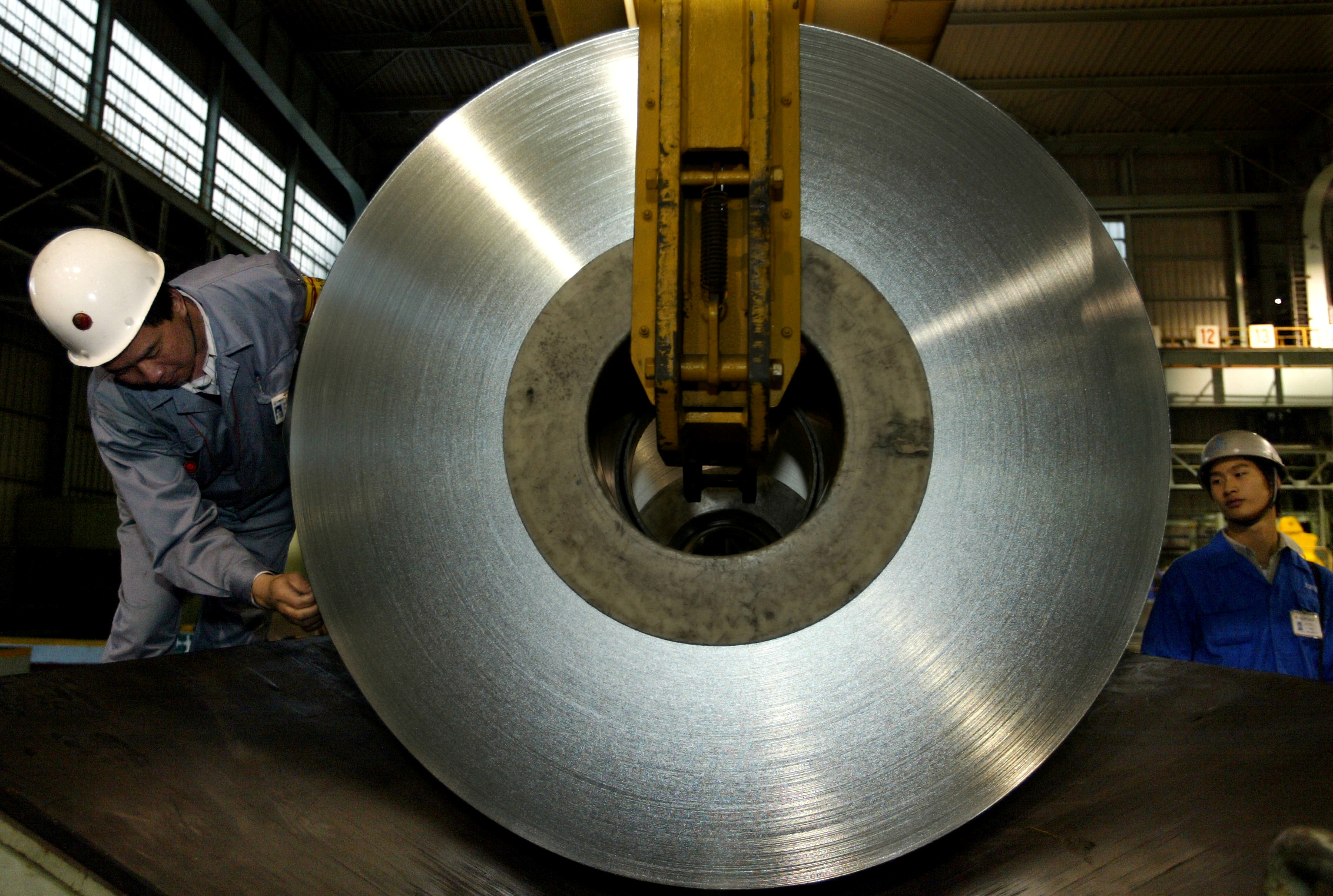 Chinese workers unload a roll of tin plate at a plant on the outskirts of Shanghai November 20, 2003. REUTERS/Claro Cortes/File Photo Register now for FREE unlimited access to reuters.comRegister
LONDON, Nov 8 (Reuters) - Tin remains the superstar of the London Metal Exchange (LME) industrial metals pack. At $37,350 a tonne LME three-month tin is up 77% since the start of the year, far outstripping aluminium, which is the second-strongest performer with a gain of " only" 26%. The London tin market has been characterised by extreme supply tightness since February. The premium for cash metal closed last week at $1,050 a tonne, a level that was unprecedented until this year. LME stocks total only 720 tonnes, having failed to rebuild despite the huge incentive for physical delivery. Shanghai Futures Exchange inventory is down to 1,256 tonnes and between them the two terminal markets hold enough tin to cover a minimal two days of global demand. There have been a couple of flash crashes in recent months and there could be more. But even if blown 20% off course by a tsunami of selling, tin would still be priced close to pre-2021 historical highs. If a supercycle means a permanent shift higher in pricing, then tin ticks the right boxes. 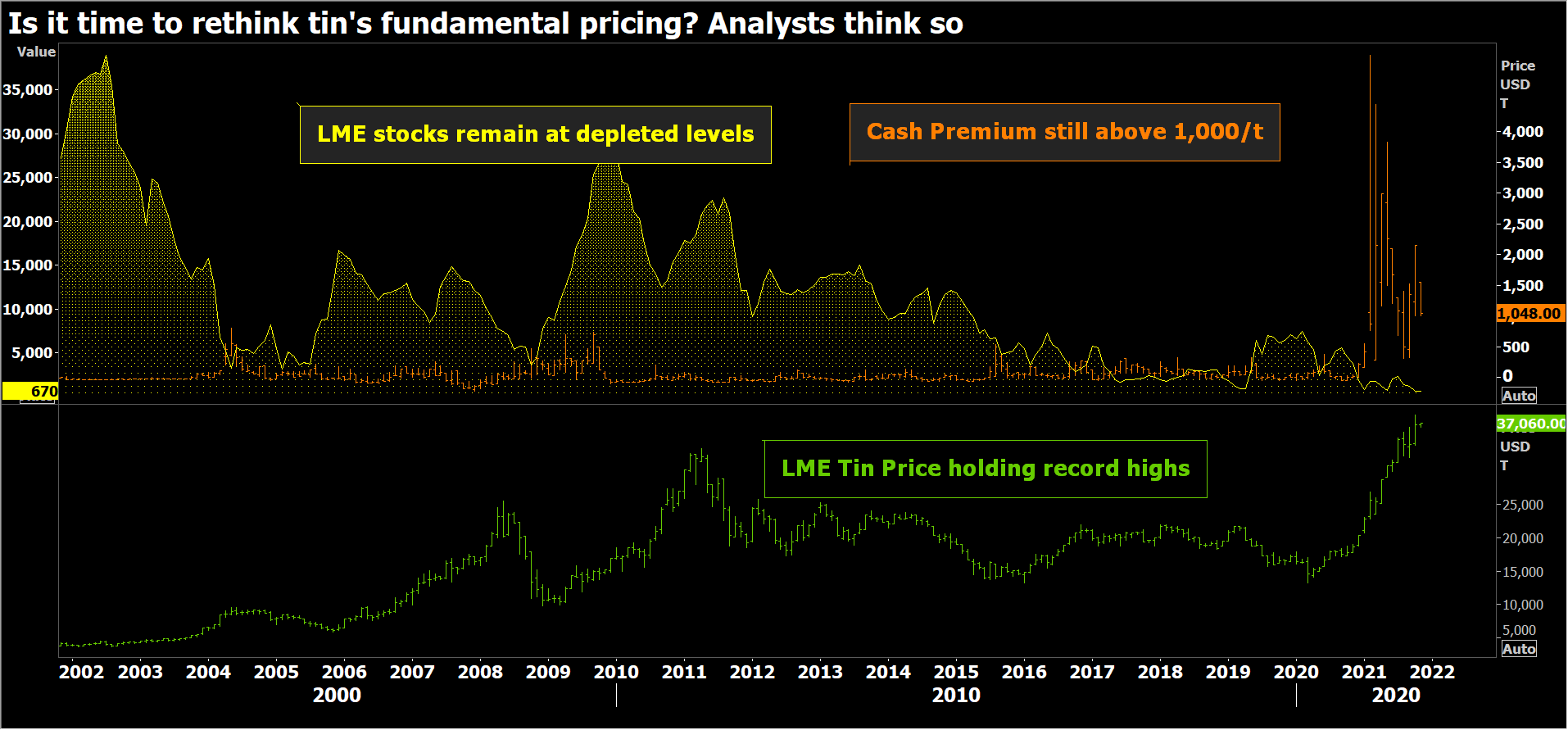 REPRICING TIN LME tin is expected to average $30,580 a tonne next year, according to the 16 analysts who participated in the most recent Reuters base metals poll . The lowest forecast was $25,250, significantly above the most bullish forecast of $22,000 made in the January poll, which generated a mean expectation for prices to average $19,800 a tonne in 2022. It' s clear there has been a fundamental rethink about tin' s long-term pricing environment. Fitch Solutions is just one of many to make upward revisions to price expectations. It has just lifted its 2022 forecast from $26,000 to $32,500 a tonne. Fitch analysts expect " the tin market' s fundamentals to ease slightly going into 2022, driven by supply increases" but " to remain on a firm uptrend in the coming decade" with an average price of $35,500 by 2030. SUPPLY INCENTIVE The common theme behind these elevated forecasts is that tin needs a period of sustained higher pricing to provide the incentive to boost supply. The global supply chain, which is dominated by a handful of producers, has been profoundly shaken by COVID-19 and some sort of normalisation is expected over the coming months. Malaysia' s MSC is hoping to restore capacity after a series of furnace failures and lockdown measures while China' s producers appear to have largely escaped the country' s latest energy crunch. Chinese tin production rose by 2.8% month on month in October and cumulative output was up by 15.1% over the first 10 months of the year. China has flipped to being a net exporter of refined tin this year to the tune of 9,800 tonnes. Shipments of 1,107 tonnes in September included 291 tonnes to the Netherlands, 225 tonnes to Italy and 40 tonnes to Romania, attesting to the gaps that have opened up in the European physical supply chain. However, Chinese producers have become increasingly reliant for raw material on neighbouring Myanmar, which has emerged as the world' s third-largest supplier over the past decade. Tin has a long history of big geological finds by artisanal miners and Myanmar is the most recent example, albeit one that is already showing signs of grade depletion. Investment in the official mining sector, by contrast, has remained extremely patchy, with tin falling below the radar of both investors and larger mining companies. If that is to change, the price will have to move into a higher range and stay there for a couple of years to attract serious investment in new production capacity. DEMAND REBOOT The reason the tin market needs more supply is because its usage profile has changed in the past 10 years, positioning it to benefit from the energy transition and a fourth industrial revolution. Although commonly associated with the tin can, packaging accounted for only about 12% of global refined tin usage last year, according to the International Tin Association (ITA). The biggest share of last year' s demand - 48% - came from the electronics sector, where tin is used to solder circuit boards. And booming demand for electronic goods is expected to drive a 7.2% surge in global tin usage this year, the ITA' s annual survey of tin users showed. Consumers will try to reduce tin usage, but miniaturisation of tin solders has been a running sectoral theme for the past decade and one that is reaching its technical limits. Indeed, tin should benefit from the final stages of the phase-out of lead in soldering over the next couple of years. The energy transition and the so-called internet of things just ticks more boxes for tin use whether it be in electric vehicles, photovoltaic cells or 5G infrastructure. SUPERCYCLE METAL Tin has been described as the forgotten foot-soldier of the green energy transition. It' s the metal that slips between the cracks and still doesn' t attract nearly as much media coverage as lithium, nickel and copper. But it is showing every sign of being the first to experience a pricing supercycle. Demand has changed structurally from the days when most tin went into cans of long-life foods. The metal is literally hard-wired into all things electronic, opening up an ever broader spectrum of next-generation usage. Supply, by contrast, has been challenged to the point that the ITA estimates that the global refined tin market registered supply deficits in four out of the five years before 2020. The official mining sector has suffered from decades of underinvestment and it is arguable that tin has avoided a supply crunch before now thanks only to artisanal finds. Relying on chance discoveries by the informal sector is not a sustainable supply solution in any sense of the word. The newly minted consensus among analysts is that tin pricing has to go super-cyclical to balance the market over the coming years. |
||
| Useful To Me Not Useful To Me | |||
|
WBdisciple
Elite |
25-Nov-2021 09:04
|
||
|
x 0
x 0 Alert Admin |
Tin prices has been on the rise...Beng Kuang' s New CEO putting his business strategy into action...
Soldering on: Tin price surges past $40,000 after Jakarta jolt
MINING.COM Staff Writer | November 24, 2021 | 10:44 am Intelligence Markets Asia Tin
Indonesia may stop tin exports in 2024 as part of its ambitions to attract investment into downstream processing and manufacturing in the Asian nation, President Joko Widodo said on Wednesday.
The news sent the metal, extensively used in the electronics sector, to a fresh record high with three-month contracts topping $40,000 a tonne for the first time ever. Prompt delivery of tin has traded at unprecedented premiums of more than $1,000 a tonne this year, indicating severe supply shortages in the cash market.
Reuters reports that at a gathering of Indonesia&rsquo s central bank stakeholders, Jokowi, as the president is popularly known, used the example of nickel as a success story to position the country as a hub in the booming electric car manufacturing industry:
&ldquo We have started with nickel. Maybe next year, we are calculating, we may stop exports of bauxite. The next year we may be able to stop copper, and the next year tin.
&ldquo We want these resources to be exported as semi-finished goods or as finished goods, because what we want is the added value.&rdquo
The nickel ban is currently before the World Trade Organization after the EU complained, and though tantalizing for markets, Indonesia&rsquo s strategy as the world&rsquo s number two producer around tin exports is not clear. Jakarta has since 2018 banned unprocessed tin exports requiring the metal to be sold in its refined form with at least 95% content.
Soldering on
Pressure on tin markets has been building since the start of the pandemic, and the price has more than doubled since this time last year.
In its latest industry report, market analyst Fitch Solutions said the rate of global tin supply has recovered from the covid-19 pandemic and has been significantly outpaced by the rapid recovery in demand. Tin is used in electronics through solders in semiconductors, a sector that saw a massive spike in demand during the pandemic due to the increased sales of medical as well as home equipment and personal devices.
The resulting reduction of global refined tin stockpiles has continued to force prices higher in the year-to-date, and left the market significantly exposed to price increases during China&rsquo s power crunch, Fitch says. With tin solder being a major part of photovoltaic cells that are the main components that make up a solar panel, demand during China&rsquo s power crunch sky-rocketed.
|
||
| Useful To Me Not Useful To Me | |||
|
tedlim
Veteran |
25-Nov-2021 09:02
|
||
|
x 0
x 0 Alert Admin |
Beng Kuang Group Unveils Specialised Dredging Equipment for Offshore Tin Mining Activities
> Designed and developed by its in-house team, the specialised dredging equipment has been tested for operational efficiency at various offshore tin mining sites within Indonesia
> Strengthening the value propositions and service offerings under the Group&rsquo s Infrastructure Engineering division as an innovative solutions provider for offshore tin mining activities
> With dwindling surface deposits and more tin ore under the seafloor in Indonesia, tin mining activities have been moving to offshore sites in recent years
> Opportunities to create new revenue streams from the sales and installation of the proprietary specialised dredging equipment and/or providing offshore dredging services for tin concession holders in Indonesia and Malaysia
Beng Kuang Marine Limited (&ldquo 明 光 集 团 &rdquo or the &ldquo Company&rdquo , and together with its subsidiaries, the &ldquo Beng Kuang Group&rdquo ), is pleased to share that its in-house team has designed and developed specialised dredging equipment for offshore tin mining activities.
Notably, the pilot phase of the Group&rsquo s specialised dredging equipment was undertaken in collaboration with a leading tin smelter based in Indonesia.
Installed on barges, the specialised dredging equipment has been tested for operational efficiency in various offshore tin mining sites in Indonesia with the following highlights:
- Deep-water extraction of up to 60 metres
- Capable of drilling and extraction of 8 &ndash 10 holes daily
- Extraction rate of 100 kg to 150 kg per hole
Tin&rsquo s high conductivity, low melting point, high specific gravity, low toxicity, and relative abundance makes it an essential component of modern electronics. In the early 2000s, electronics manufacturers and suppliers transitioned away from leaded to lead-free solders, with higher tin concentrations. As lead-free solders came to dominate the market, the demand for tin production surged(1).
At 80,000 tons annually, Indonesia is the second largest tin producer in the world, just barely behind China&rsquo s 85,000 tons. Tin mined in Indonesia and throughout the world is predominantly used in solders, both for electronics as well as for plumbing and other structural solders(1).
Since 2020, the price of tin has been on a strong uptrend, due to severe supply tightness resulting from COVID-19 lockdowns, especially in Malaysia and Indonesia, major tin producers accounting for a combined 30% of global refined tin production in 2020, Fitch notes, that has yet to match up wit demand despite easing slowly. Fitch expects tin demand to continue outstripping supply, pushing the market into deficit by 2026.
With its specialised dredging equipment, Beng Kuang Group aims to develop new value propositions for offshore tin mining activities and create new revenue streams.
Mr Yong Jiunn Run, Chief Executive Officer of Beng Kuang Group, said: &ldquo There are strong key drivers in the demand for tin globally and while there are significant tin ore deposits within Indonesia&rsquo s offshore regions, there are various operational challenges in such offshore tin mining activities.
Utilising our technical expertise from multiple business areas, we are excited to showcase how our specialised dredging equipment, technology and services can enable tin concession owners in Asia to gain greater access to these offshore tin ore deposits and create more efficiency in these operations.&rdquo
|
||
| Useful To Me Not Useful To Me | |||
|
WBdisciple
Elite |
18-Nov-2021 09:41
|
||
|
x 0
x 0 Alert Admin |
Their results have improved strongly.....mkt cap of only S$15.5m... All business units registered growth except for SH business segment in 9M2021: The Group&rsquo s IE and CP business segments delivered better performance with higher business volume in 9M2021, where IE&rsquo s revenue jumped by 106.4% or S$11.66 million from S$10.96 million in 9M2020 to S$22.62 million in 9M2021 and CP&rsquo s revenue increased by 84.9% or S$6.14 million from S$7.23 million in 9M2020 to S$13.37 million in 9M2021. For IE, the Group&rsquo s 51%-owned subsidiary, Asian Sealand Offshore and Marine Pte Ltd (&ldquo ASOM&rdquo ), was the main revenue contributor with S$16.91 million or 74.8% of IE&rsquo s 9M2021 sales as a result of the re- opening of global business travel from the fourth quarter of 2020 that enabled ASOM to ramp up its business operations. Specialising in asset integrity solutions, ASOM provides a wide range of on-site services such as repairs, engineering services, maintenances, decommissioning, among others. ASOM&rsquo s key customers are mainly operators and asset owners of Floating Production Storage and Offloading (&ldquo FPSO&rdquo ) vessels and Floating Storage and Offloading (&ldquo FSO&rdquo ) vessels. Revenue contribution from ASOM has been growing progressively over the past few years and as at 30 September 2021, ASOM has an order book of S$3.0 million. In addition, the Group&rsquo s other subsidiaries under IE have performed better for 9M2021 as compared to 9M2020 where there has been a recent uptrend in outsourcing manpower-intensive projects by established shipyard customers in Singapore to neighbouring countries to reduce the dependency on foreign workers. The Group owns and operate a waterfront fabrication yard in Batam, Indonesia with a land size of 32 hectares. In total, the IE business segment (including ASOM) has an order book of S$8.0 million as at 30 September 2021. Revenue from the Group&rsquo s CP increased by 84.9% or S$6.14 million from S$7.23 million in 9M2020 to S$13.37 million in 9M2021 with the gradual return of the Group&rsquo s foreign labour workforce to operations. The Group&rsquo s CP also recorded higher business volume in Batam. However, there are still border controls and hefty costs related to COVID-19 that were associated with new workforce employment. Revenue from the Group&rsquo s SD increased to S$3.10 million in 9M2021 from S$2.86 million in 9M2020. The Group&rsquo s SD continue to undertake a key role within the Group&rsquo s business model as our internal procurement arm to support the rest of our business units to manage the operating costs of consumables. Revenue from the Group&rsquo s SH declined substantially by S$7.57 million to S$2.13 million in 9M2021, from S$9.70 million in 9M2020 as both of the Group&rsquo s livestock vessels were taken off charter. The first livestock vessels was taken off charter since October 2020 due to an accident and it is currently docked on our Batam waterfront yard for repairs. Due to COVID-19 travel restrictions and border control measures, there were delays in coordinating onsite insurance and Class inspections. Thesecond livestock vessel was taken off charter as it was detained on 7 October 2021 by the Indonesia Navy for anchoring at unauthorised area. With the release of vessel from detention on 15 November 2021, the Group is also exploring initiatives to align the SH&rsquo s activities towards the bareboat charter business model to enhance stability in revenue streams and limiting operational risks. Gross profit increased 241% to S$5.02 million in 9M2021: The Group&rsquo s gross profit margin increased by approximately 7.4 percentage points from 4.78% in 9M2020 to 12.18% in 9M2021 largely attributed to ASOM&rsquo s increased business volume from on-site repair and maintenance services for active offshore FPSO and FSO vessels as well as CP&rsquo s higher business activities. Adjusted EBITDA increased 546% to S$2.51 million in 9M2021: With a substantial amount of fixed assets in the balance sheet, the Group registered a depreciation expense (non-cash component) of S$6.18 million in 9M2021. Hence, after adjusting for depreciation expense, grants and other income, the Group recorded an adjusted EBITDA of S$2.64 million in 9M2021. The Group generated net cash inflow of S$1.89 million from operating activities during 9M2021. To accelerate its growth plans and strengthen its balance sheet, the Company had conducted the share placement exercise of 27,000,000 placement shares and raised S$1.35 million in gross proceeds, which was completed on 21 July 2021. Further on 18 October 2021, the Company had announced that it is raising gross proceeds of approximately S$3.35 million from another share placement exercise. Both share placement exercises were undertaken by SAC Capital Private Limited. |
||
| Useful To Me Not Useful To Me | |||
|
Joelton
Supreme |
18-Nov-2021 09:08
|
||
|
x 0
x 0 Alert Admin |
Beng Kuang Group&rsquo s Revenue Jumped 34% to S$41.22 Million with Gross Profit Rising 241% to S$5.02 Million and Adjusted EBITDA Surging 546% to S$2.51 Million in 9M2021
> The Group&rsquo s IE and CP business segments registered strong revenue growth of 106.4% and 84.9%, increasing to S$22.62 million and S$13.37 million respectively in 9M2021, while revenue from the Group&rsquo s SH business segment dipped significantly as both of the Group&rsquo s livestock vessels were taken off charter during 9M2021
> With a substantial amount of fixed assets in the balance sheet, the Group registered a depreciation expense (non-cash component) of S$6.18 million in 9M2021
> The Group&rsquo s IE order book is S$8.0 million as at 30 September 2021, of which S$3.0 million is attributed to ASOM that provides specialised on-site vessel repair and maintenance solutions to FPSO and FSO vessels
> Strategic review to prioritise costs minimisation and deleveraging initiatives, while focusing on monetising fixed assets and high-potential business segments to create new growth catalysts
> The livestock carrier previously detained by the Indonesian Navy for anchoring in unauthorised area has been released from detention on 15 November 2021.
Adjusted EBITDA increased 546% to S$2.51 million in 9M2021: With a substantial amount of fixed assets in the balance sheet, the Group registered a depreciation expense (non-cash component) of S$6.18 million in 9M2021. Hence, after adjusting for depreciation expense, grants and other income, the Group recorded an adjusted EBITDA of S$2.64 million in 9M2021. The Group generated net cash inflow of S$1.89 million from operating activities during 9M2021.
To accelerate its growth plans and strengthen its balance sheet, the Company had conducted the share placement exercise of 27,000,000 placement shares and raised S$1.35 million in gross proceeds, which was completed on 21 July 2021. Further on 18 October 2021, the Company had announced that it is raising gross proceeds of approximately S$3.35 million from another share placement exercise. Both share placement exercises were undertaken by SAC Capital Private Limited.
Mr Yong Jiunn Run, Chief Executive Officer of Beng Kuang Group, said: &ldquo Our performance so far demonstrates that we are moving in the right direction, however there are still uncertainties in our livestock carrier business activities and we are taking proactive measures to mitigate the situation.
As we maintain our disciplined and proactive approach to cost minimisation and deleveraging initiatives, we will continue to focus on investing in accretive growth projects and opportunities to improve profitability and create long-term sustainable returns for stakeholders.&rdquo
|
||
| Useful To Me Not Useful To Me | |||
|
spursfan
Supreme |
17-Nov-2021 19:10
|
||
|
x 0
x 0 Alert Admin |
PRESS RELEASE - Beng Kuang Group?s Revenue Jumped 34% to S$41.22 Million with Gross Profit Rising 241% to S$5.02 Million and Adjusted EBITDA Surging 546% to S$2.51 Million in 9M2021.. https://links.sgx.com/1.0.0/corporate-announcements/SDYX2FUMN7DBOCZ7/691197_PressRelease.pdf | ||
| Useful To Me Not Useful To Me | |||