


| Latest Forum Topics / Others |
 Post Reply Post Reply
|
|
EZRA HOLDINGS - RED HOT NEWS
|
|||
|
handongni
Elite |
14-Apr-2014 13:48
|
||
|
x 0
x 0 Alert Admin |
lai lai thumb me down this is 1st. |
||
| Useful To Me Not Useful To Me | |||
|
WanSiTong
Supreme |
14-Apr-2014 13:01

|
||
|
x 1
x 2 Alert Admin |
Singapore says economy slowed sharply in January-March: AFP Singapore' s economic growth slowed sharply in the first three months of the year, data showed Monday, but the central bank stood pat on monetary policy saying it would be lifted by a pick-up in global growth. Preliminary estimates showed the city-state' s trade-reliant economy expanded a seasonally adjusted 0.1 percent quarter on quarter, the trade ministry said. That compared with 6.1 percent expansion in... October-December. The ministry said growth was hit by a 1.8 percent quarter-on-quarter contraction in the services industry. The advance GDP estimates are based on two months of data, but is given out as a preview to the trade-sensitive economy' s performance during the quarter. On a year-on-year basis, GDP is estimated to have expanded 5.1 percent in the first quarter, slower than the 5.5 percent rise in the final three months of 2013. The city' s central bank, the Monetary Authority of Singapore (MAS), forecast growth of 2.0-4.0 percent for 2014, against from 4.1 percent last year. Manufacturing rose 4.5 percent from the preceding quarter and 8.0 percent year-on-year due to a strong rebound in the output from the biomedical and chemical segments, the trade ministry said. Construction remained strong, expanding 10.7 percent from the previous quarter as the government ramped up infrastructure projects. The sector was up 6.5 percent from the previous year. Despite the first quarter slowdown, the MAS said it would maintain its policy of allowing for a " modest and gradual appreciation" of the local dollar as the global economy improves. Singapore uses the exchange rate rather than interest rates to contain inflation as the city-state imports almost all of its needs. The MAS said in a separate statement there would be no change to the slope of an undisclosed band at which the dollar is allowed to move and to the level at which the currency is centered. " The policy stance is assessed to be appropriate for containing domestic and imported sources of inflation, and ensuring medium-term price stability as a basis for sustainable growth," the MAS said. " The outlook for the global economy has brightened," it added, pointing to improving prospects in the United States, European Union and Japan. " Notwithstanding the weak growth outturn in the first quarter, the level of economic activity should stay in a broad upward trajectory for the rest of the year." The central bank forecast this year' s overall inflation rate at 1.5-2.5 percent. |
||
| Useful To Me Not Useful To Me | |||
|
|
|||
|
WanSiTong
Supreme |
14-Apr-2014 12:41
|
||
|
x 1
x 1 Alert Admin |
Published April 14, 2014 China Q1 growth slows to 7.3%: AFP survey
 " We will not resort to short-term stimulus policies just because of temporary economic fluctuations and we will pay more attention to sound development in the medium- and long-run," Premier Lisaid in a speech, state media reported - PHOTO: REUTERS [BEIJING] China' s economic expansion slowed in the first three months of this year, according to an AFP survey, and remains on track for its worst annual performance in nearly a quarter-century as reform priorities trump growth concerns.
Gross domestic product (GDP) in the January-March period expanded 7.3 per cent from the same period last year, the median forecast in AFP' s survey of 13 economists said. The National Bureau of Statistics is scheduled to release GDP data for the first quarter on Wednesday. The result would mark the fourth slowdown in the past six quarters. It comes as the government signals a willingness to accept weaker growth, as the country' s economic model pivots away from decades of double-digit expansion fuelled by big-ticket investment projects. |
||
| Useful To Me Not Useful To Me | |||
|
WanSiTong
Supreme |
14-Apr-2014 11:13
|
||
|
x 1
x 2 Alert Admin |
Published April 14, 2014
Nikkei slips to new 6-month low on Wall St slide, Ukraine jitters
 [TOKYO] Tokyo stocks slipped to a fresh six-month low on Monday as market sentiment stayed fragile after a rocky session on Wall Street and on escalating tensions in Ukraine. Bargain hunting in large caps like Toyota Motor Corp offered some support and helped the benchmark Nikkei trim earlier losses. The Nikkei average was down 0.1 percent at 13,944.43 at the midday break after falling as low as 13,885.22, its lowest level since Oct. 9. It is down 15 percent so far this year. The index shed 7.3 percent last week, its biggest weekly fall since the week after the March 2011 earthquake and tsunami. |
||
| Useful To Me Not Useful To Me | |||
|
WanSiTong
Supreme |
14-Apr-2014 10:08
|
||
|
x 1
x 1 Alert Admin |
Published April 14, 2014
Q1 GDP growth led by manufacturing sector: MTI
By Kelly Tay
 The construction sector performed better as well, thanks to stronger expansion in public sector construction activities - PHOTO: SPH Singapore' s manufacturing sector grew year-on-year at a faster pace of 8 per cent in Q1, compared to 7 per cent in the previous quarter. The strong expansion - due to higher biomedical manufacturing and chemicals output - helped to boost overall GDP growth to 5.1 per cent year-on-year in Q1.
The construction sector performed better as well, thanks to stronger expansion in public sector construction activities. The sector grew 6.5 per cent year-on-year, an improvement from the 4.8 per cent growth recorded in Q4. Growth in the services sector, however, moderated to 4.7 per cent on a year-on-year basis, lower than the 5.9 per cent growth in the previous quarter. The slow-down was due to slower expansion in the wholesale & retail trade and finance & insurance sectors. On a quarter-on-quarter basis, the manufacturing sector grew at an annualised rate of 4.5 per cent in Q1, compared to 10.4 per cent in Q4 the construction sector expanded 10.7 per cent, following the 1.4 per cent growth in the preceding quarter. |
||
| Useful To Me Not Useful To Me | |||
|
|
|||
|
WanSiTong
Supreme |
14-Apr-2014 08:46
|
||
|
x 0
x 1 Alert Admin |
Most Asian Stocks Drop as Raw-Materials Shares RetreatBy Adam Haigh Apr 14, 2014 8:24 AM GMT+0800
Most stocks on Asia&rsquo s benchmark regional equities index fell, led by declines in industrial and raw-material companies. The MSCI Asia Pacific Index was little changed at 137.84 as of 9:22 a.m. in Tokyo, before markets open in Hong Kong and China, after last week declining 1 percent. About three stocks fell for every two that rose on the gauge. Futures on the Standard & Poor&rsquo s 500 Index slipped 0.1 percent, indicating the U.S. equities benchmark index will extend last week&rsquo s biggest slide since June 2012 in which the gauge erased its gains for the year. &ldquo Our view remains that a 10 to 15 percent correction in shares is to be expected at some point along the way this year,&rdquo said Shane Oliver, who helps oversee about $130 billion as Sydney-based head of investment strategy at AMP Capital Investors Ltd. &ldquo But it would be just a correction in a still rising trend. Any such dip should be seen as a buying opportunity.&rdquo Japan&rsquo s Topix index was little changed as the yen strengthened 0.2 percent to 101.47 per dollar, extending its first weekly gain in four weeks. The Topix fell 13 percent this year though last week, the biggest decline among 24 developed markets tracked by Bloomberg. Australia&rsquo s S& P/ASX 200 Index retreated 0.4 percent today and New Zealand&rsquo s NZX 50 Index fell 0.6 percent. South Korea&rsquo s Kospi index lost 0.1 percent. Futures on Hong Kong&rsquo s Hang Seng Index (HSI) and the Hang Seng China Enterprises Index of mainland shares listed in the city were little changed in the most recent trading sessions. U.S. RoutCitigroup Inc. (C) is due to report earnings today after JPMorgan Chase & Co. declined 7.5 percent in the week through April 11, the most since May 2012, as profit declined. The Nasdaq Composite Index last week capped its worst week since 2012 amid concern valuations have climbed too high as earnings season starts. The MSCI Asia Pacific Index last week traded at 12 times estimated earnings, compared with 15.5 for the S& P 500 and 14.4 for the Stoxx Europe 600 Index, according to data compiled by Bloomberg. Russia sought an emergency meeting of the United Nations Security Council after Ukrainian security forces clashed with pro-Russian gunmen in the eastern town of Slovyansk in the latest escalation in the crisis. The Security Council session was scheduled as U.S. and Ukrainian officials accused Russia of being behind the violence. |
||
| Useful To Me Not Useful To Me | |||
|
handongni
Elite |
14-Apr-2014 08:29
|
||
|
x 0
x 0 Alert Admin |
哼 。 
|
||
| Useful To Me Not Useful To Me | |||
|
handongni
Elite |
13-Apr-2014 23:07
|
||
|
x 1
x 1 Alert Admin |
post 6 message take you 6 minute and can keep that fellow busy for 60 minutes. did that once, quite fun but a bit wu liao. 嘻 嘻 。
|
||
| Useful To Me Not Useful To Me | |||
|
|
|||
|
warrenbegger
Elite |
13-Apr-2014 13:37

Yells: "Anyhow Buy Anyhow Die ^_^" |
||
|
x 1
x 1 Alert Admin |
U still ok la, i even more jia lat than u.. I everytime for nothing kanna thumb down by those siao lang.. To me, the more siao lang thumb me down, the more happy i am. That means they love me. Just like Election, they put a X beside means they like and vote u.. 
|
||
| Useful To Me Not Useful To Me | |||
|
lim12888
Member |
13-Apr-2014 11:38
|
||
|
x 2
x 3 Alert Admin |
sorry hor! limpeh see until Tak Boleh Tahan and log in. My message may not be conveyed to the Bro who thumb those postings down. Since I am free now I did the counting. Altogether 20 thumb down here. 1 thumb down take 10 minutes, total 200 mins! Walau Eh, You are so free got nothing good to do? Got news also want to thumb down people?? Don' t hide in the dark to do these sort of things, you know or not,unreasonably thumb down people will bring you bad luck! If you want good luck, just follow limpeh do the good deed and you will sure huat!! Huat Arrr! |
||
| Useful To Me Not Useful To Me | |||
|
teeth53
Supreme |
13-Apr-2014 11:13
Yells: "don't learn through life, learn to grow with life " |
||
|
x 0
x 0 Alert Admin |
 View Photo International Monetary Fund (IMF) View Photo International Monetary Fund (IMF)
Saturday (AP) &mdash The world' s top finance officials expressed confidence that global economy finally has turned the corner to stronger growth. This time, they may be right. Despite challenges that market jitters about. Federal Reserve' s bond-buying slowdown and global tensions over Ukraine, policymakers said, there' s a foundation for sustained growth that can provide jobs for millions of people still looking for work five years after the worst recession since the Great Depression of the 1930s. " Creating a more dynamic, sustainable, balanced and job-rich global economy remains our paramount collective goal," the policy-setting panel of the 188-nation International Monetary Fund said in a concluding communique. IMF Managing Director Christine Lagarde and the finance ministers who sit on the IMF' s policy panel said they believed a new phase with stronger growth that will begin to make in-roads into unemployment that remains painfully high in many nations. At a closing news conference, Lagarde referred to the years 2008 through 2010 as an economic " disaster" and she said now " we are moving into a strengthening phase." |
||
| Useful To Me Not Useful To Me | |||
|
Octavia
Supreme |
12-Apr-2014 17:28

|
||
|
x 0
x 0 Alert Admin |
5 Things To Ponder: Is This " THE" Correction? The current levels of investor complacency are more usually associated with late stage bull markets rather than the beginning of new ones. Of course, if you think about it, this only makes sense if you refer back to the investor psychology chart above. The point here is simple. The combined levels of bullish optimism, lack of concern about a possible market correction (don' t worry the Fed has the markets back), and rising levels of leverage in markets provide the " ingredients" for a more severe market correction. However, it is important to understand that these ingredients by themselves are inert. It is because they are inert that they are quickly dismissed under the guise that' this time is different.' Like a thermite reaction, when these relatively inert ingredients are ignited by a catalyst they will burn extremely hot. Unfortunately, there is no way to know exactly what that catalyst will be or when it will occur. The problem for individuals is that they are trapped by the combustion an unable to extract themselves in time." Of course, what I didn' t realize at the time was that, on Thursday, the markets would plunge like a stone sending investors running for cover and the media scrambling for answers. What caused it? Is this THE correction? What happens now? This weekend' s edition of " things to ponder" is a collection of thoughts as to whether the current correction is just a buying opportunity, or whether this is Redd Foxx' s " It' s The Big One."
1) 5 Reasons Why The Sell-Off Spells Caution by Adam Shell via USA Today " The biggest downward driver today is the formerly high-flying biotech sector. The iShares Nasdaq Biotechnology ETF is down a whopping 5.5%. Other so-called momentum stocks, such as social-media darling Facebook (down nearly 5% today), video-streaming play Netflix (off 4.3%) and electric car maker Tesla (down 4.5%). Why the sell-off, and why now? Some theories: The stocks got too overheated the stocks were over-loved the stocks got too pricey and had to come crashing down to earth." 2) Don' t Let These Stock Market Gyrations Scare You by Howard Gold via WSJ MarketWatch " But the main causes of a genuine bear market &mdash impending recession or deflation, ultra-high stock price-to-earnings ratios or rapidly rising interest rates &mdash are not on the horizon. So unless you&rsquo ve borrowed to the hilt to buy Twitter or the biotech ETF, you should stay invested and not lose a minute&rsquo s sleep. As far as market shocks go, this looks like a mild tremor, not the big earthquake everybody fears. "
" I' m even talking somewhat against myself but we have a lot of hedges on. as I told you, shorts. I do believe that this market -- you know, everybody loves this market. You go talk to your barber shop and everybody is buying this, buying that and talking about it. That' s the time to be cautious." That' s not the only reason to be cautious. I think that a lot of the earnings are sort of artificial because, you know, the Fed did a great job in saving this country. But right now with these low interest rates it' s easy to make earnings and I don' t think that can continue forever...I' ve said that before and i continue to say it, I think that there will be a major correction, but i don' t know when. It could be three years. It could be three days." Bonus: Revisiting Price Compression by Cullen Roche via PragCap &ldquo Price compression is when market participants price in many years worth of future performance into the current price. They are, in effect, buying today with the expectation that future earnings will justify current prices. When you combine this concept with an understanding of behavioral finance and the understanding that market expectations can become irrational, you can build some understanding behind the concept of market bubbles. As I&rsquo ve described before, A bubble is an environment in which the market price of an asset has deviated from the underlying asset&rsquo s fundamentals to an extent that renders the current market price unstable relative to the underlying asset&rsquo s ability to deliver the expected result.&rdquo Have a great weekend.
|
||
| Useful To Me Not Useful To Me | |||
|
|
|||
|
teeth53
Supreme |
12-Apr-2014 17:28
Yells: "don't learn through life, learn to grow with life " |
||
|
x 0
x 0 Alert Admin |
http://www.theedgesingapore.com/blog-heads/the-edge/47945-weekend-comment-apr-11-spate-of-maas-to-continue-says-cimb.html Weekend Comment Apr 11: Spate of M& As to continue, says CIMB. &ldquo We certainly think there is still meat to this theme,&rdquo " NEW ECONOMY&rdquo stocks like the high-tech Internet startups tend to be sexier and more sought-after most of the times, but in their current downtrodden status, " Old Economy&rdquo stocks, like those in property and transport, might be the ones actually stealing the limelight.
&ldquo Asia certainly does not lack cheap old economy names,&rdquo writes CIMB&rsquo s Kenneth Ng, who heads a team of analyst there, in an April 9 strategy report Back to old economy names. Common attributes of such oldies but goldies are those with hard assets, trading at deep discounts to their assets and existing shareholders or interested parties with deep pockets.
|
||
| Useful To Me Not Useful To Me | |||
|
Octavia
Supreme |
12-Apr-2014 16:15
|
||
|
x 0
x 0 Alert Admin |
As Internet shares break down, investors see value in old tech [NEW YORK] The last six weeks have been terrible for many technology shares, but not for the four horsemen that sat atop the last tech boom. Intel, Oracle, Microsoft and Cisco, known as the four horsemen during the late 1990s technology boom due to their strong performance and leading market share, have all rallied since the beginning of March even as stocks of many other tech companies have been crushed. These legacy names have emerged as an alternative for those who want exposure to the tech sector but are spooked by the slump in high-growth stocks like Netflix. These older names have recently attracted more attention because their growth outpaces the broader market but they don' t have the high valuations of the recent momentum favorites. " They have high cash levels, nice profit margins, and when the economy returns, their cyclicality will be a positive," said Robert Stimpson, portfolio manager at Oak Associates Ltd in Akron, Ohio. " That they' re trading at a discount makes them something of a defensive play," he added. " I' d rather own them than something like utilities, which pay a dividend but offer little or no growth." |
||
| Useful To Me Not Useful To Me | |||
|
remister889
Member |
12-Apr-2014 15:25
|
||
|
x 0
x 0 Alert Admin |
Quite possible.Wont soar but steady lah cos EM PE ratio is much lower than DOw and European market.
|
||
| Useful To Me Not Useful To Me | |||
|
junction
Master |
12-Apr-2014 15:16
|
||
|
x 0
x 0 Alert Admin |
Yes the market is hoping Chinas bad news can turn into good news.
|
||
| Useful To Me Not Useful To Me | |||
|
teeth53
Supreme |
12-Apr-2014 14:57
Yells: "don't learn through life, learn to grow with life " |
||
|
x 0
x 0 Alert Admin |
Two opposite spectrum on size...Lots of penny activity as STI moves to Jardine' s tune. At one end of the size spectrum, we had the Jardine group in focus this week as Jardine Matheson, Jardine Strategic, Jardine Cycle & Carriage and Hongkong Land were chiefly responsible for volatility in the Straits Times Index. At the other end, penny stocks Albedo, Blumont, JK Tech, AusGroup and JES International stood out because of various company-specific developments, though not all had a positive impact on share prices. The external backdrop throughout was Wednesday' s release of the minutes of the latest Federal Open Market Committee meeting (FOMC) which clarified the Fed' s stand towards interest rates as being more dovish than earlier thought, and China' s Thursday release of weak manufacturing numbers that perversely didn' t put pressure on stocks, probably because of hopes that the government will have to step in with fresh stimulus. |
||
| Useful To Me Not Useful To Me | |||
|
lim12888
Member |
12-Apr-2014 09:01
|
||
|
x 0
x 0 Alert Admin |
Soorry hor, Limpeh do not have so much time to thumb you up, but my 1 thumb up equal to 10000 thumb up!
|
||
| Useful To Me Not Useful To Me | |||
|
WanSiTong
Supreme |
12-Apr-2014 08:24
|
||
|
x 0
x 1 Alert Admin |
U.S. Stocks Fall on JPMorgan Miss Treasuries, Oil Rise By Callie Bost and Jeremy Herron Apr 12, 2014 4:31 AM GMT+0800
U.S. stocks fell, giving the Standard & Poor&rsquo s 500 Index its worst week since 2012, amid disappointing results at JPMorgan Chase & Co. and signs hedge funds were dumping the bull market&rsquo s top performers. Treasuries rose, while oil hit a five-week high. The S& P 500 sank 0.9 percent at 4 p.m. in New York. The Nasdaq Composite Index fell 1.3 percent to close below 4,000 for the first time in two months. The 10-year Treasury yield lost three basis points to 2.62 percent while 30-year yields hit a nine-month low. The dollar snapped five days of losses as investor risk appetite shrank amid a drop in global equities. The S& P 500 sank 2.6 percent this week on concern that valuations aren&rsquo t justified as earnings start. JPMorgan, the first major bank to report, fell the most since 2012, dropping 3.7 percent after profit sank on lower revenue from fixed-income trading and mortgages. Consumer confidence rose in April to the highest level since July. China&rsquo s producer price index declined 2.3 percent in March, adding to signs of weak demand after data yesterday showed shrinking trade. &ldquo You need to shake out some of the speculative money and throw water on the irrational exuberance,&rdquo Randy Frederick, managing director of trading and derivatives at Charles Schwab Corp. which manages $2.2 trillion in client assets, said in a phone interview. &ldquo It&rsquo s a good reminder that markets don&rsquo t go straight up. While the long-term is positive we need to have these steps back along the way. We need this kind of pullback.&rdquo Equities Pullback The S& P 500 is down 4 percent from a record close on April 2 and trades below its average price over the past 100 days. The Nasdaq, which has lost 8.2 percent from a March high, plunged 3.1 percent yesterday, the most since November 2011. The Nasdaq Biotechnology Index sank 2.6 percent today, bringing its loss from a February high to more than 20 percent, meeting the common definition of a bear market. The percentage of hedge-fund bets that stocks will rise has decreased to 46 percent, compared with 2014&rsquo s high of 58 percent, according to an April 9 research note from Credit Suisse Group AG. Net exposure in the U.S. declined to the lowest level since August 2012, the report said. &ldquo So far, exposure reductions have been measured and at least for the time being, there has been no mass rush for the exits,&rdquo Credit Suisse&rsquo s Jon Kinderlerer wrote. &ldquo Unsurprisingly, we have seen exposure being trimmed the most in information technology where the popular longs have underperformed significantly over the last few weeks.&rdquo Hedge-Fund HoldingsCompanies with high levels of hedge fund ownership have fallen about twice as much as the overall market. S& P 500 stocks that are most popular among the speculators have fallen 7.5 percent since April 2. Hedge funds make up at least 30 percent of the shareholders in Allegion Plc, Dollar General Corp. and Constellation Brands Inc., the most among companies in the equities benchmark. About 37 percent of Allegion shares are owned by hedge funds, top among S& P 500 companies. The maker of security systems is almost 9 percent lower since April 2. H& R Block Inc., the tax software provider, is down 11 percent and is about 27 percent owned by hedge funds. Pressure may be mounting on professional speculators with losses in individual stocks spurring more pain than they do for ordinary investors. The average hedge fund has 63 percent of its assets invested in the 10 largest holdings, twice as much as mutual funds, according to a Goldman Sachs Group Inc. note from Feb. 20. About 28 percent of their holdings changed in the fourth quarter, an all-time low, the note said. Earnings SeasonInvestors have been anticipating corporate earnings reports to gauge how much weather effected results. Profit for members of the S& P 500 probably fell 0.9 percent in the first quarter, analysts now forecast, after anticipating a 6.6 percent rise in January. Sales increased 2.6 percent, according to projections. Analysts have reduced earnings estimates more than they usually do over the last three months, according to Goldman Sachs Group Inc. strategists led by David Kostin. Average profit forecasts for S& P 500 companies fell about 4 percent in the first quarter, a percentage point more than normal, they wrote. The selloff that began last week was sparked by growing concern that valuations may be too high as earnings season begins. The Nasdaq Composite trades at 35 times reported earnings of the companies in the index. That&rsquo s double the ratio for the S& P 500, which trades at about 17 times earnings. Lackluster EarningsWells Fargo & Co. added 0.8 percent after the most profitable bank in 2013 said earnings rose 14 percent as fewer customers missed loan payments. Bed Bath & Beyond Inc. tumbled the most in three months yesterday after profit fell short of estimates. &ldquo The market&rsquo s looking for a pretty lackluster earnings season and anything better than that will be viewed positively,&rdquo said Julian Chillingworth, who oversees about 22 billion pounds ($36.8 billion) at Rathbone Brothers Plc in London. About 54 companies in the S& P 500 are scheduled to report results next week, including Coca-Cola Co., Goldman Sachs Group Inc., Google Inc. and General Electric Co. The Thomson Reuters/University of Michigan preliminary April index of sentiment rose more than forecast, boosted by further improvement in the labor market that will provide some traction for the economy after a weather-related slowdown. Volatility GaugeThe Chicago Board Options Exchange Volatility Index, the gauge of S& P 500 options prices known as the VIX, rose 8.3 percent after jumping 15 percent yesterday, the most since Feb. 3. The CBOE NDX Volatility Index of Nasdaq 100 contracts climbed 10 percent to the highest since December 2012, adding to a 16 percent surge yesterday. The MSCI Emerging Markets Index declined 0.7 percent, halting five days of gains and trimming this week&rsquo s advance to 1.2 percent, its fourth consecutive weekly gain. The Hang Seng China Enterprises Index of mainland companies listed in Hong Kong slid 1.9 percent and the Shanghai Composite Index slid 0.2 percent. The dollar was little changed at $1.38831 per euro, bringing this week&rsquo s decline to 1.3 percent. The Bloomberg Dollar Spot Index, which tracks the currency against 10 major counterparts, rose for the first time in six days, adding 0.1 percent. That trimmed the decline since April 4 to 1.1 percent. Dollar Buying&ldquo It&rsquo s dollar-buying and yen-buying in a sign of market jitters,&rdquo Brad Bechtel, managing director at Faros Trading LLC in Stamford, Connecticut, said in a phone interview. &ldquo More of the developed-market equity space is getting taken to the woodshed and sparked dollar- and yen-buying.&rdquo Nickel rose for the 10th day, adding as much as 2.4 percent to $17,489 a metric ton, the highest since Feb. 20. Indonesia, the largest producer of the metal from mines, banned exports of ore nickel in January to encourage refining in the country. Minutes of the Federal Reserve&rsquo s March 18-19 meeting released this week damped speculation U.S. policy makers are moving toward raising interest rates. A 0.5 percent rise in producer prices in March exceeded forecasts while also signaling the central bank still has room to keep its benchmark-interest-rate target at almost zero without spurring above-target inflation. Treasuries headed for a weekly gain, with 10-year yields dropping the most in a month. Thirty-year yields sank to 3.48 percent, the lowest since July. West Texas Intermediate crude climbed 0.6 percent to $104.47 a barrel in New York, as U.S. consumer confidence rose in April and gasoline demand strengthened. Brent&rsquo s premium to WTI shrank to the narrowest since September. |
||
| Useful To Me Not Useful To Me | |||
|
WanSiTong
Supreme |
12-Apr-2014 08:20
|
||
|
x 0
x 1 Alert Admin |
Stocks: Heading for the exits 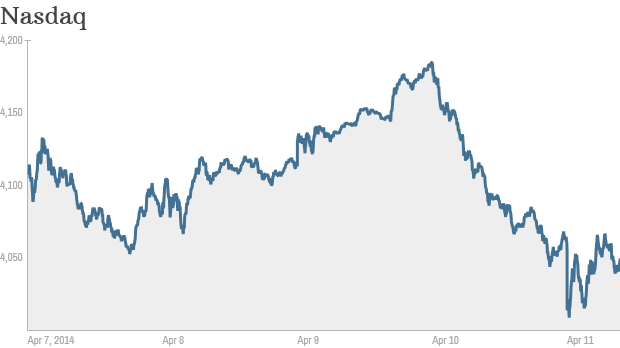
Click for more market data. Markets are finally closed for the week after a truly bumpy ride that ended with investors running for the exits Thursday and Friday.The weakness in the technology sector appears to be spreading to the broader stock market. The Nasdaq was the biggest loser. The tech-heavy index fell more than 1.3% to end below 4,000 for the first time since early February. It lost 3.1% for the week. The Dow Jones Industrial Average fell 143 points after JPMorgan (JPM, Fortune 500) reported weaker-than-expected earnings growth. The blue-chip average sank 2.3% for the week, falling after three weeks of gains. The S& P 500 was down nearly 1% today with selling in all sectors. Information technology was the hardest hit, but more defensive sectors such as utilities and telecoms were also under pressure. For the week, the S& P 500 fell 2.6%. It' s a sharp reversal for the broad market gauge, which hit an all-time high just last week. All three major U.S. market indexes are now down for the year. Related: Investors aren' t bringing sexy back The main catalyst for this week' s sell-off was a souring on so-called momentum stocks, including shares of many technology and healthcare companies. The firms had been trading at very high prices relative to expected earnings growth. For example, two popular exchange-traded funds that own biotechnology stocks (IBB) and small-cap stocks (IWM) both fell about 4% this week. But the concern now is that the sell-off is spreading to other parts of the market. " The market has run out of momentum stocks to crush, so it is moving to the fat ladies aka $SPY and $DIA," said StockTwits user ivanhoff, referring to exchange-traded funds that mirror the S& P 500 and the Dow. Stocks have been on a wild ride so far in 2014. According to Schaeffer' s Investment Research, the Nasdaq has experienced a gain or loss of 1% or more on 21 trading days since January 1. That' s roughly double the number from the same period last year. Related: Fear & Greed Index still gripped by fear European markets were also caught up in the fallout from Wall Street' s slump. |
||
| Useful To Me Not Useful To Me | |||