


Latest Forum Topics /
GuocoLand
Last:2.22
 +0.01
+0.01
|
 Post Reply Post Reply
|
|
GuocoLand
|
|||||
|
Joelton
Supreme |
03-Sep-2026 10:48
|
||||
|
x 0
x 0 Alert Admin |
Foo of DBS raises target price for GuocoLand to $3.40 following FY2026 earnings that beat expectations Tabitha Foo of DBS Group Research has maintained her " buy" call on GuocoLand along with a higher target price of $3.40, up from $3.30, after the property firm reported earnings that beat her expectations. For FY2026, the company' s underlying profit of $367.2 million, down 2% y-o-y, exceeded what Foo was projecting by 10%, thanks to its " robust" Singapore core businesses in both development and investments. GuocoLand' s headline earnings figure was weighed down by allowance of $207.2 million on its developments in China. For the same year ended June, net profit was down 11% to $95.2 million. Revenue was down 25% to $1.43 billion, mainly from the timing of revenue contribution of its ongoing development projects. The company' s revenue from its investment properties - the other half of its " twin engines" - was up 4% to $293 million, thanks to positive rental reversions. Despite the lower headline earnings number, GuocoLand improved its dividend for the second consecutive year to 8 cents from 7 cents paid for FY2025 and 6 cents for FY2024. " The progressive uplift, coupled with management&rsquo s reiteration of its commitment to sustainable dividends, reflects confidence in the underlying cashflows from the investment portfolio," says Foo, who calls the higher payout a " positive surprise" . " With dividends accounting for only around 30% of property investment revenue compared to around 70% in FY2018 to FY2020, we see significant scope for further dividend growth," she adds. Another reason for Foo' s optimism stems from the strong sales of its development projects, which will provide earnings visibility ahead. The development pipeline is supported by the 553-unit Lentor Central project, slated for launch in 1HFY2027, as well as the Berlayar Drive waterfront site, which can yield up to 416 units. According to Foo, the latest round of allowance made for China brings the total so far to nearly $400 million, bringing the value of development assets to $493 million, or just 4% of GuocoLand' s total. " It was effectively a ' kitchen-sink' exercise aimed at resetting the carrying values of its China exposure and reducing the risk of recurring write-downs," she says. The company, for now, has no plans to take on new projects in China and will just focus on selling what is on hand. The management, according to Foo, is confident that the current buffer should be sufficient to avoid further " meaningful" write-downs over the next two to three years, barring another major deterioration in the market. There are encouraging signs. For one, the commitment rate at Guoco Changfeng City in Shanghai improved to 77% from 61% a year ago, with rents at market levels. " We view the FY2026 charge as short-term pain for longer-term gain, substantially cleaning up the China balance sheet and containing downside risk, while allowing future earnings to increasingly reflect the strength of GuocoLand&rsquo s core Singapore operations," says Foo. Interestingly, following the recent privatisation of GuocoLand Malaysia, its businesses in this market could emerge as an underappreciated value-unlocking catalyst, says Foo. She describes GuocoLand' s business in Malaysia a " fragmented portfolio" spanning townships, mixed-use assets, industrial exposure and sizeable landbanks at Jasin and Sepang. The company could look to simplify its diverse asset base and potentially monetise assets to recycle capital, says Foo Foo has adjusted her RNAV estimates of the company to factor in recent land acquisitions in Singapore and the NAV of GuocoLand Malaysia. As she had not accorded any value to the China residential sites in her RNAV, the latest write-downs have no impact on her valuation. With the higher RNAV and by still applying a 35% discount to this figure, Foo has derived her new target price of $3.40. According to Foo, catalysts for the stock include continued strong sales for its residential projects launched in Singapore, and also a potential restructuring into a stapled security/REIT. " GuocoLand offers compelling value to investors in our view, trading at a 60% discount to our RNAV despite solid fundamentals &ndash steady recurring income from Guoco Tower and Guoco Midtown, as well as its strong residential execution," says Foo. GuocoLand shares, as at 11.39 am, was down 1.35%. |
||||
| Useful To Me Not Useful To Me | |||||
|
Joelton
Supreme |
03-Jul-2026 10:18
|
||||
|
x 0
x 0 Alert Admin |
GuocoLand secures $634.7 mil green financing from OCBC, ICBC to develop Lentor Central site Mainboard-listed GuocoLand Limited has secured a $634.7 million green club facility from Oversea-Chinese Banking Corporation (OCBC) and Industrial and Commercial Bank of China Limited (ICBC) Singapore Branch, to finance the development of its Lentor Central site. GuocoLand was awarded the site on March 6. The green facility for the future residential development at the Lentor Central site expands GuocoLand&rsquo s portfolio of green facilities for its residential properties, including Springleaf Residence, Faber Residence and River Modern as well as for the commercial components of its integrated mixed developments, Guoco Tower and Guoco Midtown. The 171,424 sq ft land parcel at Lentor Central marks GuocoLand&rsquo s fifth site within the Lentor Hills estate. GuocoLand plans to develop a condominium comprising approximately 553 units across three towers &mdash two at 26 storeys high and one with 27 floors. Most units will enjoy unblocked views of the surrounding landed housing, Lower Seletar Reservoir or Lower Peirce Reservoir. The 99-year leasehold site is adjacent to GuocoLand&rsquo s Lentor Modern, an integrated mixed development comprising 605 residences and a 90,000 sq ft retail mall with direct access to Lentor MRT Station on the Thomson-East Coast Line. When completed, the development at Lentor Central will achieve the Building and Construction Authority (BCA) Green Mark Platinum (Super Low Energy) award with Maintainability, Whole Life Carbon, and Health and Wellbeing Badges. GuocoLand&rsquo s latest development at Lentor Central is targeted for launch in 1H2027. The upcoming launch follows the success of GuocoLand&rsquo s four other projects in the Lentor Hills estate: Lentor Modern, Lentor Hills Residences, Lentor Mansion and Lentor Central Residences &mdash all of which are fully sold. Lentor Mansion was GuocoLand&rsquo s first development to attain the BCA Green Mark Platinum (Super Low Energy) award with Whole Life Carbon and Maintainability badges. Recent GuocoLand projects, including Springleaf Residence, Faber Residence and River Modern, are also on track to achieve the BCA Green Mark Platinum (Super Low Energy) with Maintainability, Whole Life Carbon, and Health and Wellbeing badges. Dora Chng, residential director of GuocoLand, says the group&rsquo s five land parcels in Lentor Hills reflects its &ldquo confidence in the neighbourhood&rdquo and &ldquo commitment to shaping it into a vibrant and highly sought-after residential estate&rdquo . &ldquo We have established a strong presence here and are excited to create another thoughtfully planned luxury development, with our signature features, including lush landscaping and efficient unit layouts.&rdquo Shares in GuocoLand were up 1 cent, or 0.5% higher, at $2.14 prior to the midday break. |
||||
| Useful To Me Not Useful To Me | |||||
|
|
|||||
|
n3wbie
Elite |
24-Jun-2026 11:10
|
||||
|
x 0
x 0 Alert Admin |
Great that they can be tapping the bond market for such low cost of debt at just 2.5%, testament to their strong credit profile and quality assets
|
||||
| Useful To Me Not Useful To Me | |||||
|
Joelton
Supreme |
24-Jun-2026 09:30
|
||||
|
x 0
x 0 Alert Admin |
GuocoLand unit prices S$110 million fixed-rate notes due 2030 at 2.5% [SINGAPORE] Property developer GuocoLand&rsquo s : F17 0% wholly-owned subsidiary, GLL IHT, has priced an offering of S$110 million in fixed-rate notes due 2030 at an interest rate of 2.5 per cent. The notes, which will be guaranteed by GuocoLand, are being issued in denominations of S$250,000, GuocoLand announced in a bourse filing on Monday (Jun 22). They will be issued under the subsidiary&rsquo s S$3 billion multicurrency medium term note programme. Interest on the notes will be payable semi-annually on Mar 30 and Sep 30 each year, with the first interest payment falling on Mar 30, 2027. The notes will mature on Sep 30, 2030. Net proceeds from the issue will be used to finance the general working capital and corporate requirements of the company and its subsidiaries. DBS Bank has been appointed as the sole lead manager and bookrunner for the offering. The notes are expected to be issued on or about Jun 30, 2026, subject to customary closing conditions. They will be listed on the Singapore Exchange on the market day following the issue. Shares of Guocoland ended at S$2.18 on Monday, S$0.01 or 0.5 per cent lower. |
||||
| Useful To Me Not Useful To Me | |||||
|
n3wbie
Elite |
06-Jun-2026 15:27
|
||||
|
x 0
x 0 Alert Admin |
Any followers of this stock? Trades about half book value but majority SG focused. Think market sees it largely as just residential developer (which their projects have mostly been sold out, i.e. River Modern and Tengah Garden) but they also have a solid recurring income with their office grade A buildings. Welcome any thoughts to learn perspectives | ||||
| Useful To Me Not Useful To Me | |||||
|
|
|||||
|
Joelton
Supreme |
07-Apr-2026 11:14
|
||||
|
x 0
x 0 Alert Admin |
uSmart starts GuocoLand at &lsquo buy&rsquo with a target price promising 30% upside Local digital brokerage platform uSmart has initiated coverage on Mainboard-listed property developer and investor GuocoLand with a &ldquo buy&rdquo call and $3.17 target price, which represents an upside of more than 30% against its current traded price. In a March 30 initiation report, analyst Ng Xin Yang says he expects GuocoLand&rsquo s earnings visibility to be supported by contributions from Lentor Modern and Guoco Midtown II, alongside upcoming residential launches. Valuation remains compelling, says Ng, as GuocoLand &ldquo continues to trade at a deep discount to its intrinsic value&rdquo . &ldquo As a preferred pick in the Singapore mid-cap developer space, the group&rsquo s &lsquo twin engines of growth&rsquo provide a resilient earnings base.&rdquo Ng&rsquo s revalued net asset value (RNAV) of $4.88 is underpinned by GuocoLand&rsquo s $7 billion investment property portfolio and a $5.7 billion development pipeline. &ldquo We anticipate a steady uplift in recurring income, supported by positive rental reversions at core CBD Grade-A office assets and the progressive completion of integrated projects like Lentor Modern mall.&rdquo Ng&rsquo s valuation &ldquo conservatively&rdquo accounts for $2.5 billion in estimated future capex to fund the development pipeline. Over time, the privatisation of GuocoLand Malaysia may also provide potential avenues for value realisation, adds Ng, including the recycling of mature assets into capital-light structures such as REIT platforms, which could help narrow the current valuation discount. GuocoLand operates as a key subsidiary of Guoco Group Limited, which is listed on the Stock Exchange of Hong Kong. Both GuocoLand and Guoco Group Limited are members of the Hong Leong Group in Malaysia. The group organises its operations around three &ldquo semi-autonomous geographic hubs&rdquo , notes Ng: GuocoLand Singapore, GuocoLand China and GuocoLand Malaysia. On Feb 3, GuocoLand Limited proposed to privatise GuocoLand Malaysia at RM1.10 per share (a RM270 million transaction). Ng says this is a &ldquo precursor to a larger reorganisation&rdquo aimed at reducing regulatory friction for future asset recycling. A possible near-term catalyst is the potential spin-off of GuocoLand&rsquo s commercial assets into a REIT, says Ng. &ldquo With landmark assets like Guoco Tower and Guoco Midtown achieving near-100% commitment rates, the portfolio is effectively consistent with REIT listing requirements.&rdquo GuocoLand vs peers In the Singapore real estate landscape, GuocoLand has carved a niche as a premier developer of high-end integrated mixed-use projects, says Ng. &ldquo To assess its relative value, we benchmark the group against its primary diversified peers: UOL Group, City Developments Limited, Frasers Property, Singapore Land Group, Ho Bee Land and Wing Tai Holdings.&rdquo GuocoLand&rsquo s return on equity (ROE) of 1.23% trails peers such as City Developments (6.48%) and UOL (4.34%), but this largely reflects cyclical earnings compression rather than structural underperformance, says Ng. &ldquo Significant&rdquo capital has been deployed into the Lentor Hills development precinct and the ramp-up phase of Guoco Midtown, he adds. Similarly, GuocoLand&rsquo s ebitda margin of 13.3% sits below the peer median (28.8%), reflecting a higher mix of residential development revenue versus recurring investment income. As leasing stabilises across its Grade-A office portfolio, margin expansion is expected, says Ng. GuocoLand&rsquo s valuation supports a growth-at-reasonable-price (GARP) profile. The stock trades at 18.5 times forward price-to-earnings, slightly below the peer median of 19 times. Furthermore, GuocoLand offers a 2.9% dividend yield, exceeding peers such as City Developments (1.26%) and UOL (1.76%). The dividend increase from six cents to seven cents per share in 2025 signals management&rsquo s confidence in the sustainability of cash flows, adds Ng. &ldquo As recurring income from Guoco Tower and Guoco Midtown continues to scale, dividend capacity should improve alongside earnings growth.&rdquo |
||||
| Useful To Me Not Useful To Me | |||||
|
JurongW
Elite |
08-Mar-2026 15:36

Yells: "Earnings give weight, Chart give wings" |
||||
|
x 0
x 0 Alert Admin |
More than two cheques per unit&rsquo : GuocoLand&rsquo s 455-unit River Modern sells 90% of units at launch Jovi HoSun, Mar 08, 2026 &bull 02:08 PM GMT+08 &bull &bull 6 min read Jovi HoSun, Mar 08, 2026 &bull 02:08 PM GMT+08 &bull &bull 6 min read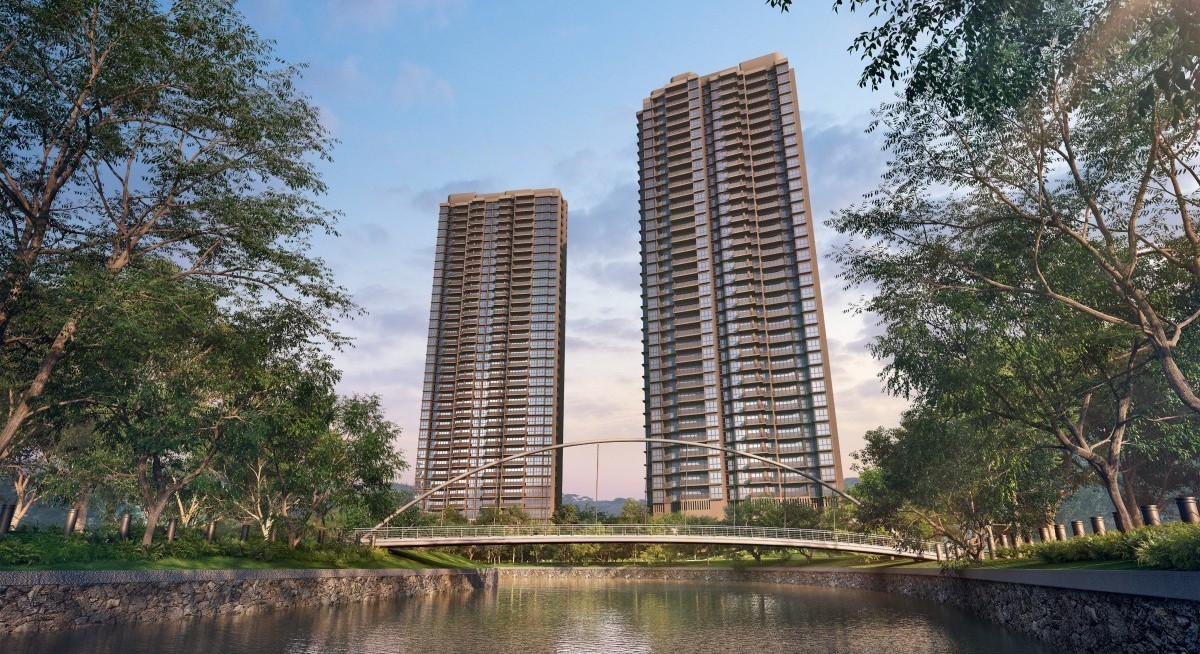 The units sold were priced from $1,548,000 for a two-bedroom unit to $6,722,000 for a four-bedroom unit. The highest price achieved was $3,693 psf. Photo: GuocoLand
GuocoLand&rsquo s River Modern condominium sold 90% of its 455 units at its launch on March 7, at an average selling price of $3,266 psf. The units sold were priced from $1,548,000 for a two-bedroom unit to $6,722,000 for a four-bedroom unit, says GuocoLand on March 8. The highest price achieved was $3,693 psf. The riverfront development located within River Valley in prime District 9 comprises 455 units spread over two 36-storey residential blocks, with six units per floor in one tower and seven in the other. More than 60% of River Modern&rsquo s units are three- and four-bedroom units. There was strong demand for all unit types, says GuocoLand, with 88% of the 175 two-bedroom units, 95% of the 210 three-bedroom units and 80% of the 70 four-bedroom units sold. Mark Yip, CEO, Huttons Asia, estimates that more than 35% of units sold were priced from $3 million. Singaporeans and Permanent Residents accounted for nearly all the buyers. The majority are owner-occupiers, with a range of household sizes, from singles to multi-generational families, according to GuocoLand. Dora Chng, residential director, GuocoLand, says: &ldquo Many of our buyers were drawn to the exceptional attributes of River Modern&rsquo s site. They also believed in GuocoLand&rsquo s strong branding and our capabilities to deliver homes with efficient layouts, lush landscaping and thoughtful facilities that make for a highly-livable development.&rdquo  The River Modern showflat drew more than 7,000 visitors over its preview weekend, which began on Feb 20. River Modern is expected to be completed in 2030. When completed, the development will attain the Building and Construction Authority&rsquo s Green Mark Platinum (Super Low Energy) certification with Maintainability Badge.  The 99-year leasehold luxury development is situated on a 126,325 sq ft site within River Valley next to Kim Seng Park. Already minutes away from Singapore&rsquo s shopping and business districts, River Modern also boasts direct connectivity to Great World MRT Station on the Thomson-East Coast Line via Exit 1, which also offers underpass access to Great World shopping mall. River Modern also has six retail shops on the ground floor, totalling about 4,300 sq ft of commercial space. The retail units will not be sold. Instead, rental will be collected to subsidise maintenance costs. The units will only be rented out after the Management Corporation Strata Title (MCST) has been set up, after which the committee will then decide on the retail tenant mix to suit residents&rsquo various needs. More than two cheques per unit&rsquo : HuttonsWith the strong response, River Modern is the best-selling private residential non-landed project by units and percentage in 2026 so far. Several major residential projects in the River Valley area were launched last year, recording strong sales. City Developments and Mitsui Fudosan&rsquo s Zyon Grand sold about 84% of its 706 units over its launch weekend in October 2025. Allgreen Properties&rsquo Promenade Peak sold more than 54% of its 596 units shortly after its launch in August 2025, while Wing Tai&rsquo s River Green sold 88% of its 524 units at its launch that same month. With 455 units, River Modern is &ldquo relatively moderate&rdquo in size compared with the recent launches in the area that exceeded 500 units, says Mohan Sandrasegeran, head of research and data analytics at Singapore Realtors Inc. (SRI). &ldquo A more manageable unit count allows demand to be absorbed more comfortably while also supporting a more intimate residential environment for future residents.&rdquo Probably the last plot of land along the Singapore River in prime District 9, River Modern attracted more than two cheques for each unit, according to Huttons&rsquo Yip. &ldquo Buyers nowadays have a preference for projects [that] offer them convenience. River Modern offers residents superb convenience with Great World MRT Station at its doorstep, retail shops below the development, Great World mall and River Valley Primary School across the road,&rdquo he adds.  In addition, River Modern attracted investors because of the palatable quantum and high rentability of apartments in River Valley, says Yip. According to Huttons, the three-bedroom units were the most popular among buyers, selling more than 90% at launch. Meanwhile, more than 80% of the two- and four-bedroom units were sold at launch. The Core Central Region (CCR) &ldquo continues to ride a wave of positive buying sentiment&rdquo , says Yip. &ldquo The shrinking premium of CCR units over Rest of Central Region (RCR) developments presented a value proposition that many buyers found hard to ignore.&rdquo Looking ahead, a residential site at Morrison Lane on the GLS Reserve List opened for tender on Feb 25 to meet potential demand in the River Valley area, notes Marcus Chu, CEO of ERA Singapore. &ldquo Against this backdrop, River Modern is expected to be the only large-scale new residential launch in District 9 this year.&rdquo The next potential private launch in the precinct is expected to come from the River Valley Green Parcel C government land sales (GLS) site, with the tender anticipated around April and any resulting development likely to be introduced only around 2027, adds SRI&rsquo s Sandrasegeran. Even so, River Modern benefits from a relatively early land cost base, says Chu. &ldquo [This] may offer buyers some insulation against future price escalation as replacement costs for upcoming CCR launches trend higher.&rdquo  Geopolitical tensions highlight Singapore&rsquo s relative safetyBased on history, past wars in the Middle East have had little impact on Singapore&rsquo s property market, says Yip. &ldquo Property prices rose by 2.8% y-o-y in 2004 after the outbreak of war in Iraq in 2003.&rdquo Rather, the geopolitical tensions in other parts of the world highlighted the importance of stability and enhanced Singapore&rsquo s status as a safe haven, he adds. &ldquo The tensions have also roiled the equities market and resulted in wild gyrations. Some buyers may have taken these into consideration and decided that investing in a stable asset such as property may be a better option.&rdquo &lsquo Meaningful&rsquo number of HDB upgraders entering District 9 ERA has observed a higher proportion of Singaporean buyers across recent launches in River Valley and the broader Robertson Quay precinct, a trend that has &ldquo become more pronounced since 2024&rdquo after the increase in additional buyer&rsquo s stamp duty (ABSD) for foreigners in April 2023. ERA also notes a meaningful number of buyers with HDB addresses in projects launched last year, such as River Green, Promenade Peak and Zyon Grand. This points to upgrader demand, says Chu.  In 2025, Bukit Merah recorded 216 million-dollar HDB resale transactions, while Queenstown saw 173 such deals. This has enabled some homeowners to unlock sufficient housing equity to upgrade to nearby private residences, adds Chu. &ldquo Meanwhile, the average amount spent by HDB upgraders on new homes in District 9 has stayed around $2 million over the years. With savings from cash and CPF, many can still afford a home in District 9, explaining the rise in buyers with HDB addresses in recent launches,&rdquo he says. |
||||
| Useful To Me Not Useful To Me | |||||
|
Joelton
Supreme |
05-Feb-2026 09:23
|
||||
|
x 0
x 0 Alert Admin |
GuocoLand&rsquo s rationale for privatising its Malaysian arm not strong But the proposed move could be the SGX-listed group&rsquo s way of priming itself to be privatised in future [SINGAPORE] On Tuesday (Feb 3) night, GuocoLand : F17 -0.37% announced that it planned to take its Malaysia-listed unit private at an offer price of RM1.10 a share, for the almost-35 per cent stake it does not already own. For minority shareholders of Bursa-listed GuocoLand (Malaysia) or GLM, the rationale to accept the proposal by GuocoLand&rsquo s wholly owned subsidiary GLL (Malaysia) to take it private is sound. Trading liquidity of GLM shares is low. Minority shareholders of GLM get to realise their holdings at a premium of 17.7 per cent to the last-traded price on Jan 30, and 47.7 per cent to the six-month volume weighted average market price up to Jan 30. Moreover, keeping GLM listed may not make sense, as it has not raised equity from the capital market in over 10 years, and resources are being incurred to maintain the listing status. GuocoLand, which owns about 65 per cent of GLM shares, could be snaring a good deal as its offer price of RM1.10 a share represents a 47 per cent discount to GLM&rsquo s net asset value (NAV) per share of RM2.08 as at end-2025. Also, the proposed privatisation of GLM is by way of a selective capital reduction, which will enable capital repayment of RM269.4 million or around S$86.9 million to entitled shareholders of GLM. Focusing on Singapore However, does it make sense for GuocoLand to raise its stake in GLM when a better path forward for the Singapore-listed group could arguably involve divesting its overseas businesses? GLM&rsquo s profits are not substantial. For the half-year ended Dec 31, 2025, it posted a net profit of RM12.8 million. For the financial year ended Jun 30, 2025, its net profit was RM18.8 million. For perspective, GuocoLand reported a net profit of S$85.4 million for the half-year ended Dec 31, 2025. For this six-month period, profit after tax from the group&rsquo s Singapore segment was S$129.5 million, compared with S$5.9 million from Malaysia and a loss of S$27 million from China. GLM has been under GuocoLand&rsquo s ownership for some time. If GLM cannot be scaled up to meaningfully contribute to GuocoLand, perhaps the Singapore-listed group is better off divesting the Malaysian business. After all, having geographic diversification can hurt productivity when overseeing the affairs of overseas businesses that make insignificant contributions would invariably consume the time and energy of GuocoLand&rsquo s Singapore-based top management. Indeed, interest in the shares of GuocoLand &ndash which has an excellent track record in building condos and integrated developments in Singapore &ndash could strengthen if it were to focus on Singapore only, given that many investors are positive on the city-state&rsquo s private residential and commercial property. By steering away from overseas ventures, GuocoLand could do even more in the Singapore market, where ticket sizes per property development project are often large. Alternative moves As for GLM, one way to drive better performance, thus benefiting its shareholders, would be to merge with or be acquired by a stronger Malaysian property group, such as Eco World Development Group, IOI Properties Group, Sime Darby Property or S P Setia, or a conglomerate like Sunway. Alternatively, GuocoLand&rsquo s chairman and substantial shareholder, Malaysian billionaire Quek Leng Chan, could privatise GLM using a private vehicle. Amid a revival of interest in the Singapore equities market and resilience in various segments of the property market here, GuocoLand&rsquo s share price has rallied in recent months. Still, the group trades at a huge discount to its end-2025 NAV per share of S$3.93. Instead of looking to raise its stake in GLM, what GuocoLand&rsquo s board of directors should prioritise is unlocking value with its prized Singapore assets. For example, consider launching a listed real estate investment trust that owns the office and retail components of Guoco Tower in Tanjong Pagar and Guoco Midtown in Beach Road. Also, GuocoLand could try to grow in managing third-party assets by using Guoco Tower and Guoco Midtown to seed a private fund. For reference, Hongkong Land : H78 -0.58% has just launched the Singapore Central Private Real Estate Fund, with an initial portfolio that includes its interests in Marina Bay Financial Centre Towers 1 and 2, Marina Bay Link Mall, One Raffles Quay and One Raffles Link, as well as Qatar Investment Authority&rsquo s Asia Square Tower 1. GuocoLand&rsquo s free float is small. Its latest annual report noted that 19 per cent of its shares are held by the public Quek&rsquo s deemed interest in the group was 71.9 per cent. GLM&rsquo s board of directors has until Mar 2 to determine if it agrees to implement GuocoLand&rsquo s proposed privatisation and table it for consideration by GLM&rsquo s entitled shareholders. In short, the fate of GuocoLand&rsquo s proposed privatisation could be in the hands of GLM&rsquo s minority shareholders. GuocoLand&rsquo s minority shareholders probably have little to celebrate if the group succeeds in privatising GLM. Instead, what tidying up GuocoLand&rsquo s holding in a Bursa-listed subsidiary could do is make a potential privatisation of GuocoLand easier to execute. This could be done by Quek-linked Hong Kong-listed investment company Guoco Group or other vehicles linked to Quek. There are numerous precedents of asset-heavy Singapore-listed property groups being successfully privatised, and Quek is a seasoned corporate dealmaker. While efforts are being made to increase investor interest in Singapore stocks, perhaps GuocoLand may exit the Singapore Exchange in the not-too-distant future. |
||||
| Useful To Me Not Useful To Me | |||||
|
|
|||||
|
SmallSmall
Supreme |
03-Feb-2026 11:25
|
||||
|
x 0
x 0 Alert Admin |
Halted. Could be privatisation as both the KLSE listed Guocoland and HKSE listed Guoco Grp also halted |
||||
| Useful To Me Not Useful To Me | |||||
|
Joelton
Supreme |
30-Jan-2026 11:12
|
||||
|
x 0
x 0 Alert Admin |
GuocoLand H1 net profit rises 14% to S$85.4 million despite lower revenue
EPS rises to S$0.0708 for the six-month period
[SINGAPORE] Property developer GuocoLand : F17 +2.29% on Thursday (Jan 29) posted a net profit of S$85.4 million for the six months ended Dec 31, 2025, up 14 per cent from the S$74.6 milllion booked for the previous corresponding period.
This translated to earnings per share (EPS) of S$0.0708 for H1 FY2026, versus EPS of S$0.0588 in H1 FY2025.
GuocoLand attributed the bottom-line growth to its share of profits from associates and joint ventures (JVs), increased income from its property investment business, gains from the disposal of Thistle Johor Bahru hotel in Malaysia and lower finance costs.
For H1 FY2026, the group&rsquo s other income increased by S$17.2 million to S$25.5 million due to its disposal of the Thistle Johor Bahru hotel.
It also recognised a S$5.3 million share of profits of associates and JVs for the half-year, compared to a share of loss in the year-ago period, due to contributions from Springleaf Residence and Lentor Hills Residences.
Net finance costs fell 30 per cent year on year to S$68.6 million, due to lower loans and borrowings, as well as lower interest rates. As a result, profit after tax rose 13 per cent on the year to S$98.6 million.
Revenue for the half-year fell 22 per cent year-on-year to S$791.9 million, from S$1 billion in H1 FY2025.
This came amid lower contributions from the property development business, which posted a revenue of S$611.9 million for H1, down from S$842.5 million, due to the timing of progressive recognition of revenue from Singapore residential developments.
However, the lower revenue from the property development business was partially offset by the property investment business, which posted a 5 per cent year-on-year increase in recurring rental revenue to S$143.2 million.
GuocoLand and IOI Properties should pool assets worth S$12.5 billion for a Singapore office-led Reit
This was supported by high committed occupancy from the company&rsquo s Singapore commercial portfolio.
The group noted that its Singapore assets accounted for 75 per cent of its total assets as at end-December, with the GuocoLand Singapore segment contributing to around 70 per cent or $549.9 million of the group&rsquo s revenue.
GuocoLand did not declare any dividend for H1 FY2026, unchanged from the year before.
The group&rsquo s total assets stood at S$11.75 billion as at Dec 31, 2025. Its total loans and borrowings were down 12 per cent on the year as at end-2025, at S$4.8 billion.
Its debt-to-assets ratio decreased to 0.41 times as at Dec 31, 2025, from 0.44 times as at Jun 30, 2025.
GuocoLand noted that the Singapore residential market is expected to remain stable, supported by lower interest rates and low unemployment.
|
||||
| Useful To Me Not Useful To Me | |||||
|
Alignment
Elite |
03-Oct-2025 21:01
|
||||
|
x 0
x 0 Alert Admin |
Not a bad price for Clementi | ||||
| Useful To Me Not Useful To Me | |||||
|
Joelton
Supreme |
01-Oct-2025 12:59
|
||||
|
x 0
x 0 Alert Admin |
GuocoLand to launch Faber Residence with prices starting at S$1,995 psf
The project comprises 399 units of two- to five-bedroom apartments in nine five-storey blocks
[SINGAPORE] GuocoLand will start previews for its Clementi project, Faber Residence, on Friday (Oct 3), with prices starting at S$1,995 per square foot (psf).
Jointly developed with TID and Hong Leong Holdings, the project comprises 399 units of two to five-bedroom apartments across nine five-storey residential blocks.
The indicative price starts at S$1.29 million or S$1,997 psf for two-bedroom units 646 square feet (sq ft) in size. They account for a fifth of the units in the development.
Three-bedders of between 797 and 1,033 sq ft, which account for half the units, are priced from S$1.59 million or S$1,995 psf. Four-bedroom apartments &ndash which are between 1,119 and 1,270 sq ft and making up a quarter of the units &ndash are priced from S$2.39 million or S$2,136 psf.
Five-bedders sized at 1,485 sq ft are priced from S$3.19 million or S$2,148 psf. They make up 5 per cent of total units in the development.
Cheng Hsing Yao, GuocoLand&rsquo s group chief executive officer, said: &ldquo Faber Residence is in a rare riverfront and landed enclave in Clementi. It is close to multiple established educational institutions and job centres, making it attractive to homeowners and investors.&rdquo
At the Sep 30 media preview, he highlighted Clementi&rsquo s popularity as a housing estate, citing trends in public housing resale prices. According to SRX and 99.co flash data, the overall median resale price for HDB flats in Clementi in August was S$609,000 the estate had 15 units being transacted for at least S$1 million that month.
Cheng attributed the area&rsquo s appeal to its proximity to schools, universities and job centres, along with its strong connectivity.
Faber Residence is near various schools, including Nan Hua Primary School, Singapore Polytechnic, Ngee Ann Polytechnic and the National University of Singapore.
The 99-year leasehold development is near key business hubs, including the International Business Park, one-north and the upcoming Jurong Lake District, which is set to be Singapore&rsquo s largest mixed-use business district outside the Central Business District.
Its proximity to major job centres, schools and universities is expected to attract both owner-occupiers and renters, said Cheng.
Eugene Lim, key executive officer of ERA Singapore, noted that in the first eight months of 2025, gross rental yields for Clementi and similar projects in the area were 3.5 to 3.6 per cent, similar to the islandwide and Outside Central Region&rsquo s yields.
Monthly rents for Waterfront @ Faber condominium, completed in 2017, are around S$4.49 psf, while the nearby Parc Clematis and Clavon fetched S$6.19 psf and S$6.02 psf in rents, respectively, data from the consultancy showed.
Still, Lim expects the majority of buyers to be owner-occupiers, including singles, couples and families.
He added that those who grew up in the Faber landed enclave may seek to purchase a condominium unit near their parents&rsquo homes.
Retirees in the area may also sell their landed properties and rightsize to a condominium by the riverfront. Meanwhile, residents of older condominiums or nearby HDB flats may look to trade up, he said.
&ldquo While several other launches are upcoming, Faber Residence will be the only remaining launch in the OCR in 2025,&rdquo said Lim. &ldquo The relatively lower price quantum, combined with the rare opportunity for riverfront living in an exclusive, yet well-connected area, will be highly attractive.&rdquo
The development is four bus stops away from Jurong East MRT interchange, which serves the East-West Line and North-South Line, and Clementi MRT station. It is also a 10-minute walk to the future Jurong Town Hall MRT station on the Jurong Region Line.
Amenities within the development include a 50-metre lap pool, leisure pool, clubhouse and reading room. Residents also have direct access to the Ulu Pandan Park Connector, which runs along Sungei Ulu Pandan and within the Clementi Nature Corridor.
Faber Residence sits on a 25,795 square metre (sq m) site, which the consortium acquired for S$349.9 million, or about S$900 per square foot per plot ratio (psf ppr) in a state land tender in November 2024.
Their winning bid was nearly 30 per cent lower than the S$1,250 psf ppr top bid offer for a nearby site in Clementi Avenue, which was sold to MCL Land and CSC Land in November 2023. That parcel is being developed into the 501-unit Elta condominium, which sold 65 per cent or 326 units at its launch in February, at an average price of S$2,537 psf.
The last state land site launched for sale in the Faber Walk area took place in January 2018, in West Coast Vale, where the 716-unit Whistler Grand condominium now stands. The project was launched in October that year at an average price of S$1,380 psf.
|
||||
| Useful To Me Not Useful To Me | |||||
|
|
|||||
|
Joelton
Supreme |
02-Sep-2025 18:06
|
||||
|
x 0
x 0 Alert Admin |
GuocoLand unit divests Thistle Johor Bahru hotel for RM150 million
The group is expected to enjoy a net gain of about RM35 million upon completion of the sale
[SINGAPORE] Property developer GuocoLand is selling the Thistle Johor Bahru hotel and the associated land for RM150 million (S$46 million).
The hotel and the land in Bandar Johor Bahru, held by GuocoLand&rsquo s subsidiary JB Parade, is being sold to Restoran Kisap, a wholly owned subsidiary of YTL Hotels & Properties.
&ldquo The transaction provides an opportunity to realise the capital value of the property and the assets,&rdquo said GuocoLand in a bourse filing on Monday (Sep 1).
The combined property has a net book value of RM93 million, with the land area at about 24,040 square metres. GuocoLand is thus expected to enjoy a net gain of about RM35 million upon completion of the sale.
The Business Times understands that JLL Hotels & Hospitality Group brokered the deal.
Thistle Johor Bahru is located within a 10-minute drive of the land border to Singapore, the world&rsquo s busiest land border crossing. It has 381 rooms featuring a mix of 347 rooms with city and sea views and 34 suites. It also has six food and beverage outlets, a two-level resort-style swimming pool, a spa, a fitness centre, tennis courts, as well as meeting and banqueting facilities.
As at 9.07 am on Friday (Aug 29), shares of GuocoLand had declined 2.7 per cent or S$0.05 to S$1.83 on the back of lower H2 net profit of S$32.4 million.
GuocoLand falls by nearly 3% after reporting slump in H2 net profit to S$32.4 million
Another GuocoLand hotel in Malaysia, Thistle Port Dickson Resort, is also on the market, reported The Edge.
On Aug 29, the group announced that its second-half net profit fell 48 per cent as China losses offset Singapore growth. This was despite a 20.3 per cent jump in revenue.
|
||||
| Useful To Me Not Useful To Me | |||||
|
SmallSmall
Supreme |
01-Sep-2025 16:35
|
||||
|
x 0
x 0 Alert Admin |
$1.93 +$0.07.....Tomorrow hope to see $2.00
|
||||
| Useful To Me Not Useful To Me | |||||
|
SmallSmall
Supreme |
01-Sep-2025 13:24
|
||||
|
x 0
x 0 Alert Admin |
Very slow moves @ $1.90 +$0.04. But once it breaks a certain threshold, the upswingg will be fast and furious. A safe stock to bet / invest
|
||||
| Useful To Me Not Useful To Me | |||||
|
SmallSmall
Supreme |
01-Sep-2025 09:03
|
||||
|
x 0
x 0 Alert Admin |
DBS raises target price for GuocoLand to $2.50, floats ' stapled security' value unlocking catalystThe Edge SingaporeMon, Sep 01, 2025 &bull 08:27 AM GMT+08 &bull &bull 2 min read
  |
||||
| Useful To Me Not Useful To Me | |||||
|
Joelton
Supreme |
30-Aug-2025 13:27
|
||||
|
x 0
x 0 Alert Admin |
GuocoLand falls after reporting slump in H2 net profit to S$32.4 million
The property developer&rsquo s earnings fall 48% on the year
[SINGAPORE] Shares of GuocoLand : F17 -1.06% tumbled by close to 3 per cent on Friday (Aug 29) morning, following the announcement of its net profit for the second half ended Jun 30 falling 48 per cent to S$32.4 million, from S$62.4 million in the same period in the year before.
As at 9.02 am, the property developer&rsquo s shares inched down to S$1.86, before declining 2.7 per cent or S$0.05 to S$1.83 by 9.07 am. The counter rose back to S$1.84 by 9.23 am, still down 2.1 per cent or S$0.04, after 174,100 securities were transacted.
The mainboard-listed group said the lower H2 net profit came mainly from losses in China offsetting growth in Singapore. The group also said it sees issues in the Chinese residential market continuing, noting an allowance for foreseeable losses of S$81.8 million in the second half of its financial year for development properties in China, reported The Business Times on Thursday evening.
Earnings per share for the six-month period declined to S$0.0256 from S$0.0479 in the same year-ago period.
A first and final dividend of S$0.07 per share was declared for the period, up from S$0.06 the year before. It will be paid on Nov 19, after books closure on Nov 6.
|
||||
| Useful To Me Not Useful To Me | |||||
|
Joelton
Supreme |
29-Aug-2025 12:27
|
||||
|
x 0
x 0 Alert Admin |
GuocoLand&rsquo s H2 net profit falls 48% as China losses offset Singapore growth
This is despite a 20.3% increase in revenue
[SINGAPORE] Property developer GuocoLand : F17 0% posted a 48 per cent drop in net profit to S$32.4 million for its half year ended Jun 30, from S$62.4 million in the corresponding period a year ago.
This comes despite a 20.3 per cent increase in revenue to S$906.3 million for its second-half period, from S$753.3 million, it reported in a Thursday (Aug 28) bourse filing.
The mainboard-listed company said this was due to losses in China offsetting growth in Singapore.
Noting that challenges in the Chinese residential market persist, the group said it recognised an allowance for foreseeable losses of S$81.8 million in the second half of its fiscal year for development properties in China.
Earnings per share for the six-month period fell to S$0.0256 from S$0.0479 in the year-ago period.
A first and final dividend of S$0.07 per share was declared for the period, up from S$0.06 the year before. The dividend will be paid on Nov 19, after books closure on Nov 6.
Full-year figures buoyed by Singapore segment
For the full year, net profit fell 16.7 per cent to S$107.1 million from S$128.5 million in the year-ago period, while revenue rose 5.3 per cent to S$1.9 billion from S$1.8 billion.
Earnings per share was S$0.0843 for the full year, compared with S$0.099 in the previous corresponding period.
Revenue growth for the full year was underpinned by strong performance from Singapore for its twin engines of property development and property investment, said GuocoLand.
Its Singapore portfolio contributed more than 80 per cent of the group&rsquo s property development revenue and 87 per cent of its investment revenue in FY2025, said the group.
China&rsquo s property development revenue saw an increase due to the handover of some residential units at Guoco Central Park in Chongqing to buyers beginning in H2 2025, it added.
Meanwhile, revenue from its Singapore property investment portfolio grew on the back of higher recurring rental revenue from Guoco Tower and Guoco Midtown, whose committed occupancy remained close to 100 per cent, said the company.
On its outlook, GuocoLand said that the office market in Singapore displayed resilience, particularly in the core Central Business District.
In the Chinese office sector, it noted that Shanghai&rsquo s vacancy rate edged up as new supply entered the market, pressuring rents.
More than 700,000 square metres of new office space is expected for the rest of the year, but the authorities are taking steps to address the issue, primarily by scaling back commercial land sales encouraging developers to return plots which have not started development and promoting conversion of existing office stock to alternative uses, said the group.
These actions will gradually reduce the volume of new office supply entering the market, it added.
As for Malaysia, GuocoLand noted that the commercial office market in Greater Kuala Lumpur continues to face challenges.
|
||||
| Useful To Me Not Useful To Me | |||||
|
Joelton
Supreme |
19-Aug-2025 10:53
|
||||
|
x 0
x 0 Alert Admin |
GuocoLand bucks overall market slide on Springleaf sales as shares rise 1.1%
The development is the seventh project to be launched in Upper Thomson&rsquo s District 26
[SINGAPORE] Shares of GuocoLand : F17 +0.57% rose by over 1.1 per cent in early trade on Monday (Aug 18) after its Upper Thomson area project, Springleaf Residence, recorded a 92 per cent take-up rate on its launch weekend, as it sold 870 out of 941 units at an average of S$2,175 per square foot (psf).
As at 9.01 am, the counter reached its intraday high of S$1.81, before easing to S$1.80 at 9.05 am and S$1.79 by 9.36 am. GuocoLand&rsquo s shares were trading at S$1.78, still up slightly above 1.1 per cent or S$0.02 after around 403,000 securities changed hands.
Springleaf Residence is the seventh project to be launched in Upper Thomson&rsquo s District 26, The Business Times reported. The prices at the development start at S$1,995 psf, with one-bedroom units of 388 square feet starting at S$878,000 or S$2,263 psf.
The site is able to yield around 595 residential units and 2,000 square metres of commercial space, with direct connectivity to Springleaf MRT station on the Thomson-East Coast Line.
GuocoLand and Hong Leong as joint developers secured the plot for S$779.6 million in April 2024, or S$905 psf per plot ratio, in a state land tender.
Within the Lentor Hills neighbourhood, six other condominiums have been brought to market from 2022, since the government started selling land in the area in 2021.
|
||||
| Useful To Me Not Useful To Me | |||||
|
Joelton
Supreme |
18-Aug-2025 10:00
|
||||
|
x 0
x 0 Alert Admin |
GuocoLand, Hong Leong sell 870 units or 92% of Springleaf Residence at average S$2,175 psf
Pricing was compelling next to other new suburban and EC projects, say agents
[SINGAPORE] GuocoLand and Hong Leong Holdings&rsquo Upper Thomson area project, Springleaf Residence, racked up a 92 per cent take-up rate over its launch weekend, selling 870 out of 941 units at an average of S$2,175 per square foot (psf).
With prices starting from S$878,000 for one-bedroom units and most units falling below the S$2.5 million mark, the project was &ldquo priced sensitively&rdquo at levels accessible to many buyers in today&rsquo s market, said Kelvin Fong, chief executive officer of PropNex.
The average price of S$2,175 psf was also &ldquo quite compelling&rdquo compared against recent transacted prices of new homes in the mass-market segment, he said. Based on caveats lodged, the average unit price of new non-landed private homes sold in the suburban Outside Central Region was nearly S$2,320 psf in the year to Aug 10, he noted.
Huttons CEO Mark Yip observed that Springleaf Residence also appeared attractive next to new executive condo (EC) projects, where prices now average S$1,750 psf.
GuocoLand and Hong Leong secured the plot in April 2024 for S$779.6 million, or S$905 psf per plot ratio (ppr), in a state land tender.
The marketing of SpringLeaf Residence came at the tail end of a busy launch season in the current quarter. Eight new condo projects have been put on the market since July.
Counting in sales at the latest launches &ndash River Green, Promenade Peak, Canberra Crescent Residences, and Springleaf Residence &ndash developers have sold more than 1,800 new units in August so far, and are on track to posting the strongest monthly new home sales numbers since November 2024, said Fong.
Springleaf Residence is also the seventh project to be launched in Upper Thomson&rsquo s District 26. Six other condos in the Lentor Hills neighbourhood have been brought to market from 2022, since the government started selling land in the area in 2021.
Prices for Springleaf Residence start from S$1,995 psf, with one-bedroom units of 388 sq ft going from S$878,000 or S$2,263 psf.
&ldquo With rising costs of construction, buyers will be hard put to find a new home below S$1 million in years to come,&rdquo said Huttons&rsquo Yip.
Two-bedders at Springleaf Residence &ndash spanning 527 to 646 sq ft and accounting for 35.3 per cent of units &ndash are priced from S$1.08 million or S$2,046 psf. Three-bedroom apartments &ndash spanning 786 to 1,076 sq ft and making up 39.1 per cent of units &ndash start at S$1.62 million or S$2,058 psf.
Four-bedders spanning 1,227 sq ft start at around S$2.45 million (S$1,995 psf), and five-bedders sized 1,453 to 1,475 sq ft are priced from S$3.02 million (S$2,077 psf).
&ldquo Enthusiastic response&rdquo
GuocoLand said on Sunday (Aug 17) that the project &ldquo received an enthusiastic response during its launch weekend&rdquo , which &ldquo reflects market confidence in the Springleaf area&rsquo s growth potential&rdquo .
The strong sales also seal the developers&rsquo stronghold in the area. Dora Chng, residential director at GuocoLand, said this marks the start of Springleaf&rsquo s transformation into one of Singapore&rsquo s most sought-after private residential enclaves, building on the success achieved at Lentor Hills estate.
Three of six projects at Lentor Hills &ndash Lentor Mansion, Lentor Central Residences and Lentor Hills Residences &ndash are developed by GuocoLand and partners including Hong Leong. A fourth, Lentor Modern, is developed solely by GuocoLand.
The 99-year leasehold Springleaf Residence is close to Springleaf MRT station on the Thomson-East Coast Line. It comprises 909 units of two- to five-bedroom apartments across five 25-storey blocks, along with 32 one- to three-bedroom units housed in a four-storey conserved building.
Singaporeans and permanent residents accounted for nearly all buyers at Springleaf Residence, with a mix of singles, young couples, families and multi-generational households.
Yip highlighted that Springleaf Residence is the second best-selling project in 2025 in terms of units sold, after Parktown Residence in Tampines moved 1,041 units or 87 per cent of the project at an average of S$2,360 psf.
Marcus Chu, CEO of ERA, noted that Springleaf Residence provided an attractive entry point for an OCR project.
The project would draw interest both from HDB upgraders and potential buyers from ageing condos in neighbouring precincts, he said, noting that between 2022 and 2025, some 4,800 flats in nearby HDB estates reached their minimum occupation period.
Chu noted that the Lentor Hills precinct, which has seen close to 3,000 units launched across its six projects, now has fewer than 100 unsold units remaining.
&ldquo Prospective buyers who had missed out, particularly those seeking larger layouts or a different neighbourhood character, have turned their attention to Springleaf Residence,&rdquo he added.
Following the strong response to Springleaf Residence, PropNex&rsquo s Fong expects developers to be encouraged to participate in the upcoming state tender for the adjacent Upper Thomson Road Parcel A site, which closes in October.
The site can yield around 595 residential units and 2,000 sq m of commercial space, with direct connectivity to Springleaf MRT station on the Thomson-East Coast Line. This marks the second time the plot has been offered for tender, after failing to attract bids during its first tender in June 2024 when it was offered with a mandatory serviced apartment component.
|
||||
| Useful To Me Not Useful To Me | |||||