|
Back
 x 0 x 0
 x 0 x 0
|
The chart painted a beautiful picture. The trajectory is correct but what is even more telling is the volume of fish from the wild stayed at 90 millions tonnes from around 1990 and continue till 2030.
That' s why the price for fish caught in the wild will surge higher and higher as compared to farmed fish.
Enjoy
|
|
Good Post
Bad Post
|
x 0
x 0
|
We have discussed about this before.
Not all fish are created equal, however. There are two types of fish production: " capture" (or wild) and " aquaculture" (or farmed). And they seem to be on different trajectories. Fish such as tuna, the majority of which is caught wild, saw much bigger price increases than salmon, which are easier to farm. Overall, the FAO' s price index for wild fish nearly doubled between 1990 and 2012, whereas the one for farmed fish rose by only a fifth. What explains this big difference ?
" As the supply of wild fish declines relative to farmed fish, it will become a luxury commodity, he explains. " In 20 years' time people will think of wild fish like we now think of venison."
SLPY69 ( Date: 16-Apr-2014 18:51) Posted:
Lucky168, you are right ... good biz, the price of fish are getting more expensive.
" As the supply of wild fish declines relative to farmed fish, it will become a luxury commodity, he explains. " In 20 years' time people will think of wild fish like we now think of venison."
Different scales
Fish are getting more expensive, but they do not all move at the same speed
Aug 10th 2013 | From the print edition
 Upwardly mobile Upwardly mobileIT IS a good time to be a fisherman. The global fish-price index of the UN&rsquo s Food and Agricultural Organisation (FAO) hit a record high in May. Changing consumer diets, particularly in China, explain much of the sustained upward movement. High oil prices, which increase the cost of fishing and transportation, also add to the price of putting fish on the table.
Not all fish are created equal, however. There are two types of fish production: " capture" (or wild) and " aquaculture" (or farmed). And they seem to be on different trajectories. Fish such as tuna, the majority of which is caught wild, saw much bigger price increases than salmon, which are easier to farm. Overall, the FAO' s price index for wild fish nearly doubled between 1990 and 2012, whereas the one for farmed fish rose by only a fifth. What explains this big difference ?
The amount of wild fish captured globally has barely changed in the past two decades. The ceiling, of about 90m tonnes a year, seems to have been reached at the end of the 1980s. Overfishing is one reason, as is the limited room for productivity growth, particularly if consumers want high quality.
Patrice Guillotreau of the University of Nantes tells the story of a fleet in France that decided to trawl, rather than line-catch, its tuna. It brought more back to shore, but the fish were damaged. It could not be sold as high-value fillets and was only good for canning. The old ways of catching fish are still best if you want the highest profits, says Mr Guillotreau.
In contrast, the farmed-fish industry continues to make productivity improvements. Fish farms have found crafty ways to use lower quantities of fishmeal as feed. In the early days of aquaculture, it could take up to ten pounds of wild fish to produce one pound of salmon. Now the number is down to five. That may still be an inefficient use of protein, but the ratio is set to improve further. Fish farms have also become more energy-efficient, meaning that they are less affected by higher energy prices. And they have learned how to handle diseases better, reducing the quantity of fish that ends up being unsellable.
As a result of all these improvements, the global production of farmed fish, measured in tonnes, now exceeds the production of beef (see chart). Output is likely to continue growing: the FAO estimates that by 2020 it will reach six times its 1990 level.
This growth will further shake up the markets for fish. The farmed kind is expected to dominate the market for medium-value produce. Suppliers of wild fish, for their part, must slither into niche markets. At the low-value end wild sardine is a crucial input for farmed fish and is in abundant supply. More than a third of the total marine catch in 2010 was used for the production of fishmeal and fish oil.
But more money may be made serving the captains of industry rather than industry itself. Sapmer, a French fishing company, recently discontinued its canned-tuna production, instead concentrating on catching tuna for sushi and sashimi for the top end of the market.
Frank Asche of the University of Stavanger, who helped to devise the FAO fish-price index, sees parallels with the divergence between farmed meat and wild game. As the supply of wild fish declines relative to farmed fish, it will become a luxury commodity, he explains. " In 20 years' time people will think of wild fish like we now think of venison."
|
|
|
|
Good Post
Bad Post
|
x 0
x 0
|
Don' t hold the anchovies: Study shows Peruvian fish worth more as food than as feed
Media Release | November 13, 2013

Rethinking the potential of anchovies could pay big dividends for the Peruvian fishing industry. Photo: Paul Asman and Jill Lenoble, Wikimedia Commons.
The true potential of Peruvian anchovy lies not in fishmeal but as food for people and as part of the ocean food web, according to Canadian and Peruvian researchers.
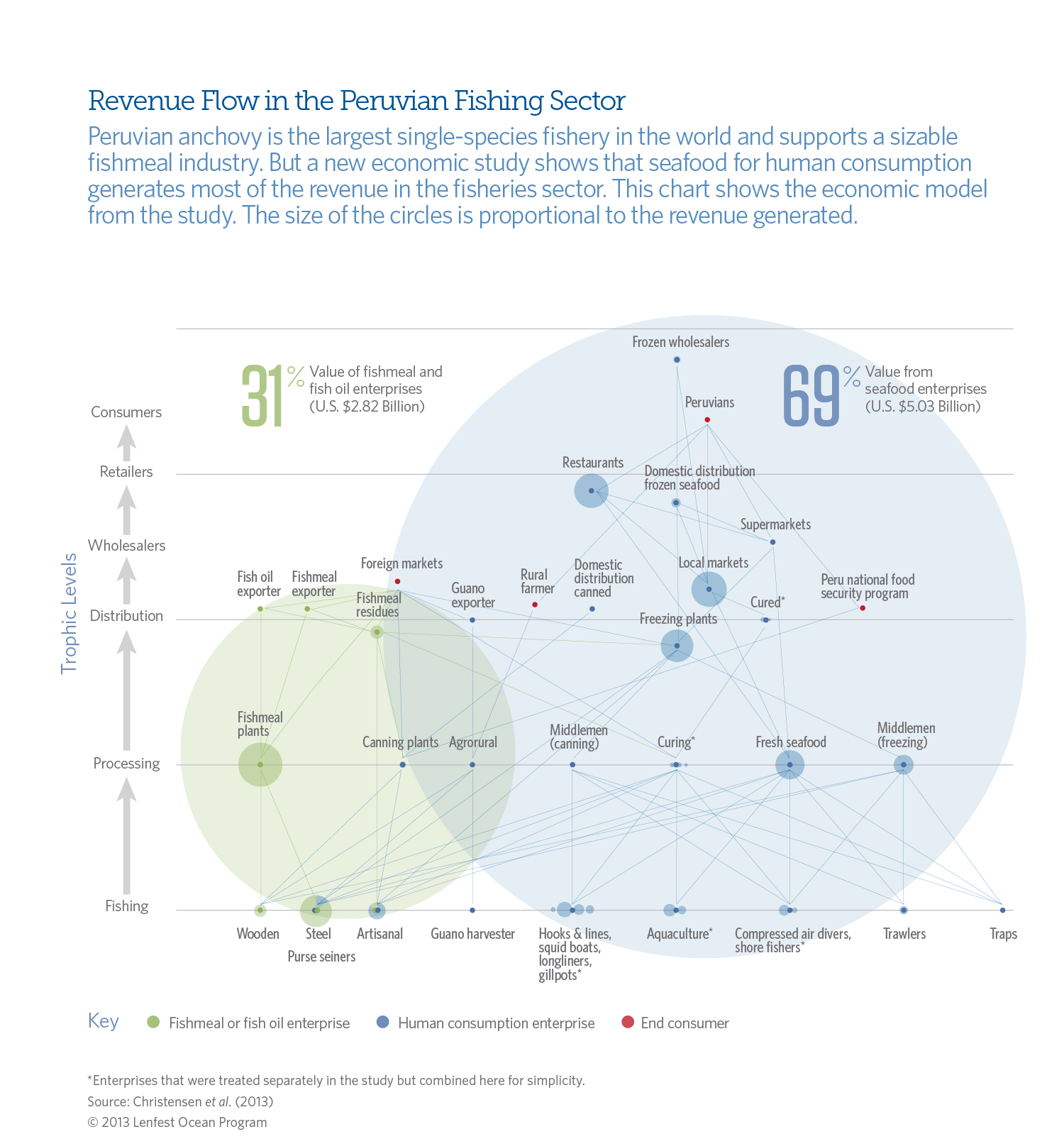
The Peruvian anchovy is the world' s biggest fishery resource, with annual landings of five to 10-million metric tons. It generates up to one-third of the world' s fishmeal supply. But a new study reveals the bulk of the revenue and employment comes from producing the seafood for human consumption.
" Anchovy accounts for upwards of 80 per cent of Peruvian landings by weight, but it' s only responsible for 31 per cent of the sector' s revenue," says Villy Christensen, a professor in the University of British Columbia Fisheries Centre. " It hasn' t lived up to its true economic value because almost all of it is ground up for low-value fish oil or fishmeal."
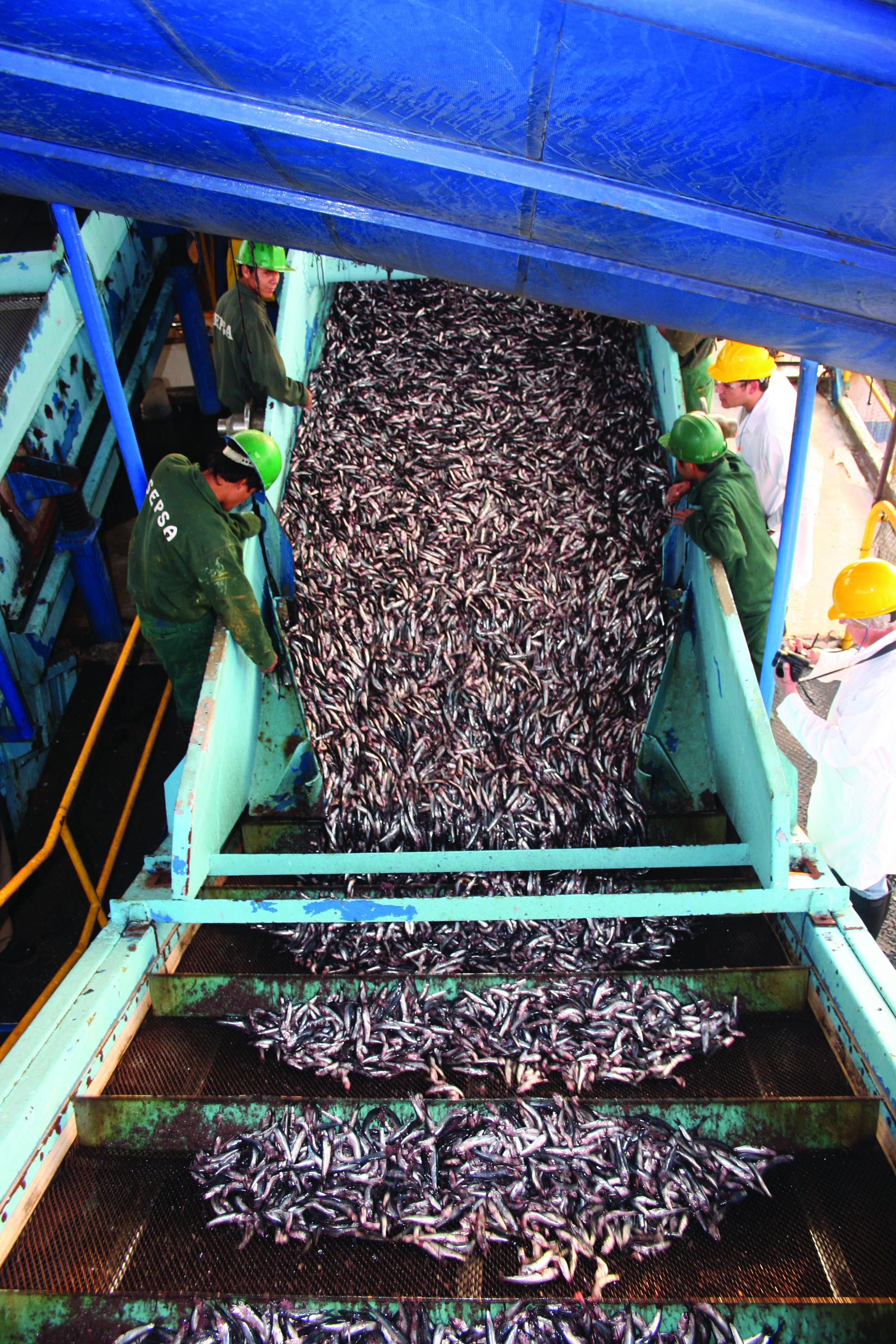
Fishing in Peru is often associated with industrial-scale catch of anchovies. (Photo: Patricia Majluf)
Christensen and colleagues at the Centre for Environmental Sustainability (CSA) at Cayetano Heredia University in Peru calculated the economic impact of anchovy and other Peruvian fisheries. They found that artisanal fishers, wholesalers, markets and restaurants generated US$2.4 billion per year, or 69 per cent of total revenue.
Meanwhile, the fishmeal industry generated only $1.1 billion, or 31 per cent of revenue. Similarly, of all the jobs supported by fishing in Peru, more than 80 per cent were part of the seafood industry. Details are published in the current issue of the journal Marine Policy.
" Current Peruvian regulations only allow anchovy caught by artisanal or small boats to be used for human consumption, forcing the majority of the landings to be exported as fishmeal," says Patricia Majluf, CSA Director and the project' s Peruvian lead.
Video: Prof. Patricia Majluf summarizes findings of the study. (Video en españ ol)
" There are far more economic and food security benefits to Peru to channel fisheries for human consumption," adds Majluf, who launched a campaign in 2006 to encourage Peruvian chefs to incorporate anchovy on their menus. " We need to reform our laws to allow anchovy fishery to reach its full economic potential."
|
|
Good Post
Bad Post
|
x 0
x 0
|
Recalled someone posted about " A new economic study shows that seafood for human consumption generates most of the revenue in the fisheries sector."
If for human consumption, prices will continue to go higher and higher. 
SLPY69 ( Date: 18-May-2014 07:00) Posted:
And it is said " A new economic study shows that seafood for human consumption generates most of the revenue in the fisheries sector."
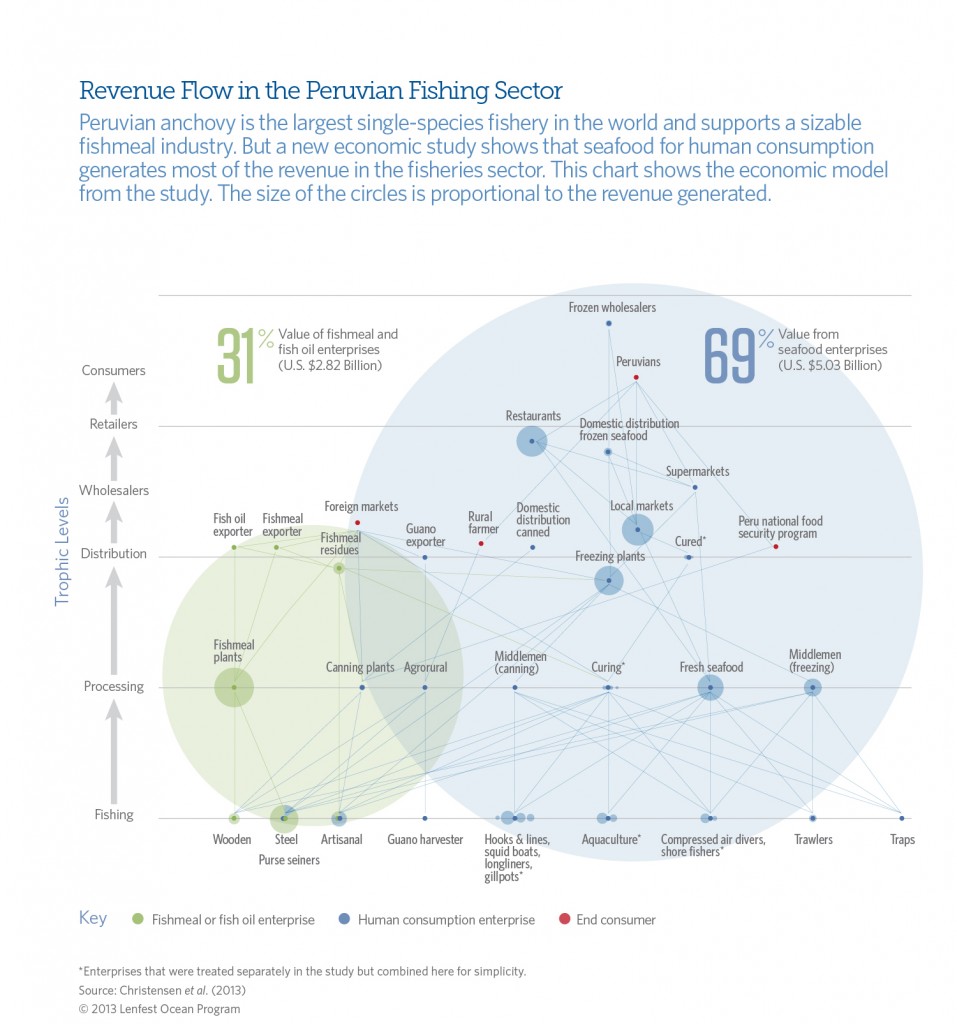
Infographic: Revenue flow in the Peruvian fishing sector (Christensen et al). Click thumbnail to enlarge/download.
|
|
|
|
Good Post
Bad Post
|
x 0
x 0
|
This is the latest report, fishmeal price has been increasing weekly from week 21, 22, 23.
When statistics are pulled out for comparison, we have to have peripheral facts to know why they are doing it or trying to justify ? Futhermore it is based on average. Informations are covered and averaged. Should provide the full report on the chart else it is misleading.
Let' s look at the currently, as it is figure. Prices of fishmeal has gone up sharply as demand is UP.
T2LE56 ( Date: 07-Jun-2014 12:53) Posted:
| |
| |
| China Peruvian Fishmeal RMB Price Report Week 23 |
| 2014-06-04 12:03:39.0 ChinaFeedOnline.com - CFO China Fishmeal Exclusive Report J W Xie |
China" Peruvian Fishmeal " Cash Market by Ports #23
China
main ports
|
Peruvian
fishmeal
|
Week 23
RMB Price
|
Week 22
RMB Price
|
Changes
RMB Price
|
Dalian
|
Super Prime 68%
|
11,800 &ndash 11,900
|
11,500
|
+ 300/mt
|
Standard 65%
|
10,800
|
10,500
|
+ 300mt
|
Tianjin
|
Super Prime 68%
|
11,800 &ndash 11,900
|
11,500
|
+ 300/mt
|
Standard 65%
|
10,800
|
10,500
|
+ 300mt
|
Shanghai
|
Super Prime 68%
|
11,600 &ndash 11,700
|
11,400 &ndash 11,500
|
+ 200/mt
|
Standard 65%
|
10,700
|
10,400
|
+ 300mt
|
Huangpu
|
Super Prime 68%
|
11,600 &ndash 11,700
|
11,400 &ndash 11,500
|
+ 200/mt
|
Standard 65%
|
10,700
|
10,400
|
+ 300mt
|
Remark :
- The prices are an indication investigated by ChinaFeedOnline.com (CFO) port agents and price changes is weekly basis.
- exchange rate: US$1 : RMB 6.2 (about)
Market Feedback :
We welcome your comments and inputs the fishing/quota in your country. To contact
reporter or China License registration, please email: JW Xie email: support@21cfo.com
|
|
|
|
|
|
|
|
|
|
|
|
Good Post
Bad Post
|
x 0
x 0
|
Like I said " Peru is an emerging, market oriented economy characterized by a high level of foreign trade. Peruvian economic performance has been tied to exports and one of their main export is fishmeal." It is in the interest of the Ministry to extend the 5 - 10 miles limits for the fishing industries.
With the recent report on " China Peruvian Fishmeal RMB Price is going higher and higher Report Week 21, 22, 23."
Let' s see how the market will perform. Enjoy Fishing and Soccer .... 
stockpicker ( Date: 18-Jun-2014 11:18) Posted:
|
|
|
Good Post
Bad Post
|
x 0
x 0
|
人 外 有 人 , 天 外 有 天 。 一 山 还 有 一 山 高
|
|
Good Post
Bad Post
|
x 0
x 1
|
Pacific Andes has 70% stake in China Fishery. The next credit rating will be good for China Fishery.
stockpicker ( Date: 06-Jun-2014 16:29) Posted:
|
|
|
Good Post
Bad Post
|
x 0
x 1
|
Peru is an emerging, market oriented economy characterized by a high level of foreign trade. If they have brought the fishing season early by one month, they will do it again. Bear in mind, Peruvian economic performance has been tied to exports and one of their main export is fishmeal. China Peruvian Fishmeal RMB Price is going higher and higher Report Week 21, 22, 23
Pacific Andes unit sold stake in salmon producer for S$112.8m and hails 100% gain on Tassal stake sale. They are sound in their investment.
It is annoying to have people posting nonsense.
Nemo me impune lacessit is the Latin motto of the Order of the Thistle and of three Scottish regiments of the British Army.
" Like the thistle, anyone trying to cut it gets a handful of painful barbs."
Like what Isolator has said " Those who sell will have to buy back higher .... Enjoy .... "
I believe this week the market will punish those culprits.
|
|
|
Good Post
Bad Post
|
x 0
x 0
|
Pacific Andes unit to sell stake in salmon producer for S$112.8m and hails 100% gain on Tassal stake sale. They are sound in their investment.
Peru on the hand is an emerging, market oriented economy characterized by a high level of foreign trade. If they have brought the fishing season early by one month, they will do it again. Bear in mind, Peruvian economic performance has been tied to exports and one of their main export is fishmeal.
It is annoying to have people posting nonsense.
Nemo me impune lacessit is the Latin motto of the Order of the Thistle and of three Scottish regiments of the British Army.
" Like the thistle, anyone trying to cut it gets a handful of painful barbs."
Like what Isolator has said " Those who sell will have to buy back higher .... Enjoy ....
I believe this week the market will punish those culprits.
|
|
Good Post
Bad Post
|
x 0
x 0
|
| |
| |
| China Peruvian Fishmeal RMB Price Report Week 23 |
| 2014-06-04 12:03:39.0 ChinaFeedOnline.com - CFO China Fishmeal Exclusive Report J W Xie |
China" Peruvian Fishmeal " Cash Market by Ports #23
China
main ports
|
Peruvian
fishmeal
|
Week 23
RMB Price
|
Week 22
RMB Price
|
Changes
RMB Price
|
Dalian
|
Super Prime 68%
|
11,800 &ndash 11,900
|
11,500
|
+ 300/mt
|
Standard 65%
|
10,800
|
10,500
|
+ 300mt
|
Tianjin
|
Super Prime 68%
|
11,800 &ndash 11,900
|
11,500
|
+ 300/mt
|
Standard 65%
|
10,800
|
10,500
|
+ 300mt
|
Shanghai
|
Super Prime 68%
|
11,600 &ndash 11,700
|
11,400 &ndash 11,500
|
+ 200/mt
|
Standard 65%
|
10,700
|
10,400
|
+ 300mt
|
Huangpu
|
Super Prime 68%
|
11,600 &ndash 11,700
|
11,400 &ndash 11,500
|
+ 200/mt
|
Standard 65%
|
10,700
|
10,400
|
+ 300mt
|
Remark :
- The prices are an indication investigated by ChinaFeedOnline.com (CFO) port agents and price changes is weekly basis.
- exchange rate: US$1 : RMB 6.2 (about)
Market Feedback :
We welcome your comments and inputs the fishing/quota in your country. To contact
reporter or China License registration, please email: JW Xie email: support@21cfo.com
|
|
|
|
|
|
|
|
|
|
Good Post
Bad Post
|
x 0
x 0
|
Independent, Objective and Expert Opinion
Customers know they can trust our credit judgments
Moody' s take investors beyond the numbers
" Moody' s applauds China Fishery makeover from pollock supplier to fishmeal co., affirm credit rating" dated 13 May, 2014
Pacific Andes' China Fishery Group is completing a major change in business says Moody' s Investor service. The company is shedding its old pollock supply business and by the second half of this year, 65% of revenues will come from fishmeal operations. In shedding its Russian pollock supply business, the company has been able to move away from a major political and economic risk.
In a press release, Moody' s Investors Service says China Fishery Group Limited' s 1H2014 results are in line with Moody' s expectations and support its B2 corporate family and senior unsecured bond ratings.
There are many criteria and factors in assessing a company and it is beyond the number.
Circumstantial evidence and happening " Pacific Andes subsidiary sells Tassal stake for A$97 million"
Moody' s take investors beyond the number.
We are not off topic if you compare the chart, they behave quite similar ... co relate. They are related
Enjoy a LONG weekends
|
|
Good Post
Bad Post
|
x 0
x 0
|
Remembered I have posted something about Pacific Andes and Tassal. Read below
Pacific Andes acquired a near 20% stake in Tassal in December 2010. Just 3 years and they made A$36.9millions. This is Fantabulous
Tchoonw, more A$10millions a year, watch how the fish jump.
They have been performing sterling in their investment including Copeinca.
Don' t know what you talking about. Enjoy LONG weekends ... shiok 
T2LE56 ( Date: 26-Mar-2014 09:17) Posted:
February 19, 2014, 5:35 pm Joo Thieng Ng, a member of the Ng family which controls Pacific Andes International Holdings, has replaced Rudi Tsai on the board of the Australian salmon farmer Tassal. Tsai resigned from his role as director on the board, said Tassal in a notice to the Australian stock exchange on Feb. 17. In the same announcement, Tassal said Ng had been appointed as non-independent, non-executive director of Tassal. " Mr Ng Joo Thieng has a principal role within the Pacific Andes Group and brings to the board extensive experience in the seafood industry," said the notice. Tsai is director of strategic development at Pacific Andes, while Ng has been described as general manager of Pacific Andes' subsidiary China Fishery Group. Pacific Andes acquired a near 20% stake in Tassal in December 2010. It has since increased its holding to just under 23%.
|
|
|
|
Good Post
Bad Post
|
x 0
x 0
|
Stockpicker, better do your sum properly. Don' t mislead others ... remove or add equal conning.
Enjoy LONG weekends.
|
|
Good Post
Bad Post
|
x 0
x 0
|
Why do you think they are getting cash ? What is their next move ?
Why they sold off at discount ? " The shares were being sold at an 11.2% discount to their last close of $4.11 and a 9.7% discount to the 5-day volume-weighted average priced."
Pacific Andes sells 17.1% stake in Tassal
Pacific Andes is selling a 17.1% stake in Tasmanian salmon farmer Tassal Group on the heels of a 49% profit drop in the first half of its current financial year, which ended on Wednesday.
UBS, the broker handling the deal, contacted fund managers after market close on Thursday, offering 25 million shares at $3.65 each, reports Hot Copper.
Undercurrent News was unable to reach Pacific Andes or Tassal to clarify how much of the shares had been sold as of Thursday morning.
The shares were being sold at an 11.2% discount to their last close of $4.11 and a 9.7% discount to the 5-day volume-weighted average priced.
Pacific Andes will be left holding about a 5.5% stake in the Tasmanian salmon grower and has agreed not to sell any more for 180 days.
Changing times for Pacific Andes
The company' s 49% profit drop comes with a 3.4% drop in sales revenue for the first half of its fiscal year although the company' s consolidated earnings increased by two thirds year on year. It said this week it plans to continue to consolidate its operations.
Consolidation of production lines is a major part of that plan, while improving productivity and maintaining customer relationships.
Sources recently told Undercurrent Pacific Andes will have to demolish its plant in Qingdao, considered the largest double frozen pollock plant in the world, due to government planning projects.
The move comes as some expect Pacific Andes to exit the Russian pollock business altogether, although the company itself has said it will keep buying pollock on the spot market, depending on prices
|
|
Good Post
Bad Post
|
x 0
x 0
|
You are right. I think tomorrow there will be a trading halt.
|
|
Good Post
Bad Post
|
x 0
x 0
|
You better divest so others can come in. Thank you
T2LE56 ( Date: 29-May-2014 00:02) Posted:
Earlybird14, 高 招
调 虎 离 山 是 打 虎 计 策 之 一 , 目 的 在 于 削 弱 对 方 的 抵 抗 力 , 减 少 自 己 的 危 险 。 在 军 事 上 指 , 如 果 敌 方 占 据 来 有 利 的 地 势 , 并 且 兵 力 众 多 , 这 时 我 方 应 把 敌 人 引 出 坚 固 的 据 点 , 或 者 把 敌 人 引 入 对 我 方 有 利 的 地 区 , 这 样 才 可 以 取 胜 。 在 政 治 斗 争 中 , 这 一 计 用 得 最 多 , 且 一 代 一 代
Create confusion to seize the opportunity ... 高 招
earlybird14 ( Date: 28-May-2014 15:50) Posted:
Last 4 years, 2nd quarter result announced on 8 to 12 May without delaying. Now is 28 May. This is not a good sign of delaying report announcement. |
|
|
cc2mss5 ( Date: 29-May-2014 08:31) Posted:
agree. results r not satisfactory.
unfortunately vested 
hopefully able to divest
earlybird14 ( Date: 28-May-2014 23:16) Posted:
I really can't understand if this is considered good result????!!!!!.
Profit drop 52%. After acquisition copeinca plus anchovy quota increase, market expect at least 50% revenue increase but it doesn't.
Look into detail, other 2 division which is contract supply from Russia pollock and china fishery fleet revenue drop massively. This is not very good especially, china fish financed few hundred million and issued bond for the contract supply business few years ago, now see like gold throw into sea, disappear totally.
Anyway, tomorrow market will tell you how they interpret the result. |
|
|
|
|
|
Good Post
Bad Post
|
x 0
x 0
|
Ya lor, Moody' s rating for China Fishery Group' s outlook is stable.
|
|
Good Post
Bad Post
|
x 0
x 0
|
I agreed with JMS " China Fishery' s liquidity position remains adequate" and more is added to the liquidity.
Enjoy Fishing
JMS213 ( Date: 27-May-2014 23:13) Posted:
My view remains the same, " what is the Equilibrium" No reason to doubt what Moody said " The rating for China Fishery' s outlook remains stable.
I don' t disagree with you. Picture (chart) is often worth a thousand words. All the indicators are converging and the pressure is getting stronger and stronger each day. Question is not how long are they going to restraint the fish from moving forward ? Question is " How high is the fish going to jump and when to get out ?"
China Fishery' s liquidity position remains adequate. As of March 28 2014, it had US$51 million in cash. Moody' s expects more cash will be received in coming months as the company traditionally releases inventories and receivables after its fishing season which ends in January.
Moreover, China Fishery expects to receive $80 million from its Russian suppliers in 3Q 2014, which will help it redeem the outstanding senior notes of Copeinca and repay its short-term debt.
Sale of freezer-trawler FV leader US$20 million
Having a generous compensation for the relocation of Qingdao plant is a bonus.
China Fishery' s liquidity is growing stronger and stronger. " Equilibrium is positive trend" No wonder Isolator kept shouting " Long"
|
|
|
|
Good Post
Bad Post
|
x 0
x 0
|
Earlybird14, 高 招
调 虎 离 山 是 打 虎 计 策 之 一 , 目 的 在 于 削 弱 对 方 的 抵 抗 力 , 减 少 自 己 的 危 险 。 在 军 事 上 指 , 如 果 敌 方 占 据 来 有 利 的 地 势 , 并 且 兵 力 众 多 , 这 时 我 方 应 把 敌 人 引 出 坚 固 的 据 点 , 或 者 把 敌 人 引 入 对 我 方 有 利 的 地 区 , 这 样 才 可 以 取 胜 。 在 政 治 斗 争 中 , 这 一 计 用 得 最 多 , 且 一 代 一 代
Create confusion to seize the opportunity ... 高 招
earlybird14 ( Date: 28-May-2014 15:50) Posted:
Last 4 years, 2nd quarter result announced on 8 to 12 May without delaying. Now is 28 May. This is not a good sign of delaying report announcement.
|
|
|
|
Good Post
Bad Post
|
|
|
|